
Kaothaj_
6 months ago
Few places on earth carry as much strategic weight as the . At just 21 miles wide at its narrowest point, this critical chokepoint handles a massive share of the world’s oil supply—making it one of the most important waterways in global geopolitics.
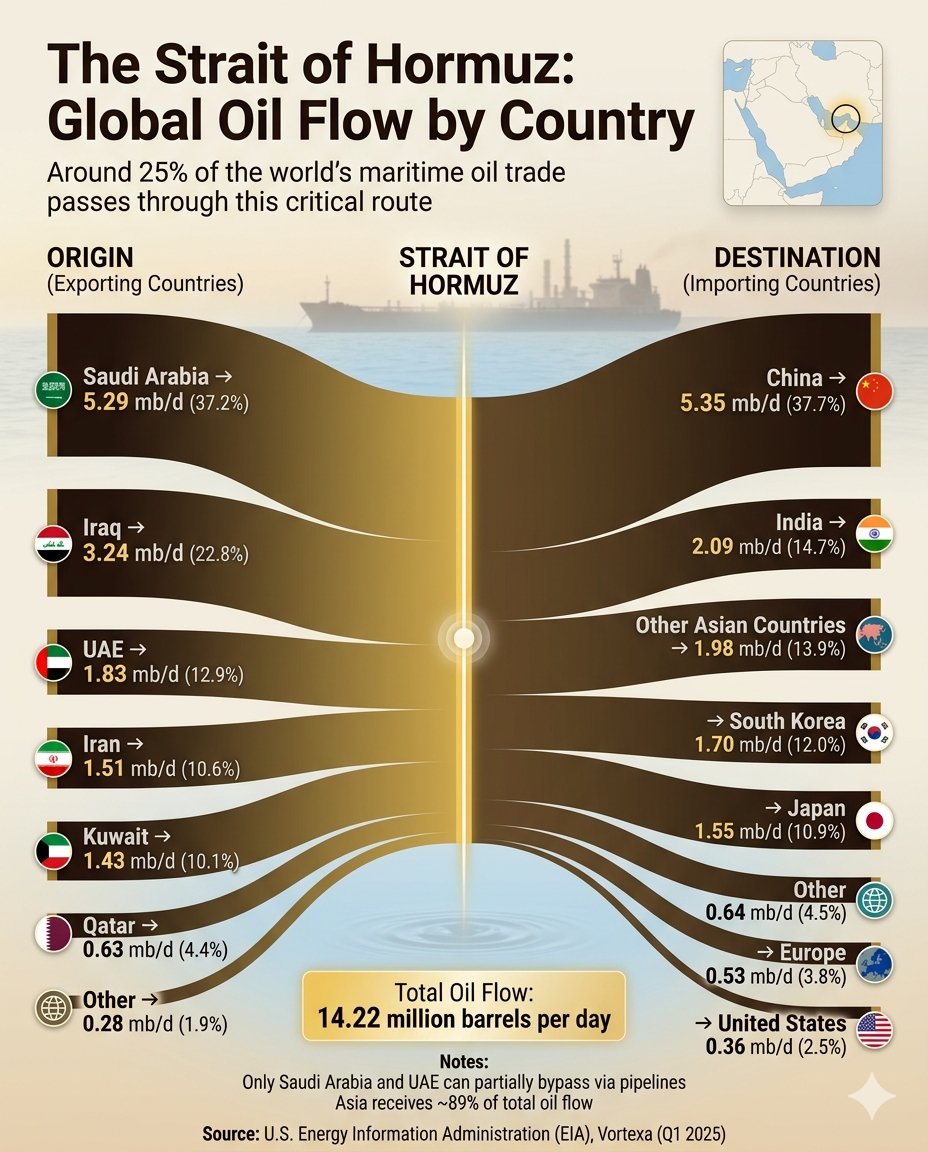
“The Strait of Hormuz moves 14.22 million barrels of oil every single day. That's not just energy, that's geopolitics, war risk, and economic survival compressed into 21 miles of water.
Drop your answer in the comments. Which country do you think holds the most leverage over this strait; the biggest exporter, the biggest importer, or the one sitting at the gate? 👇
The Strait of Hormuz: Oil Flow by Country
ORIGIN (Exporting Countries)
🇸🇦 Saudi Arabia → 5.29 mb/d (37.2%)
🇮🇶 Iraq → 3.24 mb/d (22.8%)
🇦🇪 UAE → 1.83 mb/d (12.9%)
🇮🇷 Iran → 1.51 mb/d (10.6%)
🇰🇼 Kuwait → 1.43 mb/d (10.1%)
🇶🇦 Qatar → 0.63 mb/d (4.4%)
🌍 Other → 0.28 mb/d (1.9%)DESTINATION (Importing Countries)
🇨🇳 China → 5.35 mb/d (37.7%)
🇮🇳 India → 2.09 mb/d (14.7%)
🌏 Other Asian Countries → 1.98 mb/d (13.9%)
🇰🇷 South Korea → 1.70 mb/d (12.0%)
🇯🇵 Japan → 1.55 mb/d (10.9%)
🌍 Other → 0.64 mb/d (4.5%)
🇪🇺 Europe → 0.53 mb/d (3.8%)
🇺🇸 United States → 0.36 mb/d (2.5%)Total Oil Flow → 14.22 mb/d
Around 25% of the world’s maritime oil trade passes through the Strait of Hormuz.
mb/d = million barrels per day
Source: U.S. Energy Information Administration (EIA), Vortexa”
Why This Narrow Waterway Matters
The estimates that roughly a quarter of all seaborne oil passes through this single corridor. That means any disruption—whether political, military, or economic—can ripple across global markets almost instantly.
The Export Powerhouses
On the supply side, countries like and dominate, accounting for a combined majority of oil flowing through the strait. These nations rely heavily on this route to sustain their economies and maintain their influence in global energy markets.
Other key exporters—including , , , and —further reinforce the region’s dominance as the world’s energy hub.
The Demand Giants
On the receiving end, Asia leads the charge. alone accounts for nearly 38% of imports through the strait, followed by , , and . These economies depend heavily on stable oil flows to fuel their industries and growth.
Even regions like and the , though less dependent, remain exposed to price shocks if supply is disrupted.
The Real Power Question: Who Holds the Leverage?
This is where things get interesting.
Exporters control supply—but need the route open to sell.
Importers drive demand—but depend on steady access.
Geographic gatekeepers, particularly , hold a unique advantage due to their proximity to the strait.
Iran’s position along the northern edge gives it significant strategic influence. While it doesn’t “own” the strait, its ability to threaten or disrupt passage—even temporarily—has global implications.
More Than Just Oil
The Strait of Hormuz isn’t just an energy corridor—it’s a pressure point where economics, security, and international politics intersect. Any tension in the region can trigger oil price spikes, supply chain disruptions, and even military responses.
So, Who Really Holds the Power?
Is it the countries pumping the oil, the nations consuming it, or the one sitting at the gate?
There’s no simple answer—but one thing is certain: control over this narrow stretch of water translates into outsized global influence.
0
0