
Kaothaj_
3 months ago
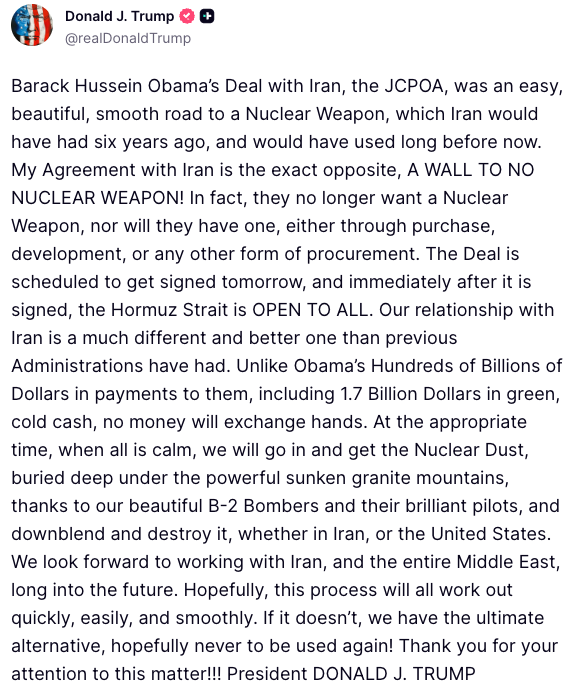
A fresh statement by U.S. President Donald Trump has sparked global attention after he contrasted his reported agreement with Iran against the 2015 nuclear deal negotiated under former President Barack Obama.
In the statement, Trump described the 2015 Joint Comprehensive Plan of Action (JCPOA) as a pathway that would have eventually allowed Iran to obtain a nuclear weapon. He argued that his own arrangement with Tehran is designed to achieve the opposite outcome, claiming it creates what he called a “wall to no nuclear weapon.”
According to the message, the proposed agreement would prevent Iran from acquiring nuclear weapons through development, purchase, or any other means. Trump also claimed that the deal was scheduled to be signed the following day and that, once finalized, the Strait of Hormuz would be reopened to international traffic.
The statement further suggested a significant shift in relations between Washington and Tehran, with Trump asserting that the United States now enjoys a stronger relationship with Iran than previous administrations did. He contrasted the reported agreement with the Obama-era nuclear deal, criticizing what he described as large financial concessions made to Tehran.
One of the most striking parts of the statement concerned Iran’s enriched uranium stockpiles. Trump claimed that, after calm is restored, the United States would oversee the recovery and destruction of what he referred to as “nuclear dust,” allegedly buried deep within fortified Iranian facilities. He credited U.S. B-2 bombers and their crews for making such an outcome possible.
Despite the optimistic tone regarding diplomacy, the statement also carried a warning. Trump noted that while he hopes the process unfolds “quickly, easily and smoothly,” the United States retains what he called the “ultimate alternative” should negotiations fail.
The comments come amid heightened international focus on Iran’s nuclear programme, regional security concerns, and the strategic importance of the Strait of Hormuz, one of the world’s most critical energy shipping routes. Any agreement affecting these issues would have significant implications for global oil markets, Middle East stability, and international diplomacy.
As with previous claims surrounding U.S.-Iran negotiations, observers are awaiting official confirmation and detailed terms from the governments involved before drawing conclusions about the scope and impact of any potential agreement.
0
0