
Kaothaj_
a month ago
In Naija politics, the most dangerous opponent you will ever face is not the one who opposed you from the beginning.
It is the one who helped you win. Who knows every crack in your foundation. Who watched you build your victory and was close enough to understand exactly which stones to remove.
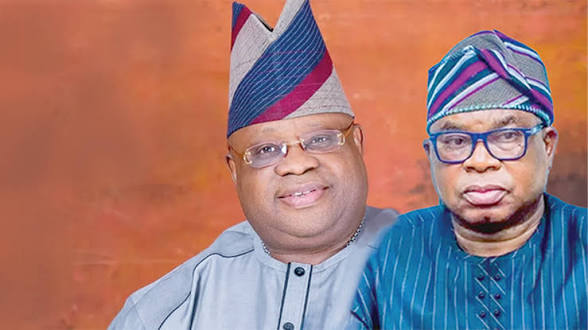
Six days before the August 15, 2026 Osun governorship election, that is the opponent Governor Ademola Adeleke is now staring at.
Not Bola Oyebamiji, the APC candidate, who has been running against him for months. Not the federal government's quiet preference for a different Osun outcome. Not the by-election result from June that showed APC sweeping the state's senatorial district with over 162,000 votes.
It is Olagunsoye Oyinlola, former Osun governor, former PDP kingmaker, and the man whose network was critical to Adeleke's 2022 comeback, standing at the WOCDIF Event Centre in Osogbo on Sunday morning and announcing that Bola Oyebamiji is the better man for Osun State.
You helped a man win in 2022 and four years later you are standing at a podium endorsing the opponent he is fighting to hold off. That is not just politics.
In Naija politics, that is a statement about what happened inside the government between winning and governing.
The Full History: How Every Win Came With Complications
To understand what this endorsement means, you have to trace the full Adeleke political story. Because nothing in it is clean or simple.
Adeleke first contested the Osun governorship in the September 22, 2018 election on the PDP platform. He finished ahead of the APC's Gboyega Oyetola in initial results. INEC declared the election inconclusive and ordered a rerun for September 27. In the rerun, Iyiola Omisore, who had come third in the original ballot on the SDP platform, delivered his votes to Oyetola. That alignment handed Oyetola the victory by a narrow margin.
Adeleke protested. The tribunal sided with him. But the Supreme Court eventually affirmed Oyetola as the valid winner in July 2019.
He lost the governorship partly because Omisore, a former Osun deputy governor and political heavyweight, calculated that his votes were better invested in the APC than given freely to Adeleke.
Then came 2022. And the political world of Osun shifted in ways nobody had fully planned.
Adeleke won the July 16, 2022 governorship election with 346,150 votes, defeating Oyetola who got 314,921 votes. The margin was 31,229 votes. Not dominant. Not comfortable. A precisely calibrated victory built on fractures inside Osun APC that produced defections, cold feet, and silent sabotage against an incumbent who had made enemies in his own party.
Oyetola lost partly because some within the APC worked against him. The 2022 victory, like the 2018 loss, was the result of coalition arithmetic rather than overwhelming popular mandate.
Now, in 2026, the coalition that produced 2022 is being systematically dismantled from the inside.
Oyinlola Said The Quiet Part Loud
Former Governor Oyinlola did not pretend his endorsement was primarily about Oyebamiji's qualities. He was refreshingly direct about what drove it.
He said his group decided to part ways with Adeleke's administration due to a lack of inclusion in his handling of government affairs.
Lack of inclusion. That is a specific complaint from a specific constituency. Oyinlola and the stakeholders standing with him helped Adeleke in 2022. They delivered votes. They brought networks. They moved resources. And their assessment of the four years since is that they were not included in what the victory produced.
He said: "Party loyalty is important, but the interest of Osun State must always come first." He added that being members of a political party does not mean abandoning conscience or the larger interest of the people they have served.
He was careful to say his group is not defecting from the PDP. They remain PDP members. They are just supporting the APC candidate. For Osun State.
In Naija politics, that framing is carefully constructed. It tells Adeleke's camp that this is not a permanent political realignment. It tells the APC that these people are available but not fully committed. And it tells Osun voters that senior PDP figures believe the current administration has failed the test of inclusion.
The Oyebamiji campaign's Director-General, Wole Oke, went further at the same event and made a public apology to the PDP leaders for defying their instructions to support Adeleke during the 2022 election cycle. He apologised. To Oyinlola and company. For having supported Adeleke.
That apology, made publicly, is the political acknowledgement that Adeleke's 2022 support was assembled from people who are now being formally thanked for coming back to the other side.
The Omisore Pattern Revisited
Here is why Oyinlola's endorsement is specifically dangerous, beyond its symbolic weight.
In 2018, Omisore's votes were the deciding factor against Adeleke. His alignment with Oyetola in the rerun converted what had been Adeleke's lead into a loss.
Oyinlola is not Omisore. His network and political capital are different in character. But the structure of the threat is similar.
A PDP-aligned political heavyweight who helped build the coalition that brought Adeleke to power in 2022 is now deploying that same network in the direction of the APC candidate.
The Accord Party's Osun State chairman Victor Akande responded by saying: "Go to their local governments. They lack the political capital to swing the people against a governor who is widely acknowledged locally and internationally to have positively transformed Osun State." He also alleged that Oyinlola, Akinbade, and Oladipo worked against Adeleke's election in 2022 but failed to stop the governor from winning.
The Accord Party's counter-argument is a factual one. If Oyinlola worked against Adeleke in 2022 and Adeleke still won, why should the same network be expected to produce a different result in 2026?
That argument has merit. It also has a gap.
The 2022 victory margin was 31,229 votes. The question is not whether Oyinlola's endorsement can flip 300,000 votes. It is whether it can influence enough votes within that 31,229 buffer to shrink Adeleke's lead below survivable levels.
In close elections, 31,000 votes is not a comfortable cushion. It is a target.
What Adeleke Has Done With Four Years
The case for Adeleke's reelection is not built only on defending against opposition attacks. It is built on what the numbers say about his governance record.
Under Adeleke, Osun State moved from 33rd to 7th in NECO ranking in 2024 and 2025. The state won the Primary Health Care Challenge consecutively, ranking first in the South-West for two consecutive years and collecting a $500,000 prize each year.
BudgIT has confirmed fiscal transparency improvements. The state cut its debt stock by over 40 percent. Teachers' salaries, which had been owed for months under previous administrations, are now being paid consistently.
He commissioned roads in communities that had not received government attention in years. He launched healthcare programmes that reached primary care at the ward level.
These are not propaganda claims. They are independently verified outcomes with institutional confirmation. The NECO ranking is published by an independent body. The PHC Challenge is a federal programme with its own verification system. BudgIT is a civil society fiscal transparency organisation.
A governor with those numbers should not be in a competitive reelection battle.
The fact that he is tells you something important about Nigerian gubernatorial politics. Governance delivery and electoral survival are not the same thing. You can move from 33rd to 7th in education rankings and still face a serious political threat if the people who hold political networks in your state feel excluded from the governance dividend.
What the June By-Election Means for August
The June 20, 2026 Enugu North senatorial by-election produced an APC win with 162,360 votes against PDP's 9,299. That result was used nationally to argue that the APC's electoral machinery is firing on all cylinders ahead of 2027.
But there is a specific Osun dimension that deserves attention.
APC won the Osun North Senatorial District by-election, that same June 20 exercise, with a dominant performance. The result was the first significant APC senatorial win in Osun's recent electoral history and gave the APC its first indication that the state's political terrain has shifted enough to be genuinely competitive at the governorship level.
Adeleke ran for the August 15 election on the Accord Party platform after the court deregistration and reinstatement saga that threatened to remove Accord from the ballot earlier in the year.
He is not even running on the PDP platform he rode to victory in 2022. He is on Accord. His own party base split between those who followed him to Accord and those who remained in the PDP, some of whom are now standing with Oyinlola endorsing Oyebamiji.
The Verdict Going Into August 15
In Naija politics, reelection battles are rarely decided by the evidence. They are decided by the organisation.
Adeleke's evidence case is strong. His governance record is independently confirmed. His education numbers are published. His healthcare results are documented. A reasonable voter evaluating performance would return him without hesitation.
But elections in states like Osun are not won primarily by the reasonable voter who reads governance reports. They are won by network activation, community mobilisation, and the energy of political structures at ward and polling unit level.
The APC has federal incumbency behind Oyebamiji. Former minister Oyetola was at the Oyinlola endorsement event alongside APC leadership. The federal government has shown its preference through the same pattern it showed in Rivers, in the ADC legal battles, and in Ekiti's comfortable 300,000-vote APC reelection earlier this year.
Oyinlola's network brings PDP internal legitimacy to the APC's push.
Oyebamiji's campaign has apologised to the very PDP heavyweights who once worked against Adeleke, signalling a unity of purpose that the APC does not always achieve at state level.
Against all of that, Adeleke has his governance record, his Accord Party machinery, and the fact that the people who helped Oyinlola try to stop him in 2022 failed.
Will that be enough on August 15?
It might be. Governance records do sometimes win elections in Nigeria, especially when the alternative has not made a strong enough case for change beyond borrowed networks and federal alignment.
But the 31,000-vote 2022 margin is not a fortress. It is a test. And on August 15, every vote inside that margin will matter.
This is Naija politics. A governor who turned his state from 33rd to 7th in education rankings is fighting for his political life against the same forces that underestimated him in 2022.
The question is whether those forces have learned from 2022 well enough to make this time different.
Or whether Adeleke, once again, survives the coalition assembled against him.
What do you think? Can Adeleke's documented governance record overcome the Oyinlola endorsement and federal APC backing heading into August 15, or does the fracture of the 2022 coalition that brought him to power represent a structural threat his numbers alone cannot defeat? Drop your thoughts in the comments section. Today is August 10, 2026. This Naija politics battle for Osun State is one of the most closely watched political contests of the 2027 pre-election season and six days from now we will know whether governance delivery or political network realignment wins.
0
53