

Kaothaj_
9 months ago
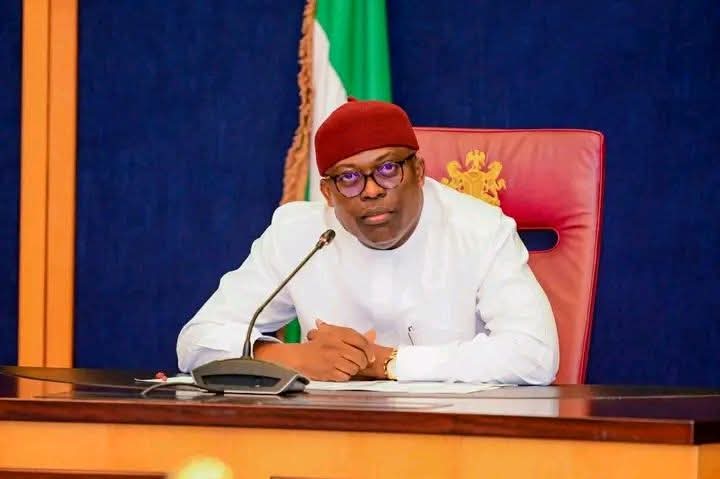
In a stunning political development that has sent shockwaves through Nigeria's political landscape, Rivers State Governor Siminalayi Fubara officially defected from the Peoples Democratic Party to the All Progressives Congress during a stakeholders' meeting at the Government House in Port Harcourt on Tuesday, December 9, 2025.
A Historic Shift for Rivers State
This marks the first time that the oil-rich state will have an APC governor, as the PDP had maintained a tight grip on Rivers State since 1999. The defection represents more than just a party switch—it signals a fundamental realignment of political power in one of Nigeria's most politically significant states.
Why the Move?
In explaining his decision, Governor Fubara stated bluntly that "PDP failed to protect me," adding that the state cannot support President Tinubu if they don't fully identify with him. The governor framed his move as necessary for stable governance and effective collaboration with the federal government, suggesting that alignment with the center is essential for Rivers State's development.
Fubara emphasized his commitment to ensuring stable governance and aligning with partners who support the progress of Rivers State, making it clear that practical governance considerations drove his decision rather than mere political opportunism.
The Context: A State in Political Turmoil
Governor Fubara's defection cannot be understood without considering the turbulent political backdrop. The state has been embroiled in crisis, with tensions between the governor and former Governor Nyesom Wike, who now serves as Minister of the Federal Capital Territory and was a key figure in supporting President Tinubu's election despite being a PDP member.
In March 2025, President Tinubu declared a state of emergency in Rivers State, suspending the governor, his deputy, and state lawmakers for six months due to political unrest. The emergency rule ended in September, with Fubara being reinstated, but the underlying tensions remained.
Just days before Fubara's announcement, the Speaker of the Rivers State House of Assembly, Martin Amaewhule, along with 17 other lawmakers, defected to the APC on December 5, citing the crisis within the PDP as their reason for leaving. This created additional pressure on the governor's position.
The timing is also significant: the governor's defection came hours after his closed-door meeting with President Bola Tinubu at the presidential villa in Abuja on Monday evening.
Part of a Larger Trend
Governor Fubara's move is not happening in isolation. Before his defection, Fubara was the only governor on the platform of the PDP in the South-South region, following the defection of governors Sheriff Oborevwori of Delta and Umo Eno of Akwa Ibom to the APC earlier this year. The PDP is clearly experiencing a mass exodus in this strategic region.
What This Means for 2027
With the next general elections scheduled for 2027, this defection reshapes the political map considerably. The APC now controls Rivers State, giving the ruling party a significant advantage in a state that has historically been an opposition stronghold. The move also demonstrates President Tinubu's political reach and the APC's growing dominance across Nigeria's geopolitical zones.
For the PDP, losing Rivers State is a devastating blow. The party is already grappling with internal leadership crises and factionalization at the national level. Losing such a strategic state only compounds these problems and raises serious questions about the party's viability as a national opposition force heading into 2027.
Looking Ahead
Governor Fubara's defection raises several important questions. Will other PDP governors follow suit? How will this affect the political dynamics within Rivers State itself? And can the PDP recover from what appears to be a slow-motion collapse in its traditional strongholds?
What is clear is that Nigerian politics continues to be characterized by fluid party loyalties, with politicians willing to cross party lines when they perceive it to be in their interest or necessary for effective governance. Whether this serves the interests of Rivers State citizens or simply reflects elite political calculations remains to be seen.
For now, the APC can celebrate a major political victory, while the PDP must confront the uncomfortable reality that it is losing ground in regions it once dominated. The political landscape of Nigeria has shifted once again, and Rivers State sits at the epicenter of that transformation.
0
0