
Kaothaj_
3 months ago
In Naija politics, there is a moment in every messianic political movement when the messiah is finally asked a follow-up question.
That moment arrived this week for Peter Obi. And the answer he gave will be studied in Nigerian political communication classes for years, right alongside Baba Go Slow and Emi Lokan, as one of the great non-answers in the history of Nigerian campaign television.
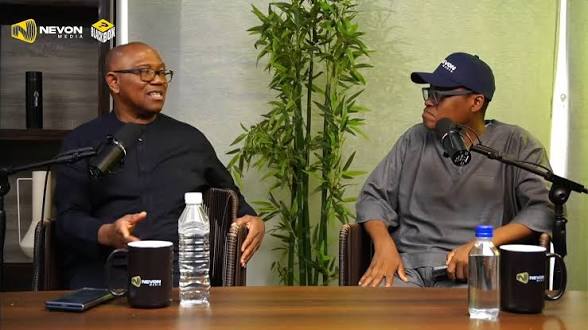
Rufai Oseni, the Arise TV anchor whose interviewing style has become must-watch programming precisely because he refuses to let politicians slide past their own promises, sat across from the NDC presidential candidate and asked him a simple question.
How exactly will you generate 10,000 megawatts of electricity in four years?
Obi's answer deserves to be carved into the walls of every secondary school civics classroom in the country.
"No, no, no, I'm not going to tell you how. It is not for you to know how. It is for you to look at the man who is saying this."
It is not for you to know how.
Said to 220 million Nigerians who have been promised electricity by every single Nigerian government since independence and have watched every single one of those promises evaporate into darkness, generator fumes, and NEPA jokes that have outlived three republics.
The Manifesto That Trusts You to Trust Him
Let us be fair to Obi and give the full context, because satire requires precision.
At the NDC's national convention on Saturday May 30, 2026, while accepting his nomination as presidential candidate, Obi outlined plans across power, healthcare, education, agriculture, security and governance. He said Nigeria's power shortfall continues to cripple businesses, choke industries, and stall overall economic growth, and pledged that his administration would generate, transmit and distribute at least 10,000 megawatts of electricity within four years.
A real number. A real timeline. A real sector everyone agrees is broken.
What was missing, then and now, is the part where a serious presidential candidate explains which power plants will be built, which gas supply agreements will be signed, which transmission infrastructure will be upgraded, and which of the billions of dollars required will come from where.
When pressed on the specifics of how the target would be achieved, he declined to provide details.
That is not frugality. That is not the discipline that built his Anambra reputation. That is a man asking Nigerians to grade an exam he refuses to submit.
The Security Question Gets Even Better
If the electricity answer was a masterclass in evasion, the security answer was a doctoral thesis.
Rufai asked him directly: "Security, if you were the Commander in Chief, what would you do about our kids being in the bush, and how would you do it?" Peter Obi replied: "I will not tell you." Rufai pressed: "Why? But Nigerians need to know." Obi answered: "Nigerians are not asking that. It's people who don't know what to..."
Nigerians are not asking that.
The families of the schoolchildren currently in Boko Haram and bandit custody across multiple northern states would beg to differ. The retired General whose death in kidnappers' custody Obi himself condemned just two days earlier on June 14 would beg to differ. The 98 criminal incidents recorded across Nigeria in a single week in June 2026 alone, including 51 attacks and abductions, would beg to differ.
But according to the man asking to be Commander-in-Chief, that is not a question Nigerians are actually asking.
It takes a special kind of political confidence to be told a question is important and respond by reclassifying the question as unimportant in real time, on camera, while the cameras are rolling.
The Dialogue and War Combo That Sounds Suspiciously Familiar
Here is where the satire turns genuinely instructive, because Obi did eventually offer something resembling a position.
He said his administration would explore both dialogue and military engagement with armed groups, a combination of negotiation and force, depending on the circumstances.
That is, word for word in substance, the exact approach the Tinubu administration has been running since 2023. Dialogue with repentant bandits. Reintegration programmes. Military offensives in parallel. The Borno State government, just this week, reintegrated 720 former terrorists, alongside 992 spouses and 2,050 children, under its ongoing deradicalisation and rehabilitation programme.
The current administration is running dialogue plus military force right now. And the result, according to data obtained from the Open Treasury Portal, is that the Federal Government spent N57.78 billion on security-related projects in the first four months of 2026, a 127.97 percent increase from the previous year, while 98 criminal incidents including 51 attacks and abductions were recorded in just one week.
More money. More attacks. Same strategy.
A security analyst reviewing the current reintegration approach put it plainly: "I've never heard it anywhere in the world that terrorists who have terrorised, damaged and killed will be integrated back into society. To me, I think the government is totally helpless, total incapability, lack of political will."
So when Obi says his security solution is dialogue plus war, the question Rufai Oseni should have asked, and the question that deserves a billboard in every Nigerian city, is this.
If the current administration's dialogue plus war strategy is already producing a worsening security crisis, what exactly does Obi's identical dialogue plus war strategy do differently?
The answer, based on the interview, is nothing. Except possibly a man you should simply trust more.
The Presidency Could Not Resist
Naturally, the Tinubu camp smelled blood and pounced before the interview clip had even finished trending.
Daniel Bwala, Special Adviser to President Bola Tinubu on Media and Policy Communication, posted on his verified X account on Wednesday, saying Obi failed to clearly present his ideas during the interview despite what he described as "leading questions." He wrote: "This is the bold vision of Peter Obi as expressed by himself on a podcast interview."
The bold vision. Sarcasm so dry it could cure Lake Chad.
Bwala had also accused Rufai Oseni of being an unofficial spokesman for Obi just two weeks earlier, mocking him in a post on X over his recent interrogation of Obi on policy issues, particularly electricity generation.
The irony, of course, is that Bwala simultaneously accused Oseni of being too soft on Obi and too hard on Obi within the same news cycle. Which tells you everything about how political communications teams operate in Naija politics. The goalposts move depending on which direction produces the better headline.
The Real Punchline
Here is the part of this story that should worry Obi's most ardent supporters more than anything Bwala or the APC has said.
In 2023, Obi's entire brand was built on the promise of transparency. He counted Anambra's money in public. He published his asset declarations. He told Nigerians he would show his work because Nigerians had been burned too many times by leaders who governed with secrecy and called it strategy.
"We no dey give shishi" was never just about vote-buying. It was a broader philosophy about a different, more honest relationship between leader and citizen.
And now, in 2026, when asked the most basic accountability question a presidential candidate can be asked, how will you do the thing you promised, the answer is: it is not for you to know how, just trust the man.
That is not the Obi of 2023. That is the playbook of every Nigerian politician who has ever asked for power on the basis of personality rather than plan.
In Naija politics, "just trust me" has a long, undistinguished history. It is the answer given by every governor who could not account for local government allocations. Every minister who could not explain a contract award. Every president who promised stable power and delivered a national grid that still collapses with the predictability of a Lagos traffic jam.
Peter Obi spent three years building a reputation as the man who would finally show his work.
This week, on live television, with Rufai Oseni asking the exact questions a serious electorate should demand, Obi decided that showing his work was beneath him.
It is not for you to know how.
In Naija politics, that sentence has never once, in the history of the Fourth Republic, been followed by 10,000 megawatts of anything except disappointment.
What do you think? Does Obi's refusal to detail his electricity and security plans represent legitimate political strategy to avoid giving the APC ammunition, or does it expose a candidate whose promises rest more on personal trust than actual policy substance? And if dialogue plus war is already Tinubu's failing strategy, what does Obi's identical approach actually change? Drop your thoughts in the comments section. This Naija politics credibility test arrived right on schedule and the only thing missing from Obi's answer was the candour that made Nigerians fall in love with him in the first place.
0
79