
Kaothaj_
5 months ago
In Naija politics, a confident man does not explain himself.
He governs. He delivers. He lets his record speak.
A nervous man does something different. He calls meetings, gathers supporters in the Presidential Villa, and starts talking about his opponents' histories. He brings up steel companies that closed two decades ago. He makes jokes about ADC conventions being held on the street.
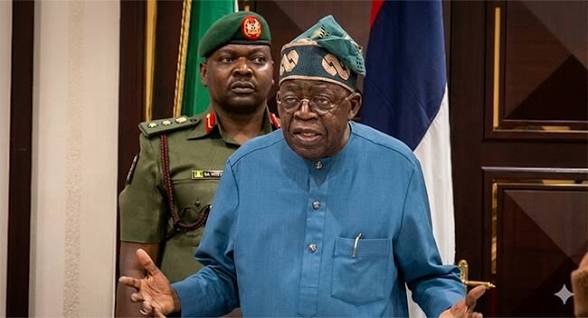
On Thursday, April 16, President Bola Tinubu did exactly that.
And in doing so, he told every attentive observer in Nigeria precisely how worried he is about what is building inside the African Democratic Congress.
The Steel Joke That Revealed The Fear
Tinubu was hosting the Renewed Hope Ambassadors at the Presidential Villa in Abuja, a gathering of political supporters assembled to spread his agenda to the grassroots ahead of 2027.
He should have been calm. Confident. Presidential. He has thirty-one governors. He has federal resources. He controls the legislature. By the numbers on paper, he is the most powerful political incumbent Nigeria has produced since the return to democracy.
Instead, he spent part of his speech attacking the opposition by name.
Making veiled reference to Atiku, he said: "The head was the chairman of the Privatisation Council of Nigeria in this country. One time, he privatised the steel industry in Delta. Is it working today? No. Once they privatised Ajaokuta, is it working today? God released the… They privatised another man's political party. Your job is done."
He also told the gathering directly: "They want to scare me off? It is a lie. I have been through this path before."
You scare easily when you repeatedly say you are not scared.
The Delta Steel reference is Tinubu's way of painting Atiku as a man who destroyed industrial Nigeria during the Obasanjo years. Delta Steel Company in Warri was privatised under the National Council on Privatisation that Atiku chaired as Vice President. The company's subsequent deterioration into near-total collapse is well documented. It is a legitimate criticism of that era's privatisation programme.
But here is the problem with a sitting president reaching back twenty years to find something to say about his opposition.
When you govern well, you campaign on what you have done. When you cannot, you campaign on what the other man did before you arrived.
Atiku's Reply: No More Mr. Respectful
The response from Atiku's camp came on Friday. And it was not soft.
Phrank Shaibu, Atiku's Senior Special Assistant on Public Communication, described Tinubu's remarks as a "reckless tirade" and accused the president of a "troubling pattern of hypocrisy and historical amnesia."
The statement hit back on the privatisation argument first, pointing out that Atiku had long advocated privatisation of the NNPC and the refineries, positions Tinubu reportedly resisted at the time. It then accused the current administration of implementing a shadow version of that same programme without transparency. The statement declared: "You cannot oppose reform when it demands courage and then execute a shadow version of it in power."
The camp also listed companies from the privatisation era as proof of its success: Oando Plc, Conoil Plc, Ardova Plc, Indorama Eleme Petrochemicals, Benue Cement Company, and Transcorp Hilton Abuja. All functional today. All products of the same programme Tinubu was mocking.
But then came the sentence that will live in this election cycle.
"It is not our fault that the President does not and cannot read, because Bola Tinubu has a history of attending a school in Lagos two years before it was founded, upon which he claimed his Chicago State University degree."
The statement also directed Tinubu to read El-Rufai's autobiography, The Accidental Public Servant, where the privatisation programme is documented clearly. El-Rufai is in ADC. His book is now being used to defend ADC's record against Tinubu's attacks. The irony of that alone could power a generator.
The statement concluded with a warning: "A leader who has not fully resolved questions about his own background should exercise restraint before casting aspersions on others. Nigerians are watching."
That last line. Those two words. Nigerians are watching.
In Naija politics, a presidency that begins receiving that line in April 2026 is a presidency that has lost the moral high ground thirteen months before election day.
Why Tinubu Is Afraid Of This Specific Coalition
Let us be precise about what exactly is torturing Aso Rock's sleep about ADC.
It is not the party name. It is not the David Mark convention drama. It is not even Atiku or El-Rufai individually.
It is Obi-Kwankwaso.
Because Obi-Kwankwaso is a problem Tinubu cannot solve with money.
In 2023, Tinubu's path to the presidency ran through splitting the opposition. Jonathan's supporters in the South-South broke in different directions. The South-East gave their votes to Obi. The North-West gave their votes to Kwankwaso. The North-East split between Atiku and Tinubu. The result was a fractured opposition and a Tinubu plurality that didn't even require a majority.
Now the arithmetic is trying to reassemble.
Obi sweeping the South-East, Lagos, and the FCT with over six million votes in 2023. Kwankwaso dominating Kano and the North-West Kwankwasiyya network. Atiku's North-East and broader northern structure. El-Rufai's northern intellectual credibility and political machine. Tambuwal's Sokoto. Malami's network. Babachir Lawal's North-East reach.
Each individual piece does not beat Tinubu's thirty-one governors. But together, properly assembled, they form a mosaic that maps across enough states to build an electoral victory.
And the most dangerous piece in that mosaic is one that has no equivalent in the APC's toolkit.
The Obidients.
These are not ordinary political supporters. They are ideology-driven, digitally organised, geographically spread across urban Nigeria, and they do not respond to the standard levers of Nigerian electoral manipulation. You cannot use federal allocation to buy them. You cannot use security agencies to scare them into silence. You cannot use a governor's machinery to override them in their communities because many of them are not in the communities where their governors think.
In 2023, they turned up and voted even where the machines said they would not. In Lagos. In Abuja. In multiple northern states where PDP had its machinery parked and waiting.
If Obi leads the ADC ticket with Kwankwaso as his running mate, those Obidient votes come with him. All of them. Every single constituency Tinubu stole from Obi in 2023 becomes contested territory again.
That is why Tinubu is talking about Delta Steel. Because he cannot talk about what he would do if those votes consolidate against him.
The ADC's Numbers On Paper Still Threaten
Consider the structural arithmetic even with all the party chaos.
INEC data from the 2023 presidential election show that Tinubu polled 8,794,726 votes nationwide, with 5,346,686 coming from the North, highlighting the region's electoral importance.
More than 60 percent of Tinubu's total votes came from the North.
Now look at what is happening in the North. The Northern Elders Forum is uncomfortable. The Arewa Consultative Forum rejected calls to back Tinubu. El-Rufai, who helped deliver the North-West for Tinubu in 2023, is in ADC. Malami is in ADC. Tambuwal is in ADC. Babachir Lawal is in ADC. Kwankwaso is in ADC.
These are the men who know exactly how northern votes are moved. They understand which local government chairmen matter. Which traditional rulers open doors.
And they are now on the other side.
Researchers have also warned of a surge in violence that has deepened northern dissatisfaction, with two Brigadier-Generals killed in five months and communities sacked by bandits issuing levy demands. Security is now an election issue in the North in a way it was not in 2023 because people are no longer hearing about insecurity in faraway villages. It is arriving in state capitals.
If even 15 percent of Tinubu's 2023 northern votes shift to the ADC candidate, the election becomes genuinely competitive. If 25 percent shift, Tinubu loses.
That is what Tinubu is looking at when he looks at ADC. Not David Mark's convention drama. Not the INEC portal crisis. Not the three chairmen in Enugu.
He is looking at the votes. And the votes say this is not the comfortable walk-over he budgeted for.
The Hypocrisy Argument Goes Both Ways
One thing Atiku's camp got exactly right is the hypocrisy point.
The Tinubu administration removed fuel subsidy, a policy Atiku advocated and Tinubu's allies in the Senate long resisted. The Tinubu administration floated the naira, a market reform that progressive economists had long pushed. The Tinubu administration is now settling the GenCos electricity debt after Peter Obi called it out publicly.
As Atiku's camp stated: "You cannot oppose reform when it demands courage and then execute a shadow version of it in power."
But all of these reforms arrived with lateness of the cushion of social protection programmes that were always the companion policy to shocks of this size. The subsidy removal hit without cash transfers that reached scale. The naira float arrived without productive sector incentives. The electricity settlement came three years into darkness.
Good policies executed badly on the backs of hungry people are not a campaign platform. They are a campaign liability.
The ADC's best argument in 2027 is not that Tinubu's policies were wrong in principle. It is that they were handled in a way that inflicted maximum pain with minimum governance competence. And the evidence for that case is in the petrol queues, the electricity bills, the military bases that cannot maintain their armoured vehicles, and the communities in Katsina running from bandits who send written levy demands.
Can The Opposition Convert Fear Into Victory?
Here is the cold honest assessment.
Tinubu attacking ADC publicly is proof that his campaign team has run scenarios and found outcomes they do not like. A president who wasn't worried does not hold rallies to talk about opposition politicians.
But fear in an incumbent does not automatically become victory for the opposition.
The ADC still has its convention results disputed across multiple states. The Federal High Court still has not issued a definitive ruling on the party's legitimate leadership. The primary deadline is May 30. Obi and Atiku are still in a quiet tug of war over the ticket. Kwankwaso's Kano numbers are being contested by Governor Abba. El-Rufai remains in legal proceedings.
The coalition has all the pieces. But the pieces are still fighting each other instead of the man in Aso Rock.
In Naija politics, Tinubu will not fall because ADC is strong. He will fall because he governs badly and ADC is strong enough to capitalise on it.
Right now, one of those conditions is being met more convincingly than the other.
The presidency's Thursday speech in the Villa was the speech of a man watching that gap slowly close.
And for Nigerians who have endured three years of N900/litre petrol, collapsed grid power, dead generals, and sacked villages, the question is not whether Tinubu is afraid.
The question is whether ADC will be disciplined enough, unified enough, and strategic enough to make that fear count on January 14, 2027.
What do you think? Has Tinubu's decision to publicly attack ADC confirmed that the coalition genuinely threatens his second term? And with Atiku landing the certificate jab in return, is this now a full presidential campaign between two men, months before the primary has even been held? Drop your thoughts in the comments. The Naija politics battle for 2027 just moved from the convention halls into direct presidential combat, and every exchange from here counts.
0
60