
Kaothaj_
7 months ago
Power, Peace or Political Survival? – Why Fubara’s Public Praise of Wike Changes the Rivers Equation
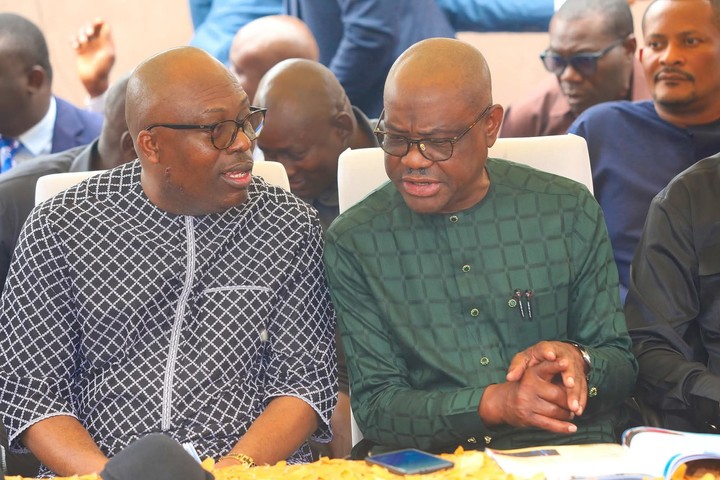
PORT HARCOURT, RIVERS STATE – Rivers State Governor Siminalayi Fubara has made his clearest public acknowledgment yet of the political influence of the Minister of the Federal Capital Territory, Nyesom Wike, declaring that he would not have become governor without Wike’s backing.
Speaking at an award ceremony in Lagos, Fubara described Wike as the man who “discovered” him and gave him the platform that propelled him into prominence. He went further to dedicate his award to the former governor despite their prolonged and highly publicised political dispute.
The statement is not merely sentimental. It is politically loaded.
Discovery, Loyalty and the Language of Power – What Fubara Is Signalling
By publicly crediting Wike for his emergence, Fubara reframed a conflict that had previously appeared existential. The Rivers political crisis, which paralysed the State House of Assembly and triggered impeachment threats, was widely interpreted as a battle for control of political structures and institutional authority.
Fubara’s language now suggests a shift from confrontation to strategic accommodation.
He described himself as choosing “weakness” deliberately for peace and survival. In a political culture where strength is often equated with dominance, redefining weakness as virtue is a calculated message. It signals that preservation of office and stability may take precedence over open confrontation.
According to Angle 360 analysis, this rhetorical pivot reflects a broader reality. In Nigerian state politics, political godfather relationships rarely dissolve cleanly. They mutate, recalibrate, and renegotiate.
Weakness as Strategy – Retreat or Reinvention?
Fubara’s assertion that weakness “pays at the right time” invites deeper interrogation. Is this humility or tactical patience. Is it reconciliation or temporary détente.
Political survival in Nigeria often depends on managing alliances rather than defeating rivals outright. By acknowledging Wike’s foundational role in his rise, Fubara reduces immediate hostilities while retaining executive authority.
The more significant question is whether this recalibration alters the underlying power architecture in Rivers State.
The earlier standoff fractured the legislature, polarised political actors, and required intervention by Bola Tinubu to broker relative peace. That intervention stabilised the situation but did not erase structural tensions.
Public praise may ease optics, but institutional balance remains the real test.
The Tinubu Factor – Federal Mediation and Political Order
The involvement of the presidency in resolving the Rivers dispute underscored how state level conflicts can escalate into national political concerns. Tinubu’s mediation positioned the federal executive as arbiter in a regional power struggle.
Fubara’s renewed conciliatory tone suggests that federal pressure may have reinforced the cost of prolonged conflict. Political instability in a strategic oil producing state carries economic implications beyond partisan rivalry.
Peace in Rivers is not only local. It affects revenue flows, investor confidence, and broader federal political arithmetic.
The Assembly and Governance – Has Stability Truly Returned?
The crisis between Fubara and Wike fractured the Rivers State House of Assembly and stalled governance processes. Recent signs of reconciliation, including submission of commissioner nominees and softened rhetoric, suggest incremental stabilisation.
However, Angle 360 notes that reconciliation announcements do not automatically equal durable institutional alignment. Political truces in Nigeria are often conditional.
The durability of the current calm will depend on shared control of party structures, influence over legislative leadership, and alignment ahead of future electoral cycles.
Godfather Politics – Structural Feature or Democratic Constraint?
Fubara’s acknowledgment that Wike “gave him loudness” reopens a familiar debate about political mentorship and patronage. In many Nigerian states, political ascent is shaped by established power brokers who control party machinery.
This structure can provide continuity. It can also constrain autonomy.
By embracing rather than repudiating his political origin story, Fubara appears to be choosing coexistence over rupture. Whether this strengthens governance or entrenches dependency remains open.
0
0