
Kaothaj_
5 months ago
In Naija politics, your greatest enemy is never always the man in Aso Rock.
Sometimes it is the man standing right next to you at the opposition's own press conference. The one with the brilliant speech, the dedicated supporters, the credible record, and the habitual inability to stay in a room long enough to finish a fight.
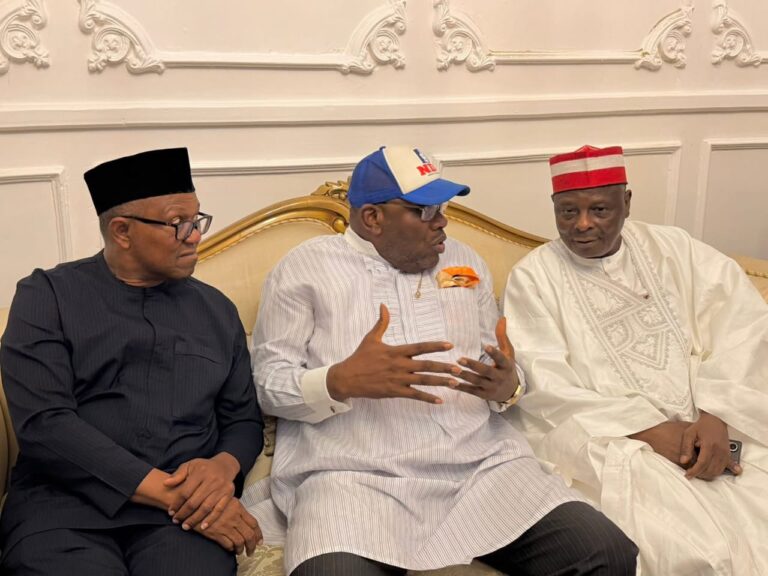
Yesterday, May 3, 2026, Peter Obi and Rabiu Musa Kwankwaso arrived together at Senator Seriake Dickson's residence in Guzape, Abuja at exactly 5:18 in the evening. Their supporters were already outside chanting "O-K is okay." The two men went inside together, sat in a closed-door meeting together for ninety minutes, came out together, drove to the Nigeria Democratic Congress national secretariat together, and collected their NDC membership cards together.
Kwankwaso received his card first. Obi received his second.
And somewhere in Aso Rock, Bola Ahmed Tinubu did not need to make a single phone call, file a single lawsuit, or instruct a single INEC official.
The opposition had just done his campaign work for him. Again. Together.
This Is Not The First Time. It Is The Pattern.
Let us start at the beginning. Not 2026. Not even 2023.
Start in 2022, when the PDP held its presidential primary and the outcome offended both Obi and Kwankwaso's respective camps. Obi did not stay to resolve the crisis. He did not convene stakeholders. He did not negotiate. He took his supporters and left for the Labour Party. Kwankwaso left separately for the NNPP he had been building in Kano.
The result of two men leaving PDP separately rather than staying to either win or build a coalition internally?
Tinubu won the 2023 presidential election with 8.79 million votes. Atiku got 6.98 million. Obi got 6.1 million. Kwankwaso got 1.49 million.
Add Obi's votes to Atiku's. Add half of Kwankwaso's to that sum. The presidency changes hands.
But the votes were split across three platforms because the men who carried them refused to be in the same vehicle.
Tinubu did not win 2023 because he was invincible. He won because his opponents delivered him the presidency by refusing to stand together.
Then Came 2025 and The ADC Coalition
When the coalition of El-Rufai, Atiku, Amaechi, Obi, Tambuwal, Malami, Babachir Lawal and eventually Kwankwaso began assembling inside the ADC, it looked for the first time like the opposition had learned something from the 2023 disaster.
The most dangerous collection of political capital and northern network assembled since the 2013 APC merger was taking shape in one party. Not perfect. Not without egos. But together.
The Ibadan Declaration of April 25, 2026, one week ago, produced a signed nine-point document committing all participating opposition parties to field one presidential candidate. Atiku was there. Obi was there. Kwankwaso was there. Amaechi was there. Makinde was hosting.
Obi was at that table when his name was being discussed as the consensus presidential candidate. He was part of the coalition.
Six days later, he and Kwankwaso were out. Together.
Obi announced his defection citing internal crises and a toxic political environment. He said their move to the NDC was driven by the need for a peaceful platform free from internal crises. Speaking at the NDC secretariat he stated: "We are here to be part of a peaceful family that will work hard to build a united, secure, and prosperous Nigeria that works for everyone."
Control and exclusion. Internal crises. Toxic environment.
Nyesom Wike said it in October 2024. Nobody in the ADC coalition wanted to hear it then.
Wike stood on a convention stage and asked the question the opposition refused to answer: "Would he have abandoned Nigeria for another country if elected president? Jumping ships or defecting to another party does not show leadership."
He was talking about a different defection at the time.
But he was describing a character pattern that has now revealed itself once more.
How The Joint Move Actually Happened
Obi and Kwankwaso arrived at Dickson's Guzape residence at about 5:18 p.m., drawing a crowd of supporters under the Obi-Kwankwaso Movement, who chanted "O-K is okay" as the two leaders were ushered into the premises. Kwankwaso appeared in a white babanriga paired with his signature red-and-white Kwankwasiyya cap, while Obi wore an all-black kaftan and matching cap.
The detail that changes the entire narrative is this. Obi and Kwankwaso did not make separate decisions that happened to align. They made one decision together. They moved as a coordinated unit. The joint exit from ADC and the joint entry into NDC was planned, choreographed, and executed in a single afternoon.
After about 90 minutes of closed-door consultations, Obi said the decision to join the NDC was driven by shared ideological alignment between him, Kwankwaso and the party leadership. He stated: "We came here with our team to consult with the leadership of the party on our ideology, our blueprints and what we believe in."
Dickson welcomed the new entrants saying: "You may not have come with a crowd, but you represent one. Nigerians know the value you bring. There will be time for campaigns and to unveil our political processes."
He also described the NDC as a party with no faction and no litigation whatsoever.
No faction. No litigation. That is the pitch. After months of Supreme Court hearings, Federal High Court injunctions, three ADC factions and INEC portal removals, Dickson was selling the one thing the ADC could never credibly offer.
Peace. And a clean legal slate.
What this coordinated move also confirms is that the Obi-Kwankwaso ticket is still intact. The alliance survived the party change. The "O-K is okay" chant outside Dickson's gate was not just nostalgia. It was a declaration that the combination is still on the table, now wearing NDC colours instead of ADC ones.
Where They Went: The NDC Question
The NDC. A party most Nigerians were still Googling as the membership cards were being photographed.
The "O-K is okay" slogan was coined by supporters to indicate a joint presidential ticket, with Obi as the lead and Kwankwaso as his deputy.
The ticket is intact. But the platform is new, unfamiliar, and untested.
The ADC, for all its legal battles and factional chaos, had INEC recognition, registered members in all thirty-six states, the Atiku northern structure, and the momentum of a Supreme Court ruling that had just restored the Mark-led NWC to the INEC portal days earlier.
The NDC has Obi, Kwankwaso, Seriake Dickson, and whatever structural capacity it can build from scratch before the May 30 primaries deadline.
Twenty-seven days.
The NDC has twenty-seven days to conduct ward congresses, local government congresses, state congresses, and a national convention that INEC will recognise. Twenty-seven days to build the primary infrastructure that the ADC spent nine months building and is still fighting about in court.
Obi directly addressed the litigation issue, saying: "The government has fueled crisis after crisis, leading to lawsuits that forced us to leave our former parties. Even in new parties, we encountered the same unresolved disputes. That is why we are here in the NDC, where we have been assured there is no litigation. We plead: let there be no court cases. Let lawyers practice their profession elsewhere."
He is pleading with people not to sue the party he just joined. On the day he joined it.
In Naija politics, when a man's first speech in a new party is a plea against litigation, the institutional memory of every crisis he has left behind is sitting in the room with him.
Onanuga Said It. And For Once, He Was Not Entirely Wrong.
Presidential adviser Bayo Onanuga described Obi as a "political nomad," dismissing his reasons for leaving the ADC as self-serving. He said: "Peter Obi avoids tough contests and takes the easy path." APC spokesperson Felix Morka also questioned Obi's pattern of switching parties, arguing that consistent commitment to a single platform is essential for political stability and effective leadership.
Onanuga is not a neutral observer. He speaks for a presidency that benefits every single time Obi leaves a party. His motivation is political and his credibility on anything is compromised by the source.
But the observation, stripped of the source, carries weight that Obi's supporters need to sit with honestly.
APGA. A party Obi promised he would never leave. He left.
PDP. A party he joined with fanfare. He left before the primary dispute was resolved.
Labour Party. A party he built into a national movement with the Obidient army. He left while it was still burning from internal strife, handing its base to a movement that became rudderless after his exit.
ADC. A party he joined in December 2025. He left in May 2026. Five months.
NDC. Party number five. The membership card is still warm.
Obi's defenders will say each departure was principled. That he left because the processes were compromised. That he cannot control other people's corruption and power games.
That is true. And it is also incomplete.
Because a man who wants to lead 220 million Nigerians through the permanent crisis that is Nigerian governance cannot audition for the role by exiting every room where a crisis develops. A president does not get to resign because the National Assembly is fractured. A president does not get to defect because the cabinet is full of competing egos.
The job Obi is seeking is the job of staying in the hardest rooms and fixing what is broken. His pattern is the opposite of that job description.
What This Does To The 2027 Opposition Arithmetic
Let us look at the damage with clear eyes.
The Atiku, Amaechi, Mark and remaining ADC coalition have been handed a primary that is now significantly simpler to control. With Obi and Kwankwaso gone to NDC, the ADC ticket becomes a contest Atiku can win with his eyes half closed. He has the delegate numbers. He has the northern structure. He has the coalition agreement that bound the faction.
But here is what the ADC without Obi and Kwankwaso actually looks like on a 2027 ballot.
In 2023, Atiku contested directly against Tinubu and lost. Tinubu got 8.79 million votes. Atiku got 6.98 million. And that was with PDP's full national structure behind him, seventeen years of presidential ambition driving his campaign, and a well-resourced party machine operating in all thirty-six states.
Now Atiku would be going into 2027 without Obi's South-East votes, without Kwankwaso's Kano movement, and without the Obidient energy that made 2027 look genuinely different from every previous cycle.
The ADC primary without Obi and Kwankwaso produces an opposition candidate that fits the profile of every opposition candidate Tinubu has already beaten. The result is already written in 2023's election figures.
Meanwhile the NDC has the Obi-Kwankwaso ticket but needs to build a national primary structure in twenty-seven days from a party that most state INEC officials did not have on their operational radar a fortnight ago.
Two opposition candidates on two platforms. Splitting the same anti-Tinubu votes the way 2023 was split.
The mathematics of that outcome are already written. Tinubu has seen this film before. He knows how it ends.
The NDC Gamble: Can Obi Build Something Real in 27 Days?
Here is the generous interpretation of what Obi and Kwankwaso are doing.
They looked at the ADC and made a calculation that the legal battles, the three factions, the Federal High Court injunctions, and the fundamental structural rot created by the Nafiu Bala crisis would not be resolved cleanly enough before May 30 to produce a primary that carries full electoral legitimacy.
They chose the NDC not because it is stronger than the ADC but because it is legally cleaner and structurally simpler. A smaller platform with no factions. No competing chairmen. No status quo ante bellum orders. No INEC portal crisis.
And they moved together as a unit, which means the ticket survived the transition intact.
If that calculation is correct, and if the NDC can conduct a clean INEC-monitored primary before May 30, and if the Obidient movement follows them to the new platform, and if Dickson's Bayelsa network contributes South-South support, the NDC could emerge as a leaner, cleaner vehicle than the ADC's chaos ever allowed.
Kwankwaso encouraged Nigerians to register with the NDC immediately, declaring that his political structure had already commenced the process.
The Kwankwasiyya machine is now pointing at NDC registration. That is not a small thing. That is a northern grassroots mobilisation network that knows how to move bodies to registration points.
But the ungenerous reading is simpler and shorter.
Two men who signed a unity declaration in Ibadan six days ago just abandoned the coalition that produced it. And in Naija politics, a coalition that cannot survive six days between its declaration and its defections has not really built a coalition. It has built a photo opportunity.
The Final Verdict
In Naija politics, the Nigerian voter has a long memory for some things and a short memory for others.
They remember hunger. They remember darkness. They remember N1,400 petrol. They remember soldiers dying in armoured vehicles that would not start.
They also remember the men who were supposed to rescue them from all of that.
And they will ask on election day whether two men who moved through five parties between them in eight years have the institutional discipline to fix a country that requires someone to stand still, absorb the pressure, and rebuild from the inside.
Obi's record in Anambra as governor was excellent. His performance in 2023 was extraordinary against all odds. His criticism of the Tinubu government has produced real policy responses. Kwankwaso's education revolution in Kano is documented. His loyalty to his movement is unquestioned.
All of that is real. None of it is diminished by yesterday's defection in isolation.
But the pattern is what it is. And patterns, in politics as in everything else, are what you are ultimately judged by.
Tinubu has thirty-one governors, federal resources, an APC that stayed together through its own internal tensions, and now the gift of a freshly fragmented opposition one week after the Ibadan Declaration promised unity.
He did not do this to them.
The chant outside Dickson's gate said "O-K is okay."
In Naija politics, the only honest response to that chant right now is a question.
Okay for who?
Because from where Tinubu is sitting tonight, things are looking very okay indeed.
What do you think? Is the Obi-Kwankwaso move to NDC a masterstroke that gives the opposition a clean legal platform, or is it the final proof that the opposition will always find a way to divide itself at the worst possible moment? And with twenty-seven days to the INEC primaries deadline, can the NDC build a national primary structure fast enough to put a candidate on the 2027 ballot? Drop your thoughts in the comments section. This Naija politics self-destruction is becoming a genre of its own and Nigerians deserve better from the people asking for their votes.
0
53