

Kaothaj_
7 months ago
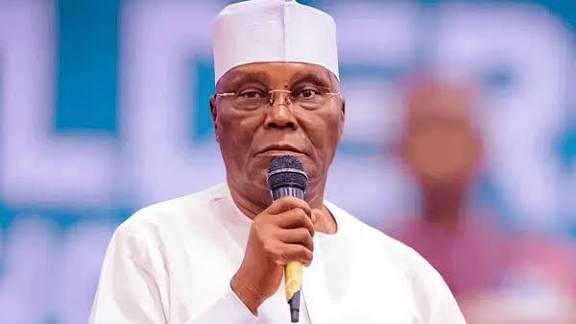
There's a particular irony that defines Atiku Abubakar's entire political career, and it was on full display this week. While Peter Obi was leading thousands of Nigerians in protest at the National Assembly, while Rotimi Amaechi—highly unexpectedly—joined the demonstrations with his doctor son, while El-Rufai was lending his support virtually from abroad, Atiku Abubakar was doing what he does best: hopping between parties, meeting with political godfathers, and calculating his next move.
On Tuesday, February 10, former Vice President Atiku Abubakar and Oyo State Governor Seyi Makinde held a closed-door meeting with former Military President Ibrahim Babangida at his residence in Minna, the Niger State capital.
What could Atiku possibly be planning? Here's a man who just joined ADC, meeting with IBB—one of Nigeria's most influential political strategists—alongside Makinde, who's currently battling Wike for control of PDP. This is classic Atiku: always meeting, always calculating, always positioning himself for the next big move.
The brutal truth operating in the constantly shifting dynamics of naija-politics is this: Atiku Abubakar is a political nomad. A serial defector whose entire career has been defined not by building institutions, but by jumping from party to party in pursuit of one thing: the presidency.
Let's count his defections, because they tell the whole story:
From PDP to APC and back again, Atiku Abubakar's history of party defections spans decades. This marks his seventh party defection in over 30 years.
Seventh! Let that number sink in. Atiku has changed political parties seven times.
Here's the full list:
1. UNCP to PDP (1998): As the transition programme suffered a natural death following Abacha's demise, Atiku ended his stint with the UNCP and joined the PDP in 1998 ahead of the 1999 general elections [Punch](https://punchng.com/tinubu-shettimas-frequent-foreign-trips-raise-eyebrows/) .
2. PDP to ACN (2006): Following his fallout with Obasanjo towards the end of their second tenure, Atiku switched from the PDP to the Action Congress of Nigeria (ACN), in preparation for the 2007 elections [Punch](https://punchng.com/tinubu-shettimas-frequent-foreign-trips-raise-eyebrows/) .
3. ACN back to PDP (after 2007): He returned to PDP when ACN couldn't deliver the presidency.
4. PDP to APC (2014): In November 2013, Atiku Abubakar, former vice president of Nigeria, defected from the governing PDP to the APC, along with five serving governors [Punch](https://punchng.com/opposition-fumes-as-tinubu-makes-15th-foreign-trip-in-2025/) .
5. APC back to PDP (2017): Former Vice President Atiku Abubakar defected from APC and returned to PDP in 2017 [Africanews](https://www.africanews.com/2024/03/21/tinubu-suspends-public-funded-foreign-trips-by-ministers-govt-officials/) .
6. PDP to ADC (July 2025): "I find it necessary to part ways due to the current trajectory the party has taken, which I believe diverges from the foundational principles we stood for," Atiku said in a letter dated July 14, 2025 [The ICIR](https://www.icirnigeria.org/one-year-in-office-tinubus-foreign-trips/) .
7. And now?: He was just recently seen meeting with the National Chairman of the Action Democratic Party (ADP), Yabagi Yusuf Sani, at his Abuja residence.
Is another defection coming? Is Atiku now shopping for yet another platform?
Atiku is not an epitome of party loyalty. He sees every party through the prism of his ambitions. Yet, he brings nothing truly substantial, such as Buhari's cult following or Tinubu's resources, to the table.
And that's the fundamental problem with Atiku's political strategy. If Atiku wanted to hold sway in a political party, he should have invested heavily in one and built a formidable political base. He did neither.
Think about it: Tinubu spent decades building ACN/APC in the Southwest. He invested money, built structures, created a political machine that could deliver. That's why he's president today.
Buhari had a cult following in the North that transcended party lines. People voted for Buhari, not for his party.
Kwankwaso built Kwankwasiya movement and dominated Kano for years.
What has Atiku built? Nothing. He's been too busy moving from party to party to actually invest in building any of them.
Atiku's defections were motivated by his search for a platform to actualise his lifelong presidential ambitions. When he joined the Action Congress in 2006, it was because the party would offer him the ticket for the 2007 presidential election, which the PDP denied him.
Every single defection has been about one thing: getting a presidential ticket. Not about ideology. Not about party building. Not about creating lasting institutions. Just about finding whoever will give him a platform to run.
And here's the most damning part: Atiku Abubakar ran unsuccessfully for President of Nigeria six times, in 1993, 2007, 2011, 2015, 2019, and 2023.
Six failures. And now in 2025, he has defected from PDP to the African Democratic Congress (ADC), under which he is assembling a coalition to face the APC and its flagbearer, President Bola Tinubu, in the 2027 presidential election. That would be Atiku's seventh attempt at the presidency, aged 80!
Eighty years old and still chasing a dream that has eluded him for over three decades. At what point does ambition become obsession? At what point does persistence become stubbornness? At what point does determination become delusion?
And here's where the contrast with Peter Obi becomes devastating in the unpredictable arena of naija-politics:
While Obi was at the National Assembly joining protesters demanding electoral integrity, Atiku was meeting with IBB planning political strategies. Speaking to journalists after the meeting, Atiku said his visit was aimed at strengthening the structures of the African Democratic Congress (ADC) in Niger State and was not connected to any 2027 presidential ambition.
"Not connected to 2027 presidential ambition?" Who is Atiku trying to fool? Everything he does is connected to his presidential ambition. Every meeting, every defection, every statement—all of it is about one thing: finally becoming president.
Former Labour Party presidential candidate, Peter Obi, and former Rivers State Governor, Rotimi Amaechi, have joined pro-democracy protesters demanding urgent reforms to Nigeria's Electoral Act, particularly the retention of mandatory real-time electronic transmission of election result.
And Amaechi's presence was particularly striking. Amaechi, a chieftain of the ruling All Progressives Congress (APC), joined the protest alongside his son, a medical doctor.
Amaechi explained that he deliberately brought his son along in case the protest turned violent, saying leaders must be willing to stand at the forefront of civic struggles with their families.
That's leadership. That's putting your body where your words are.
And El-Rufai, though outside the country, said during an interview on Trust TV that "It's unfortunate I have not been able to return to Nigeria, I would have joined Mr. Peter Obi and other party leaders in protesting to the National Assembly to restore the real-time and mandatory transmission of results from the polling unit".
So you have Obi leading protests. Amaechi joining with his son. El-Rufai supporting from abroad. All of them fighting for electoral integrity.
And Atiku? Meeting with IBB and Makinde behind closed doors, "strengthening ADC structures."
The optics couldn't be worse. One set of opposition leaders is fighting for democracy on the streets. The other is making backroom deals with political godfathers.
One group is mobilizing citizens. The other is mobilizing party structures.
One represents new politics. The other represents everything Nigerians are tired of.
Now, about that meeting with IBB and Makinde—what could Atiku possibly be planning?
The most likely scenario: Atiku is hedging his bets again. He's in ADC, yes, but he's also keeping lines open with PDP through Makinde. He met with the ADP chairman recently. He's positioning himself to jump to wherever offers the best deal.
This is vintage Atiku: never fully commit to one party, always keep your options open, always be ready to defect if a better opportunity emerges.
Political nomadism trivialises politics and treats it as a self-serving endeavour rather than a serious, public-spirited calling .
And here's the ultimate question: Can Nigerians trust Atiku and give him the presidential ticket and later votes?
The answer, for anyone paying attention, should be no.
How can you trust someone who's changed parties seven times? How can you believe someone who says he cares about party principles when he abandons parties the moment they don't serve his interests?
If Atiku were to die without becoming Nigeria's president, how would he be remembered politically? Well, for two things: a habitual presidential aspirant and a serial party defector .
That's his legacy. Not as a party builder. Not as an institution creator. Not as someone who transformed Nigerian politics. But as someone who spent 30+ years jumping from party to party, chasing a dream he could never catch.
Will he ever stop decamping and build a party structure?
At 80 years old, the answer is clearly no. If he hasn't done it by now, he never will. Atiku is incapable of building a lasting political home because building requires patience, investment, and commitment—none of which align with his strategy of constant movement in search of presidential tickets.
Compare him to Tinubu, who spent decades building APC. Compare him to Obi, who's building a grassroots movement. Compare him even to Kwankwaso, who at least built something in Kano before it collapsed.
Atiku has built nothing. And at 80, with seven defections behind him and possibly an eighth on the horizon, he never will.
The tragedy is that Atiku might actually have been a decent president if he had won 15 or 20 years ago. But now? Now he's just a cautionary tale about what happens when ambition outlives relevance, when persistence becomes obstinacy, and when a refusal to build institutions dooms you to perpetual political homelessness.
And in the evolving dynamics of naija-politics where younger Nigerians are demanding change, where Peter Obi is mobilizing protests, where even El-Rufai and Amaechi are taking bold stands—Atiku's backroom meetings and serial defections look increasingly out of touch.
He's a relic of old politics in an era that's crying out for something new. And no amount of meetings with IBB, no number of party switches, no amount of "strengthening structures" can change that fundamental reality.
What do you think? Should Nigerians trust a man who's changed parties seven times? Can Atiku ever build a lasting political institution, or is he doomed to keep jumping until he's too old to jump anymore? And what does his meeting with IBB and Makinde really signal about his next move? Drop your thoughts in the comments section!
0
80