
Kaothaj_
6 months ago
In Naija politics, when a man is found dead in the middle of the road, the first instinct is to ask who pushed him.
The honest answer is usually more complicated than one name.
Because sometimes a man walks to the middle of the road himself, lies down voluntarily, argues with his fellow pedestrians about who should help him up, and then blames the driver for what happens next.
The Nigerian opposition has been walking to the middle of that road since 2022. And right now, in May 2026, with the INEC primaries deadline at May 30, with Obi and Kwankwaso in the NDC, with Atiku holding fort in an increasingly hollowed ADC, and with Tinubu watching the whole spectacle from the comfort of Aso Rock, the question is no longer academic.
Who is to blame for this?
Let us argue it out properly. Three defendants. Three charges. All of them partially guilty.
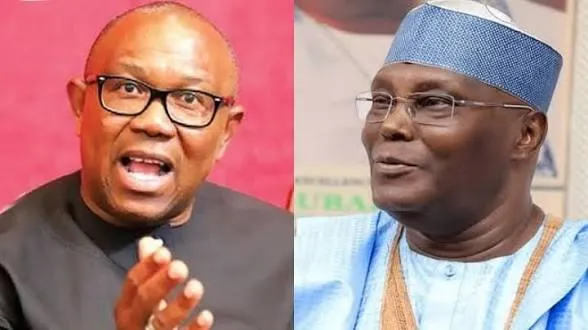
The Case Against Peter Obi: Brilliant Candidate. Terrible Coalition Partner.
The prosecution's argument against Peter Obi is straightforward and supported by a consistent pattern across eight years of Nigerian political history.
In 2022, Obi attended the PDP presidential primary process and left when the outcome displeased him. He did not stay and challenge the process from inside. He did not mobilise delegates to overturn the result at a subsequent convention. He left. For Labour Party.
That exit split the PDP's anti-APC vote down the middle. In 2023, PDP, Labour Party and NNPP ran separately and handed the APC victory with barely 36 percent of the vote. A divided opposition gifted Tinubu the presidency.
Then in December 2025, Obi joined the ADC coalition. He joined, by Babachir Lawal's own account, after the coalition had already been building for months. Lawal said: "Peter Obi joined the coalition after it had all begun for quite a long time. He had always been somebody that is very shifty when it came to ADC. We never felt his heart was in it."
The ADC bent over backwards to keep him. Lawal revealed: "To accommodate Peter Obi, we offered him to single-handedly bring the organising secretary of the party. We never extended that goodwill to any other member of the party. We felt that if you have confidence in the party's organising secretary, that assures you that you cannot be manipulated out, because the heart of electoral processes in a political party is the organising secretary's office."
One man. Offered unilateral control of the most important administrative office in the party's primary process. A concession given to nobody else in the building. And his response was still to leave.
Lawal delivered the hardest verdict: "I don't think it is suspicion; I think it's fear. And a democrat, a politician who fears election, I think, has no business being one."
Obi's defence is that the ADC primary was heading toward a dollarised process. That Atiku was financially inducing party leaders to deliver delegates. Obi's camp accused Atiku of plotting to financially induce party leaders to enable him grab the ticket, a development that the former governor's supporters had warned against, with the Obidient Movement declaring their principal would not participate in any dollarised primary election.
That defence has merit. Transactional primaries are a real Nigerian political phenomenon.
But here is the prosecution's closing argument.
If Obi's concern was a compromised primary, the answer was to fight it from inside, expose it publicly, demand INEC monitoring, build pressure with fellow aspirants who shared the same concern. Amaechi is still inside the ADC. He did not leave. The fight against a rigged primary is a fight you win by staying and applying pressure, not by exiting and handing the man you feared the ticket on a platter.
Representative Uzokwe of the NDC inadvertently confirmed the prosecution's case when he said: "Let Atiku say today that he is stepping down and has conceded to the South. Peter Obi will come back tomorrow."
Peter Obi will come back tomorrow. If Atiku concedes.
That sentence exposes the real reason for the exit. It was never purely about litigation or toxicity. It was about whether Obi was getting the presidential ticket. When the answer looked uncertain, he left. As he has done before. In other parties.
APGA to PDP to Labour Party to ADC to NDC.
Five parties. One candidate. Zero completed internal fights.
The Case Against Atiku Abubakar: A Man Who Calls His Ambition a Coalition
The case against Atiku Abubakar is older, quieter, and in some ways more damaging than the case against Obi.
Because at least Obi is transparent about his movement. You always know when Obi is leaving because he tells you. Atiku's damage has been more structural. More systemic. More difficult to see until the building falls.
The testimony that broke this case open came from Representative Ifeanyi Uzokwe of Nnewi North, Nnewi South and Ekwusigo Federal Constituency, who appeared on Channels Television and stated plainly: "We left ADC because His Excellency Atiku Abubakar said that the coalition was formed in his house. That ADC is his party and nobody will tell him anything."
The coalition was formed in his house. ADC is his party. Nobody will tell him anything.
This is not a reported allegation from a hostile witness. This is a lawmaker who was in the room, who heard the words, and who made the statement under his own name on national television.
Uzokwe added: "We went to him and said, 'Can you step down and leave Peter Obi, Rotimi Amaechi and others to go into primaries. Let Atiku say he is stepping down for Rotimi Amaechi and Peter Obi and that he has conceded to the South.' He refused."
Here is the context that makes Atiku's refusal particularly difficult to defend.
This is the Southern turn in the power rotation. The unwritten gentlemen agreement, which produced a northern president in 2015, means the political consensus points toward a southern candidate in 2027. That is not Obi's invention. That is not a demand from NDC. It is the agreed framework that has governed Nigerian political space for succession and which every northern politician in the coalition understood when they joined.
Atiku joined a coalition where the power rotation argument pointed south. Then he told his coalition partners the party was formed in his house and nobody could tell him anything.
TheCable's analysis captured the structural contradiction precisely: "For Atiku, ADC serves a dual purpose. Win in 2027 and he finally reaches Aso Rock. Lose, and he controls the party machinery for 2031. For everyone else in the coalition, ADC is now or never."
Atiku has a 2031 fallback. Obi does not. Kwankwaso does not. The South-East does not. The asymmetry of stakes within the coalition was always going to produce the explosion it produced.
The ADC's defence of Atiku is that he publicly pledged to support whoever won the primary. ADC chieftain Chille Igbawua said: "Nobody who has come into the ADC has been given preference over him. Atiku Abubakar himself has said that he will contest this as his last attempt at the presidency and that should somebody else win, he is very willing to support such a person."
But public pledges and private conversations are two different things. And when a lawmaker goes on national television and reports what was said in the private conversation, the public pledge carries less weight than the private declaration.
Atiku's sixth presidential run is personal. It has always been personal. A man who has spent thirty years seeking the Nigerian presidency is not going to subordinate that ambition to a rotation agreement without a fight. The problem is that he joined a coalition where subordinating that ambition was the implicit price of admission.
He collected the coalition's benefits, the structure, the numbers, the Ibadan Declaration platform, and then told the building the building was his.
The Case Against The Entire Opposition Establishment: They Never Learned 2023's Lesson
But here is the verdict that neither Obi's supporters nor Atiku's camp wants to hear.
Both men are guilty. And they are guilty of the same crime they committed in 2023.
TheCable's analysis described the 2023 result with devastating clarity: "The goal was stated plainly: unseat President Bola Tinubu in 2027. The method was equally clear. Avoid the fatal three-way split of 2023, when PDP, LP and NNPP ran separately and handed APC victory with barely 36 percent of the vote. A divided opposition had gifted Tinubu the presidency. A united one would take it back."
They knew this going in. Every single person in that coalition had watched 2023 happen. They had counted the votes. They had done the arithmetic. They knew that Obi's 6.1 million plus Atiku's 6.98 million plus Kwankwaso's 1.49 million totalled more than Tinubu's 8.79 million.
They knew exactly what split opposition produces.
And they built a coalition. They signed the Ibadan Declaration. They posed for photographs. They gave speeches about rescuing Nigeria.
Then Atiku said the building was his. And Obi left the building. And the coalition that was assembled to prevent the 2023 split has now produced a 2027 split before a single primary vote has been cast.
Daily Post captured the political verdict most accurately: "The divided vote that gave Tinubu victory in 2023 is what they are about to repeat in 2027."
At least one analyst went further, suggesting that what has unfolded was not entirely accidental. He warned: "Watch out. The whole crisis in ADC will end this week. You will look for Bala and you won't find him, why? He has completed his task."
Whether Nafiu Bala Gombe was a genuine aggrieved politician or a planted instrument of disruption is a question Nigerian political history will eventually answer. What is not in question is the result his lawsuit produced. It froze the ADC, created space for the Ibadan Declaration to be signed and then abandoned within six days, and ended with the coalition fractured into two parties heading into the same election.
The Defence That Nobody Wants to Make But Has To Be Made
There is a third party to this case that sits at the back of the courtroom and has said very little.
The Nigerian government.
Obi himself said in his exit statement: "The government has fueled crisis after crisis, leading to lawsuits that forced us to leave our former parties. Even in new parties, we encountered the same unresolved disputes."
INEC acted on a Court of Appeal ruling on March 31, the same day Kwankwaso received his ADC membership card, after seven months of silence on that ruling. Atiku's own spokesman described attempts to deregister the ADC as "a desperate and failed plot conceived in the shadows of fear." El-Rufai faced monitoring at Nigerian airports. Multiple simultaneous lawsuits from multiple directions landed on a party that was already fighting one internal dispute.
All of this is real. All of this is documented. And all of it created the conditions in which the coalition's internal tensions, which existed independently, were magnified beyond the point of management.
But here is the problem with assigning all blame to the government.
Tinubu did not tell Atiku to say the coalition was formed in his house. Tinubu did not tell Obi to leave ADC after five months instead of fighting from inside. Tinubu did not break the promise to Nafiu Bala Gombe in July 2025. Tinubu did not stop Obi and Atiku from agreeing on the presidential ticket in the twelve months between the coalition's formation and its collapse.
A government that creates difficult conditions for the opposition is not a democratic ideal. But an opposition that cannot survive difficult conditions has not yet built the kind of coalition that takes power from an incumbent.
The APC of 2013 faced government pressure, EFCC cases, PDP's federal machinery, and internal ego clashes of its own. Tinubu held it together anyway. Not because the conditions were easy. Because the discipline was real.
The ADC coalition never had that discipline. And without it, the government's interference was a spark landing on a room already full of petrol.
The Final Verdict
In Naija politics, the Nigerian voter is the ultimate judge. Not the court. Not the analyst. Not the lawmaker on Channels Television.
And the voter's verdict in January 2027 will be delivered in the simplest possible language.
If Atiku is on the ADC ballot and Obi is on the NDC ballot, the vote splits. Tinubu wins. The 2023 result, with different name plates on the opposition parties, reproduces itself in 2027. And a man who won the presidency with 36 percent of the vote in 2023 wins his second term with similar arithmetic while his opponents congratulate each other on the courage of their principles.
The only verdict that changes that outcome is one that does not yet exist.
A single candidate. One ticket. One platform. One ballot.
Representative Uzokwe said the quiet part out loud: "Let Atiku say today that he is stepping down and has conceded to the South. Peter Obi will come back tomorrow."
One man's decision. Available today. With twenty-four days left before the INEC primaries deadline.
That is how thin the margin is between a real opposition and another Tinubu landslide.
Blame Obi. Blame Atiku. Blame the government. Blame the judiciary. Blame Nafiu Bala Gombe.
All of those blame assignments have evidence behind them.
But in Naija politics, assigning blame correctly has never stopped an incumbent from winning a second term.
Only a candidate on a ballot can do that.
And right now, the opposition does not have one.
What do you think? Is Atiku's refusal to concede to the South the single biggest obstacle between the opposition and Aso Rock? Or has Obi proven, across five parties, that the problem is ultimately about one man's unwillingness to finish a fight? And is there still time for a grand bargain before May 30 saves the opposition from itself? Drop your thoughts in the comments. This Naija politics self-examination is the most important conversation the opposition's supporters can be having right now and the clock is not waiting for anyone.
0
101