
Kaothaj_
7 months ago
In the chaotic theater of naija-politics where most opposition leaders issue statements from air-conditioned offices and then retreat to safety, Peter Obi has done something that marks him as fundamentally different: he showed up. He joined the protest. He led from the front.
Peter Obi has joined ongoing protests at the National Assembly in Abuja over the rejection of e-transmission of election results. The protest, tagged 'Occupy National Assembly', saw Nigerian youths and pro-democracy activists converging at the entrance of the National Assembly to express opposition to the Senate's rejection of e-transmission of election results.
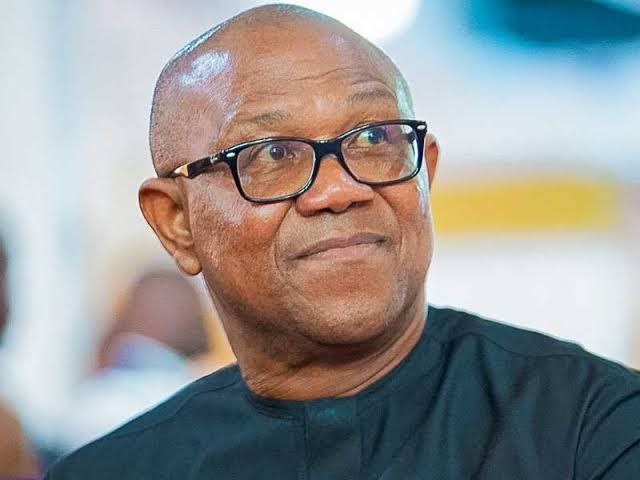
This is not a politician sending supporters to do his dirty work while he watches from a distance. Peter Obi, wearing black in front, led protesters to NASS. Among the protesters are student and civil society groups, some members of the African Democratic Congress (ADC), and the Obidient Movement—a group of Obi's supporters.
Think about what this means. A former Vice Presidential candidate, a man who came third in the 2023 presidential election, a politician who could easily issue a statement and call it a day—chose instead to physically join thousands of young Nigerians at the gates of the National Assembly demanding electoral integrity.
"Allow the elections to go through the normal process. Whoever wins, we would accept," Obi said as the demonstrators chanted solidarity slogans and songs. "So, why are you bringing this confusion?"
That simple statement captures everything. Obi is not asking for special favors. He's not demanding the system be rigged in his favor. He's simply asking for transparency. For a level playing field. For real-time electronic transmission so that INEC can't pull another "glitch" like they did in 2023.
DAILY POST reports that the demonstration attracted a heavy security presence, with personnel drawn from the Nigeria Police Force, the Nigerian Army, and the Nigeria Security and Civil Defence Corps, NSCDC, deployed to maintain order around the complex. The protesters are demanding that the National Assembly reconsider its position on the e-transmission clause of the Electoral Act Amendment Bill, insisting that electronic transmission is vital to transparency, credibility, and public confidence in Nigeria's electoral process.
And here's what makes Obi's presence at the protest so significant in the constantly shifting landscape of naija-politics: his boldness has worked.
Following the widespread criticisms that have trailed its rejection of a proposed amendment to Clause 60, Subsection 3, of the bill, which sought to make the real time electronic transmission of election results mandatory, the Senate has been forced to reconvene an emergency plenary sitting tomorrow, February 10, 2026, at 12:00 noon.
Read that again: The Senate has been FORCED to reconvene. They had adjourned until February 24. They thought they could pass their anti-transparency bill and escape for budget sessions. But the protests, the public outcry, the massive mobilization led by Peter Obi and supported by civil society groups, NLC, NBA, and concerned Nigerians—all of this forced Senate President Godswill Akpabio to call an emergency session.
The new development to reconvene tomorrow was formally contained in an official notice dated February 8, 2026, signed by the Clerk of the Senate, Emmanuel Odo, on the directive of the President of the Senate, Senator Godswill Akpabio.
This is democracy in action. This is what happens when an opposition leader doesn't just talk but mobilizes. This is the power of people-powered protest backed by credible leadership.
Peter Obi's presence at the protest front shows he is ready to make the ruling party stand on their toes and work for the benefit of the country. Not from behind a desk. Not through surrogates. But personally, physically, visibly.
Obi said the Senate must prevent the kind of glitches that the Independent National Electoral Commission (INEC) reported in 2023, and make real-time electronic transmission of results mandatory .
He's speaking from experience. He's speaking as someone who watched INEC's "glitches" undermine the 2023 election. He's speaking as someone who has the moral authority to demand transparency because he's not asking for manipulation—just fairness.
And the protest's call has been echoed by serious institutions. A coalition of Nigerian political activists and elder statesmen has launched a fierce opposition to the National Assembly's recent decision to exclude mandatory electronic transmission of election results from the Electoral Act Amendment Bill 2026. Under the banner of the newly formed Movement for Credible Elections, the group described the Senate's action as a calculated move to facilitate electoral fraud ahead of the 2027 general elections.
The statement read, "The action of the lawmakers is considered by MCE as a direct assault by the National Assembly to subvert the right of Nigerians to freely choose the leaders of their choice. By rejecting the mandatory transmission of election results from the polling units, the National Assembly has chosen opacity over transparency, manipulation over credibility".
Even the Nigeria Labour Congress has joined the fight, warning of possible nationwide strikes and election boycotts if the Senate doesn't reverse course.
But it's Peter Obi who's become the visible face of this resistance. It's his image—wearing black, leading from the front—that's dominating media coverage. It's his voice calling for electoral integrity that's resonating across the nation.
This is leadership. And Nigerians are noticing.
The protest and the subsequent Senate reconvening demonstrate something crucial: when opposition leaders show boldness, when they put their bodies where their words are, when they risk discomfort and potential danger to fight for democracy—the system responds.
The Senate wouldn't have called an emergency session if this was just social media noise. They're reconvening because thousands of Nigerians showed up physically at the National Assembly. And those thousands showed up because Peter Obi led them there.
Compare this to what other opposition figures are doing:
Atiku? Issuing statements from his Abuja home, meeting with party chairmen, calculating his primary chances.
Kwankwaso? Still weighing options, still calculating, still waiting to see if it's worth joining the fight.
Makinde and Bala Mohammed? Fighting Wike over PDP's corpse, more concerned with party control than electoral integrity.
Only Peter Obi is on the streets with Nigerians, demanding accountability from the National Assembly.
This matters enormously for his ADC primary chances. Because when delegates are choosing who can lead the opposition against Tinubu, they'll remember this moment. They'll remember who showed up when it mattered. They'll remember who was willing to lead protests, not just campaigns.
And they'll ask themselves: "Who has the courage to stand up to Tinubu's government? Who can mobilize Nigerians to action? Who has proven they're not just in this for power, but for principle?"
The answer, increasingly, is Peter Obi.
His boldness in joining the Obidients Movement protest, his willingness to physically occupy NASS, his insistence on electoral integrity even when it's politically risky—all of this builds his credibility as the authentic voice of opposition.
And now, with the Senate forced to reconvene in emergency session, with the entire nation watching to see if they'll reverse course, with Obi having demonstrated that sustained pressure works—he's proven something crucial in the brutal mathematics of naija-politics: he's not just a candidate, he's a movement leader.
That's what makes him dangerous to Tinubu. Not his policies. Not his experience. But his ability to mobilize Nigerians to hold their government accountable.
The Senate will reconvene tomorrow. They might reverse their decision on electronic transmission, or they might double down. But regardless of the outcome, Peter Obi has already won something more important: he's shown that he's ready to fight for Nigeria's democracy, not from behind, but from the front.
And Nigerians are rallying behind leaders who fight with them, not for them from a distance.
This is how you build a presidential campaign. Not through backroom deals and party chairman meetings, but through visible, courageous leadership on issues that matter to ordinary Nigerians.
Peter Obi is betting that boldness, principle, and people-powered movements can defeat incumbency, money, and rigging. Tomorrow's Senate session will show whether that bet is paying off.
But one thing is already clear: in a political landscape full of calculating, risk-averse opposition figures, Peter Obi's willingness to occupy NASS alongside protesters has marked him as something different. Something Nigeria desperately needs.
A leader who leads from the front, not from behind.
What do you think? Does Obi's boldness in joining the protest strengthen his position as opposition leader? Will the Senate reverse course tomorrow? And can this kind of grassroots mobilization actually defeat Tinubu's rigging machinery in 2027? Drop your thoughts in the comments section!
0
83