
Kaothaj_
4 months ago
In Naija politics, a promise from a politician is not a commitment.
It is a starting position in a negotiation that has not yet been scheduled.
And nobody in Nigerian political history has demonstrated that truth more consistently, more publicly, and more repeatedly than the man who sat before a camera yesterday and said he would not stay in Aso Rock a single day beyond four years, even with a gun to his head.
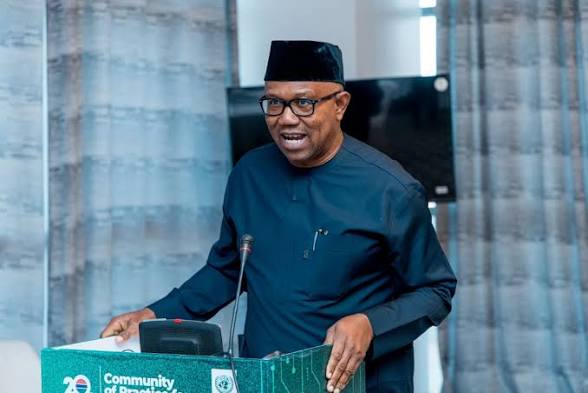
Peter Gregory Obi. Former governor. Five-time party member. NDC presidential aspirant.
Yesterday on News Central TV, Obi looked into the camera and delivered the most dramatic one-term pledge in recent Nigerian political history.
He said: "I want to be a one-term president because of stability. I would not stay a day, with a gun to my head, longer than four years."
A gun to his head.
The Obidient movement erupted. His supporters shared the clip ten thousand times before midnight. Trending nationwide. Powerful delivery. Quotable. Cinematic.
And then those of us with longer memories asked the only question that matters.
Where have we heard this level of commitment from Peter Obi before?
The APGA Oath: When Commitment Was Personal, Cultural, and Sacred
In Naija politics, there are levels of commitment. You have a press statement. A public declaration. An oath before witnesses. And then there is the category that Obi occupied with APGA.
This was not a party loyalty pledge made in front of journalists. This was an oath given to Chukwuemeka Odumegwu Ojukwu, the Ikemba Nnewi, the most sacred and respected political figure in Igbo political consciousness since the civil war. Given on his deathbed. With Obi standing before him. In the culture from which Obi comes, that is not a political statement. That is a covenant.
Presidential spokesman Onanuga described it plainly: "While in APGA, he famously placed himself under a self-curse, vowing never to leave the party that made him governor. He gave his word to the Ikemba, even on his deathbed, swearing loyalty and fidelity to APGA."
A self-curse. Not a press release. A self-invoked spiritual consequence for breaking the promise.
And Obi himself confirmed what happened in a recent interview on News Central TV where he explained his departures from APGA and PDP.
He said: "Some men change parties because of their principles, some others change their principles for the sake of their party. So for me, I changed party because of my principle because I've been in a system where you can see that it is no longer what you believe in, what you want to practice. I left APGA because I was forced to leave. I left PDP because of my principles."
He was forced to leave. That is his stated reason.
Now here is where his own children enter the story.
Obi himself has said in past interviews that his children, aware of his various political declarations, began asking whether they should record him on camera whenever he made a strong public commitment. Not as a joke. As a form of accountability. His own children, watching their father make solemn commitments and then watching those commitments eventually give way to a different political reality, started treating their father's strongest declarations as something to be documented for future reference.
That detail is not from an opponent. That is from Obi himself. And it is the most devastating self-description of a credibility problem that any Nigerian politician has ever voluntarily offered in public.
His children. His own household. Recording him. Just in case.
Onanuga Landed The Punch. And This Time, He Was Not Entirely Wrong.
Onanuga wrote on X: "If you believe Peter Obi's promise to serve only one term as president, you'll believe anything."
He added: "Yet, Peter Obi's pledges have always been short-lived. He ultimately abandoned APGA for the PDP, and since then, he has drifted from one political platform to another, a political rolling stone. By his own actions, Peter Obi has shown that his word cannot be trusted. His promises are as fleeting as his political allegiances."
A rolling stone. From a man who speaks for a president with genuine credibility problems of his own on multiple policy promises.
But here is what good analysis requires. Onanuga's motivation is political and his employer is not exactly a monument to kept promises. Tinubu promised that removing petrol subsidy would immediately release funds to improve lives. He promised 24-hour electricity. He promised one million jobs. He promised to fix the refineries. Most of those promises have a complicated relationship with delivery.
So the criticism comes from a questionable source. But the facts it references are real.
Obi gave his word to Ojukwu on his deathbed. He left APGA.
He joined PDP with declarations of commitment. He left PDP.
He joined Labour Party and built a movement of millions behind him. He left Labour Party.
He joined ADC and signed the Ibadan Declaration committing to a unified opposition candidate. Six days later, he left ADC.
He is now in the NDC and has said with a gun to his head, he will not serve more than four years.
The pattern is not in dispute. The question is what to do with it.
The Defence That Obi's Supporters Must Make Honestly
If you support Obi, here is the argument you must be able to make with a straight face to a sceptical Nigerian.
Each departure, from APGA, PDP, Labour Party, and ADC, happened because of circumstances that were genuinely beyond Obi's control or because the platforms themselves had been corrupted. He did not leave APGA because he lost an election. He left because the party leadership structure had become what he described as incompatible with his governance principles. He did not leave PDP out of spite. He left because the primary was transactional and he refused to pay delegates. He did not leave Labour Party casually. He left because the party he had built had been overtaken by interests that were undermining its structure. He did not leave ADC on a whim. He left because three court cases, three factions, and a May 30 deadline made a clean primary legally impossible.
These are not invented defences. They are defensible positions with factual support.
But here is what that defence cannot explain.
A man who has left five parties in eight years, each time with a principled reason, must at some point confront the question of whether the problem is always external or whether part of it is internal. Whether the inability to resolve any internal party crisis without exiting is a situational problem or a character attribute.
Nigeria's next president will inherit a National Assembly that is internally fractured. A cabinet that will contain competing egos. A Supreme Court that has historically had an uncomfortable relationship with his opponents. An INEC that he has described as compromised. A civil service that has decades of institutional inertia. A northern political establishment that will resist reforms.
None of those rooms will be clean. None of those systems will be cooperative. None of those crises will have easy exits.
The question the one-term pledge forces is not whether Obi will overstay four years. It is whether a man who has demonstrated, across five parties, that his response to irresolvable internal difficulty is departure rather than sustained engagement, has the institutional temperament to govern the most complex country in Africa from a house he cannot leave.
Governing Nigeria is not a party you can defect from.
What The One-Term Promise Actually Reveals
Here is the thing that nobody is saying about the one-term pledge itself.
It is politically brilliant and it is also structurally dangerous.
Brilliant because it positions Obi as the antithesis of every power-hungry Nigerian politician who has ever promised one thing and delivered another. It speaks directly to the exhaustion that millions of young Nigerians feel about career politicians who treat the presidency as a personal property to be occupied indefinitely. Gun to his head is vivid, memorable, and travels fast on social media.
But structurally dangerous because a president who enters office already committed to one term has a weakened hand in virtually every political negotiation from day one. Every senator who wants something from the presidency knows the occupant will not be around to punish defiance in a second term. Every governor calculates accordingly. Every cabinet member knows their principal is not building a re-election machine.
One-term presidents in parliamentary or semi-presidential systems sometimes govern effectively for this reason. In Nigeria's system, where the presidency's strength comes partly from its capacity to reward loyalty and punish defection across electoral cycles, a voluntary lame duck is a structural vulnerability in a political environment that punishes weakness with paralysis.
The commitment is noble. The governing reality of Nigeria does not reward nobility with compliance.
The Final Assessment
In Naija politics, trust is not given. It is earned through consistency between public declaration and private behaviour, maintained across time, under pressure, when the convenient option was available.
Obi's record on that definition is complicated. His governance record in Anambra is genuinely impressive. His analytical capacity is real. His critique of the Tinubu administration has produced policy responses. His 2023 performance was extraordinary.
But his political commitment record, measured across five parties, one deathbed oath, and the testimony of his own children who started recording him just in case, raises a legitimate question.
Not whether Peter Obi is a good man. He may well be.
Not whether he wants to build a better Nigeria. His policy positions suggest he does.
The question is whether a man whose strongest political commitments have historically come with an exit clause is the same man who will look at Nigeria's hardest governance problems and stay in the room until they are resolved.
A gun to his head, he said.
His children used to ask if they should record him.
They were asking the right question.
And on May 15, 2026, with the NDC primaries eight days away and a presidential bid that has already survived five parties, Nigerians deserve to ask it too.
What do you think? Does Obi's consistent pattern of principled departures from political parties disqualify him from the trust that a one-term pledge requires, or does the quality of his governance record in Anambra matter more than his party loyalty history? And if you were one of his children, would you record him this time? Drop your thoughts in the comments section. This Naija politics credibility debate is one that every Nigerian voter needs to resolve in their own mind before January 14, 2027.
0
52