

Kaothaj_
5 months ago
In Naija politics, the most powerful thing that can happen to a fractured opposition is not a court victory.
It is not a defection. It is not a viral speech or a trending hashtag.
It is a room.
A room where the men and women who have spent the last twelve months fighting each other in courtrooms, on television, and in factional press conferences, sit down on the same chairs, face the same direction, and sign their names to the same document.
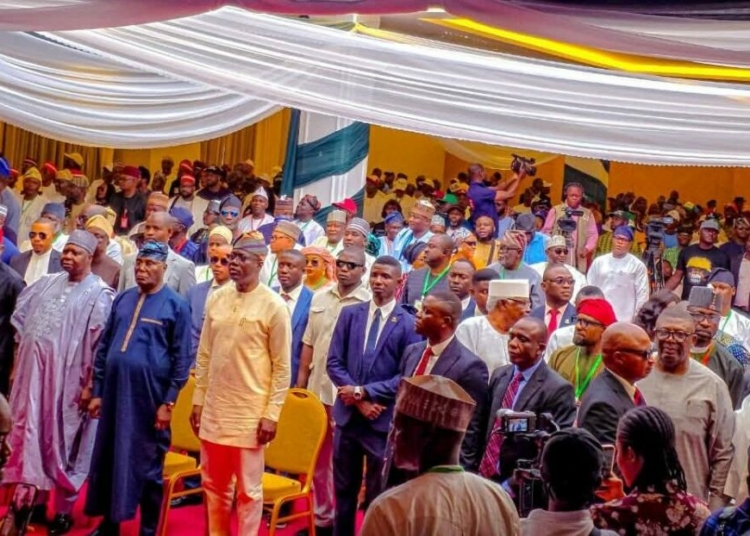
That room existed on Saturday, April 25, 2026, at the Government House Banquet Hall in Ibadan, Oyo State.
And what came out of it may be the most significant development in Nigerian opposition politics since the APC merger of 2013.
What Actually Happened in Ibadan
Governor Seyi Makinde of Oyo State hosted what was billed as the National Summit of Opposition Political Party Leaders. And the names that walked through that door removed any doubt that this was a serious gathering.
Former Vice President Atiku Abubakar. Former Anambra Governor Peter Obi. Former Kano Governor Rabiu Musa Kwankwaso. Former Rivers Governor Rotimi Amaechi. ADC National Chairman Senator David Mark. ADC National Secretary Rauf Aregbesola. PDP factional chairman Kabiru Tanimu Turaki. Former Information Minister Professor Jerry Gana. Activist Aisha Yesufu. Professor Pat Utomi. Former Osun Governor Olagunsoye Oyinlola. Former Niger Governor Muazu Babangida Aliyu. Former Sokoto Governor Aminu Tambuwal. Former Kwara Governor Abdulfatai Ahmed. Former Presidential Liaison Officer Kashim Imam.
And more.
In one room. In Ibadan. On a Saturday afternoon.
This is the same collection of people who have spent the last six months suing each other, suspending each other from their own parties, accusing each other of being APC moles, and arguing on national television about whose northern support base is bigger.
The fact that they all came to the same table is not a small thing. Even in Naija politics, where summits are common and follow-through is rare, the symbolism of that gathering deserves to be acknowledged before the scepticism begins.
The Ibadan Declaration: Nine Points That Signal Intent
After extensive deliberations, the participating opposition parties issued a nine-point communiqué now formally known as the Ibadan Declaration.
They resolved to resist all machinations by the APC to foist a one-party state on Nigeria. They committed to fielding candidates and contesting the 2027 presidential and other elections despite what they described as the ruling party's manoeuvrings to impose Tinubu as the sole presidential candidate. They pledged to work towards fielding one presidential candidate agreed upon and supported by all participating opposition parties.
Then they went after INEC directly and without restraint.
The declaration called on the National Assembly to review the 2026 Electoral Act to remove sections that threaten election integrity and contradict constitutional provisions. It demanded the immediate release of all leading politicians detained or harassed on bailable offences, a clear reference to El-Rufai and others currently entangled in EFCC proceedings. It stated that the INEC guidelines were "deliberately engineered to impose conditions and deadlines on the opposition parties" and demanded that INEC extend the deadline for primaries to the end of July 2026.
And then came the sentence that will travel further than any other line in the communiqué.
The declaration stated that INEC Chairman Professor Joash Ojo Amupitan, having shown bias and partisanship in favour of the ruling APC, should not conduct the 2027 general elections. It said Nigerians across the board have lost confidence in him and his capacity to guarantee neutrality, and that his continuous stay in office is vexatious and capable of triggering widespread crisis.
The opposition just formally called for the removal of the INEC Chairman.
By name.
In a signed, published document.
In Naija politics, that is not a press release. That is a declaration of war on the institutions the ruling party controls.
Makinde, the host, went even further in his opening remarks. He warned that the 1960s crisis of Operation Wetie started right in Ibadan as a reaction to one-party dominance. The message was deliberate. Unmistakable. One-party dominance produced violence in Ibadan before. It will not be tolerated again.
APC Responded Immediately. And the Response Revealed Everything.
A confident ruling party ignores an opposition summit.
The APC could not ignore this one.
Within hours, APC National Secretary Senator Ajibola Basiru was in front of cameras delivering a lengthy dismissal. He described the gathering as a mere assemblage of individuals rather than a formally constituted meeting of political parties, saying: "The so-called Ibadan summit is a ruse. It was an assemblage of individuals, not ten political parties. For parties to meet, there must be prior authorisation from their NWC or NEC. Without that, it is simply a gathering of individuals."
He then made an argument that accidentally proved the opposition's point. He said the successful hosting of the summit contradicts allegations that the administration is steering the country toward a one-party system, adding: "If they now claim that ten political parties met to gang up against one party, it contradicts their earlier narrative. It shows that the political space remains open, but they lack the strength to compete individually."
Read that again. The APC National Secretary said ten parties ganging up against one party proves the space is open.
He is right that the space is technically open. But ten parties feeling compelled to gang up against one is not evidence of a healthy democracy. It is evidence that the one party has grown so dominant that ten others cannot beat it individually. That is the definition of a political monopoly dressed in democratic clothing.
Basiru then dismissed the plan for a unified candidate as unrealistic, saying: "We wish them luck if they can have it, but they will still have to fly on the platform of a particular political party, so they should first agree on which particular party they want to fly their so-called candidate. I do not see any viable coalition. What I see are individuals driven by personal ambitions. They will soon begin to disagree among themselves."
He is not wrong about the personal ambitions part. But that is a critique the opposition already knows about itself. The Ibadan Declaration itself was the acknowledgement that those ambitions needed to be subsumed.
The Oyo State APC went further and less diplomatically. Its Publicity Secretary described attendees as "clownish characters" and "opposition jesters" lacking the competence and seriousness required to mount a credible political challenge, insisting that neither President Tinubu nor the APC leadership was concerned about the outcome of the meeting.
Clownish characters. Opposition jesters.
The statement added: "They are just wasting their time as it is just impossible for them to catch up with a man who is several kilometres ahead of them in a marathon."
That is not the language of a party that is comfortable. That is the language of a party that is agitated enough to call senior politicians clowns on a Sunday morning.
The APC's National Publicity Secretary Felix Morka also condemned Governor Makinde's Operation Wetie remarks as reckless, calling it a clear and present threat to peace and national security, and urging security and intelligence agencies to take the development seriously.
Three separate APC statements. National Secretary. State Publicity Secretary. National Publicity Secretary. All within twenty-four hours of a summit that, by their own account, was just a ruse involving clowns.
In Naija politics, when a ruling party uses three different spokespersons to dismiss something it claims is irrelevant, it is not dismissing it. It is responding to a threat it has decided to call by a different name.
What the Ibadan Declaration Actually Changes
Let us be precise about what this summit did and what it did not do.
What it did: it produced a public, signed, multi-party commitment to field a single opposition presidential candidate. That is new. It did not exist last week. Not in writing. Not with signatures. Not with Atiku, Obi, Kwankwaso, Amaechi, Mark, and Aregbesola in the same photograph.
What it also did: it formally put the demand for an extended INEC primary deadline on the record as a unified opposition position. If INEC refuses to extend beyond May 30, the opposition can point to this document and argue that the refusal is political rather than administrative.
What it also did: it called for the removal of the INEC chairman. That demand is unlikely to be granted. But it forces the political conversation about INEC's neutrality into the mainstream in a way that individual complaints from single parties could not achieve.
What it did not do: it did not resolve who the single presidential candidate will be. Atiku is still Atiku. Obi is still Obi. Amaechi has said publicly he will not step down. Kwankwaso has his own calculations. The summit agreed on the principle of one candidate. It did not agree on the name.
That gap between principle and name is where Nigerian opposition coalitions have historically gone to die.
But here is what is different this time. The men in that room all know, individually, that they cannot beat Tinubu alone. Atiku could not beat Tinubu with PDP's full structure in 2019. Obi could not beat Tinubu with the Obidient wave in 2023. Kwankwaso could not beat Tinubu from Kano alone. Amaechi could not.
The calculation has changed from who should be president to who can actually win. And the Ibadan Declaration is the moment the opposition formally acknowledged that the answer to both questions cannot be the same person if they keep insisting on individual tickets.
Can They Actually Unite Behind One Candidate?
This is the question that every previous opposition coalition in Nigeria has eventually failed to answer.
The honest assessment requires looking at what 2015 teaches. Tinubu, Buhari, Saraki, Kwankwaso, Atiku, and others forged the APC merger in 2013. Not because they agreed on everything. Not because there was no ego in the room. But because Tinubu enforced the consensus with enough strategic ruthlessness that each man calculated their best individual outcome was inside the coalition, not outside it.
The Ibadan Declaration creates the framework. But framework is not enforcement. Someone must play the role Tinubu played in 2013, the man who holds the coalition together not by charm but by making defection more costly than unity.
Governor Makinde is the closest thing to that figure in this gathering. He is PDP's last standing governor. He has no personal presidential ambition on the 2027 ticket. He has the infrastructure of a functioning state behind him. He has relationships across the divides that attended his summit. And he made the phone calls that brought Atiku, Obi, Kwankwaso, and Amaechi to the same Ibadan table.
If Makinde can continue playing that convening role, if he can take the nine-point Ibadan Declaration and turn it into a specific selection process with a binding timeline, the coalition has a chance.
If the men who signed the declaration walk out of Ibadan and return to their individual media handlers, individual legal cases, and individual ambitions, the document becomes another artifact of Nigerian opposition history. Impressive in appearance. Hollow in execution.
What This Means For Tinubu's 2027 Ambition
Here is the number Aso Rock cannot argue away.
INEC data from the 2023 presidential election show that Tinubu polled 8,794,726 votes nationwide, with 5,346,686 coming from the North, highlighting the region's electoral importance.
More than 60 percent of his total votes came from the North. The same North where Atiku has his structure. The same North where Kwankwaso commands the Kwankwasiyya movement. The same North where Tambuwal's Sokoto network and Malami's connections still carry weight. The same North where two Brigadier-Generals have been killed in five months and communities are paying bandit levies.
A unified opposition candidate combining Obi's South-East sweep, Kwankwaso's North-West numbers, Atiku's North-East structure, PDP's remaining South-South networks, and Makinde's South-West foothold does not just challenge Tinubu's margin.
It reverses it.
The APC knows this. Which is why the response to a gathering they called a ruse came in three waves, from three spokespeople, within twenty-four hours.
Tinubu's path to a comfortable second term requires the opposition to remain fragmented. His path to a difficult second term runs through Ibadan and everything that was signed there on Saturday.
The APC's National Secretary said they will all disagree soon. He may well be right. That has been the Nigerian opposition's most reliable pattern.
But something is different about this moment. The Supreme Court is about to rule on the ADC and PDP cases. INEC's deadline is approaching. The economic pain is real. The security failures are documented. The bodies of generals are being buried.
The pressure to unite is not coming from ideology this time. It is coming from arithmetic. From desperation. From the shared recognition that another four years of individual opposition runs produces another four years of Tinubu.
And desperation, in Naija politics, has occasionally produced miracles that comfortable men assumed were impossible.
The Ibadan Declaration is not a miracle. Not yet.
But it is the first credible down payment on one.
What do you think? Can the opposition overcome their personal presidential ambitions and actually agree on one candidate before the May 30 deadline, or will the Ibadan Declaration end up as another beautiful document that accomplished nothing? And with Makinde emerging as the opposition's unlikely convener, is the Oyo governor now the most important political figure in Nigeria that nobody is talking about? Drop your thoughts in the comments section. The Naija politics chess match just entered its most consequential week and every move from here will shape Nigeria's next four years.
0
63