
Kaothaj_
6 months ago
Nigeria’s 2023 presidential election remains one of the most discussed political events in recent history. With shifting alliances and ongoing debates about electoral strategy, a fresh analysis has sparked renewed conversation about what could have been—and what might still be possible in future elections.
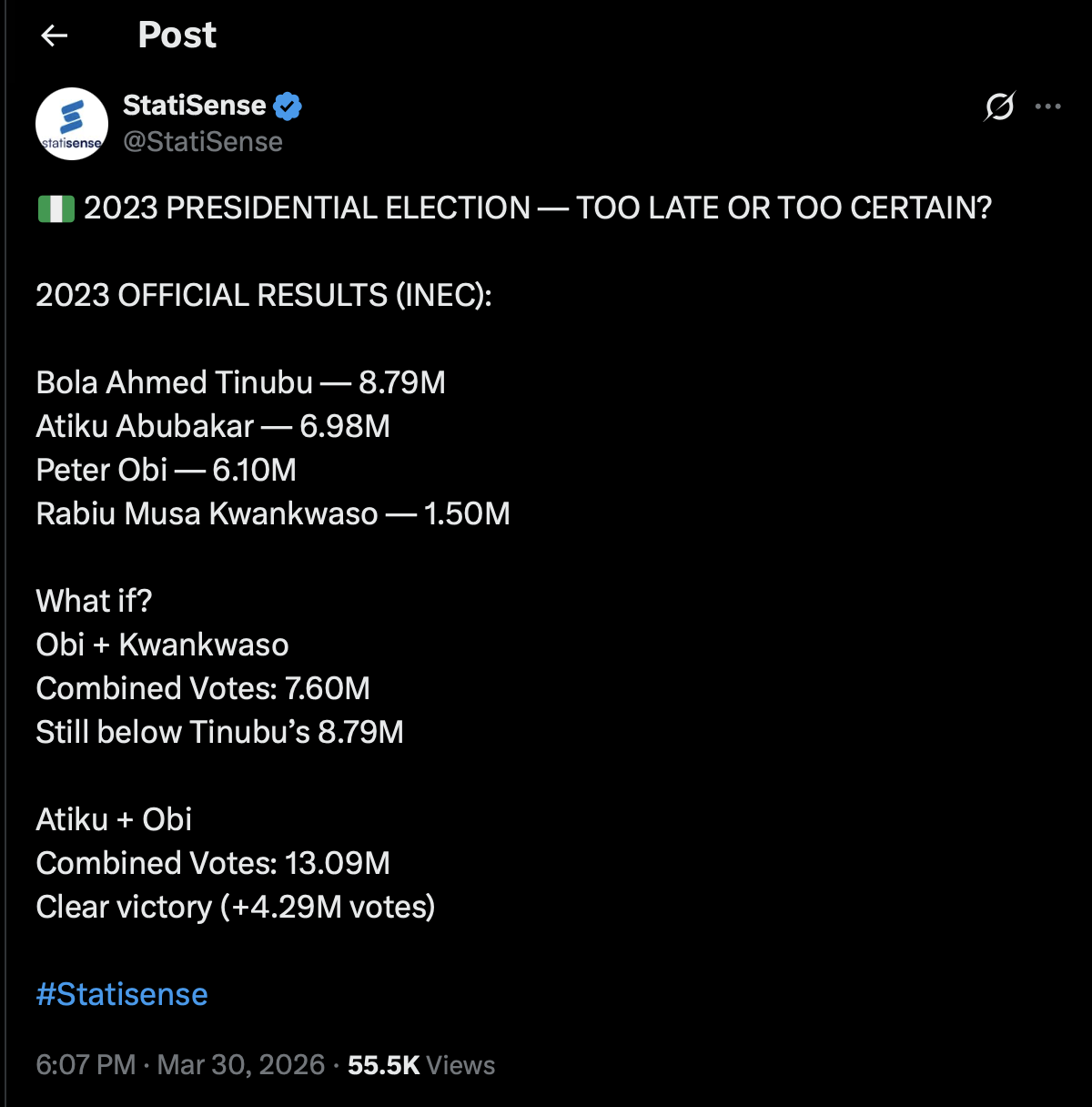
“Atiku + Obi Combined Votes Will Lead To A Clear Victory - Statisense
2023 PRESIDENTIAL ELECTION — TOO LATE OR TOO CERTAIN?
2023 OFFICIAL RESULTS (INEC):
Bola Ahmed Tinubu — 8.79M
Atiku Abubakar — 6.98M
Peter Obi — 6.10M
Rabiu Musa Kwankwaso — 1.50M
What if?
Obi + Kwankwaso
Combined Votes: 7.60M
Still below Tinubu’s 8.79M
Atiku + Obi
Combined Votes: 13.09M
Clear victory (+4.29M votes)”
A Look at the Numbers
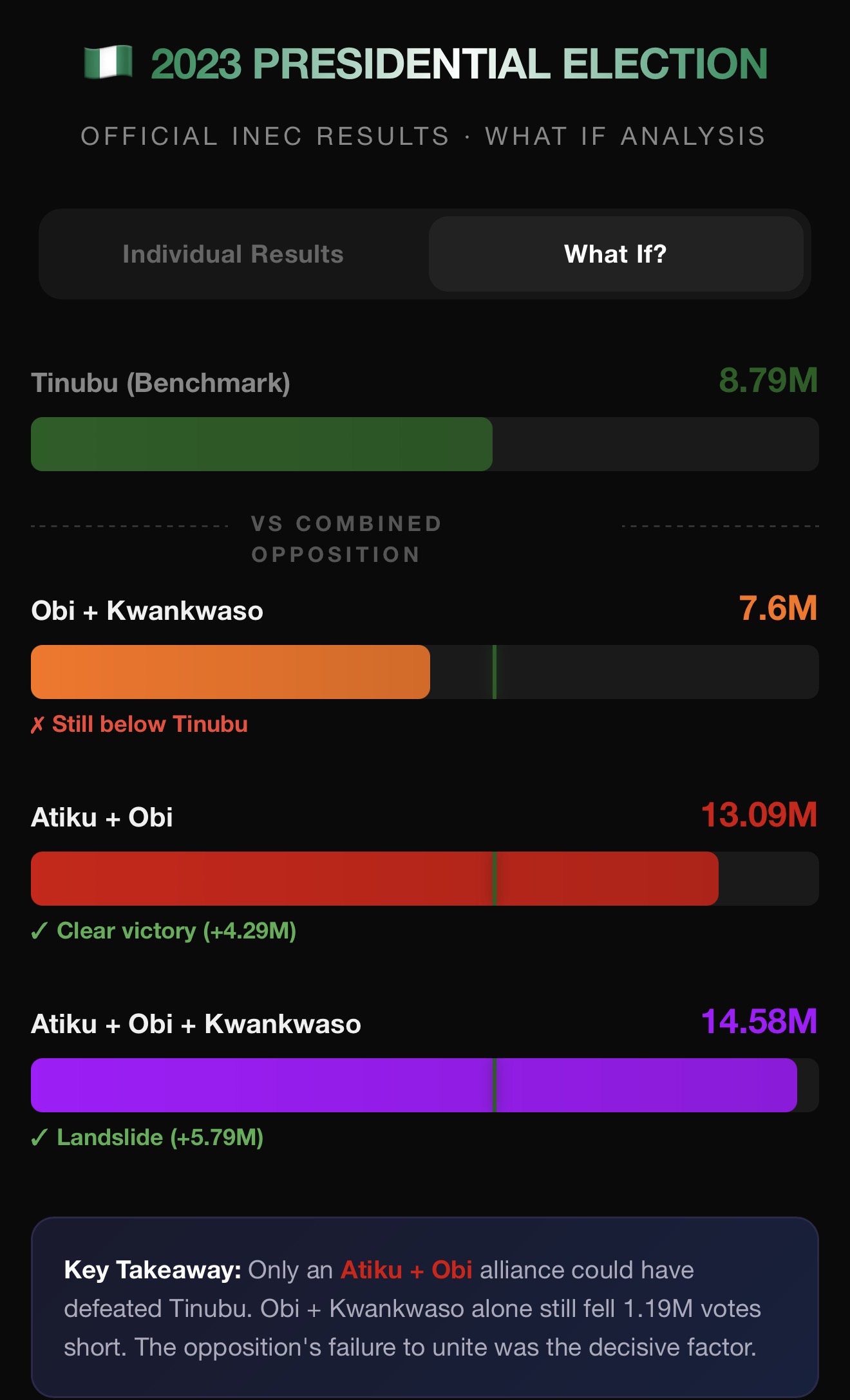
According to official results released by Independent National Electoral Commission (INEC), Bola Ahmed Tinubu secured victory with 8.79 million votes. His closest rivals, Atiku Abubakar and Peter Obi, garnered 6.98 million and 6.10 million votes respectively, while Rabiu Musa Kwankwaso trailed with 1.50 million votes.
Individually, none of the opposition candidates surpassed Tinubu. However, when the numbers are hypothetically combined, a different picture emerges.
The “What If” Scenario
The data suggests that a potential alliance between Atiku and Obi could have produced a total of 13.09 million votes—far exceeding Tinubu’s tally by over 4 million votes. On the other hand, a merger between Obi and Kwankwaso would still fall short, reaching only 7.60 million votes.
This raises a key question: was the opposition’s fragmentation the deciding factor in the election outcome?
Politics Beyond Numbers
While the arithmetic appears straightforward, elections are rarely just about numbers. Voter loyalty, regional dynamics, party structures, and campaign strategies all play crucial roles. Combining vote counts assumes a perfect transfer of voter support—something that is often unrealistic in practice.
Supporters of different candidates may not necessarily align ideologically or politically, even if their leaders form an alliance. In Nigeria’s complex political landscape, such mergers can sometimes lead to voter apathy rather than consolidation.
Lessons for the Future
The 2023 election offers a clear takeaway: unity within opposition parties could significantly reshape electoral outcomes. Whether political actors choose to act on this insight remains to be seen.
As Nigeria looks ahead to future elections, the conversation is no longer just about who runs—but who runs together.
0
0