
Kaothaj_
3 months ago
In Naija politics, the universe has a sense of humour.
It is not always funny. Sometimes it is the kind of humour that makes you wince. The kind that identifies the exact thing a man said he would never do and then arranges for him to need to do it at the worst possible moment.
Peter Obi said, on the night he joined the Nigeria Democratic Congress, that he did not want court cases. He said it clearly. He said it publicly. He said it as a direct explanation of why he was leaving the ADC and joining the NDC.
"We don't want court cases here. That's for lawyers."
That was May 2026.
This is June 29, 2026.
And the only thing standing between Peter Obi and complete electoral oblivion is a stay of execution that his lawyers are filing in court.
For court cases.
For lawyers.
The universe delivered this punchline in under sixty days. Without even being asked.
The Full Journey: A Tribute to Nigerian Democracy's Most Travelled Passenger
Let us do what any good satirist must do before the final punchline. Let us document the journey properly so that future political historians have an accurate record.
Station One: APGA.
Obi made a promise to the Ikemba on his deathbed. Ojukwu was dying. Obi was present. In Igbo political culture, a promise made at a dying man's bedside is not casual conversation. It is a covenant. Obi told the Ikemba he would never leave APGA.
He left APGA.
Station Two: PDP.
He joined the Peoples Democratic Party citing his principles. He attended the presidential primary process. He observed what he described as transactional conduct. He departed.
Station Three: Labour Party.
He built the most energised political movement Nigeria's Fourth Republic had produced. He came third in 2023 with 6.1 million votes on a party that had no governors, no senatorial structure, and no federal machinery. The Obidient wave was real, documented, and genuinely historic.
Then the party had internal problems. He left.
Babachir Lawal's description of Obi's ADC membership is worth repeating here: "Peter Obi joined the coalition after it had all begun for quite a long time. He had always been somebody that is very shifty when it came to ADC. We never felt his heart was in it."
Station Four: ADC.
He joined. He wanted the presidential ticket. The primary was heading toward Atiku. He cited toxic environment, transactional processes, and general crisis. He left.
Station Five: NDC.
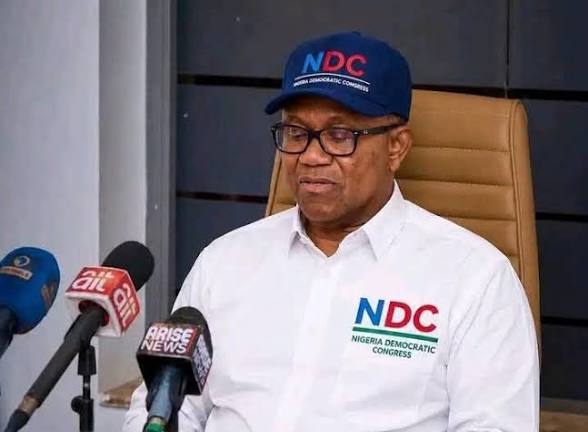
He arrived on the evening of May 3, 2026, at Senator Seriake Dickson's Guzape residence in Abuja at exactly 5:18pm, wearing an all-black kaftan. His supporters chanted "O-K is okay" outside the gate. He collected his membership card alongside Kwankwaso. He made his statement about courts.
He said: "We don't want court cases here. That's for lawyers."
That sentence is now the most ironic statement in the 2026 political calendar.
Station Six: To be announced.
The Logo That Killed a Party
Here is where the satire meets genuine tragedy, because what happened to the NDC is as absurd as it is devastating.
Justice Isa H. Dashen of the Federal High Court Lokoja Judicial Division set aside the December 10, 2025 judgment that had directed INEC to register the NDC as a political party. The reason was straightforward and brutal: the Peace Movement Party, which claimed ownership of the logo used by the NDC, was not joined as a party in the original suit that produced the registration order.
A logo.
Not a constitutional violation. Not a fraudulent registration process. Not a criminal conspiracy against democracy.
A logo that belonged to another party. The PMP. The Peace Movement Party. A party most Nigerians could not identify in a lineup.
The NDC was registered in December 2025 on a court order. That court order is now nullified because the party whose logo the NDC used was not invited to the original hearing. The PMP was not given the opportunity to defend their intellectual property in court. Therefore the court that produced the registration order did so without hearing from all affected parties.
Procedurally correct. Politically catastrophic.
Peter Obi joined a party whose entire legal existence rested on a December 2025 court order that has now been nullified by a June 2026 court order from the same judicial system he said he did not want anything to do with.
The NDC's National Publicity Secretary Osa Director confirmed that the party approached INEC for the access code to upload candidates and was told: "They will get back to us."
They will get back to us. From INEC. To Peter Obi's party. On the day access codes were supposed to be released.
This is the same INEC that Wike told his NEC members to stop worrying about. The same INEC whose chairman Professor Joash Amupitan the Ibadan Declaration demanded should not conduct the 2027 elections. The same INEC that gave Wike's PDP faction the access code while telling NDC they would get back to them.
They will get back to you, Peter.
"No Court Cases" and the 60-Day Irony
Let us revisit the exact circumstances of Obi's NDC statement about courts. Because the context makes the irony more perfect.
He had just left the ADC. The ADC was drowning in court cases. The David Mark faction versus Nafiu Bala. The three factions. The Supreme Court reserved judgment. The Federal High Court injunctions. The INEC portal removals.
Obi walked out of that litigation labyrinth and into Dickson's living room and said: courts are for lawyers. We want peace. We want to build.
It was a beautiful statement. It resonated because every Nigerian who had watched the ADC's court drama unfold knew exactly what he meant.
The NDC, by contrast, had been registered on a December 2025 court order. Clean. Simple. No factions. No rival chairmen. No Nafiu Bala figure lurking in an Abuja hotel.
Except the PMP was waiting quietly with a logo ownership claim and a lawyer.
The NDC's Osa Director said: "We will go back there by tomorrow. I believe by tomorrow we must have filed a stay of execution in court."
A stay of execution. In court. Filed by lawyers.
For a man who said courts are for lawyers.
In Naija politics, the distance between a political statement and its satirical fulfilment is usually measured in months. Obi achieved it in weeks.
What This Means For the Obidient Movement
The Obidients have been through five political addresses with their candidate. They followed him from APGA to PDP to LP to ADC to NDC. They defended each departure. They trusted each explanation. They chanted "O-K is okay" outside Dickson's gate in Guzape.
Now the party is legally deregistered by a court. INEC is withholding the access code. Obi's lawyers are racing to file a stay of execution. And the presidential candidate who told the Nigerian electorate he would not leave if elected with a gun to his head is, by the logic of his own pattern, in the market for Ship Number Six.
The Obidients deserve credit for loyalty that most political movements cannot sustain across one party, let alone five. But loyalty without strategic pressure on a candidate to stay and fight is not a political movement.
It is a travelling fan club.
And the question the Obidient leadership must now answer publicly, with a microphone and cameras rolling, is this.
If the NDC's stay of execution fails. If INEC deregisters the party. If the logo lawsuit ends badly. If Peter Obi calls a press conference in July 2026 and says he has been forced to seek a new platform due to circumstances beyond his control.
Will they follow him to Ship Number Six?
Or will they finally demand that the man asking to be Commander-in-Chief of a nation facing bandits, terrorists, collapsing infrastructure and economic collapse demonstrates, at minimum, the institutional courage to stay in one party long enough to see a lawsuit through to the end?
The Final Question
In Naija politics, this story contains two possible outcomes.
In the first outcome, the NDC's lawyers file the stay of execution today. A judge grants it before INEC formally deregisters the party. INEC pauses. The NDC continues operations. Obi and Kwankwaso remain on a recognised platform. The 2027 campaign continues with the O-K ticket intact.
If that happens, Obi will have survived his most immediate crisis by doing the exact thing he said he did not want to do. Using courts. Using lawyers. And the irony will be noted but forgiven because the result is survival.
In the second outcome, the stay of execution is denied. INEC deregisters the NDC. Obi is politically homeless for the sixth time in eight years. The O-K ticket is dissolved. Kwankwaso's VP concession, which required genuine ego sacrifice, is rendered pointless by circumstances neither of them controlled.
And then Peter Obi must choose.
Does he stay and rebuild from a deregistered party's legal wreckage while the January 14, 2027 presidential election clock ticks?
Does he negotiate a return to a party with an existing platform?
Or does he do what the pattern says he always does when the room becomes too legally complicated?
The man who said "with a gun to my head" about the presidential tenure has his gun moment.
Not about leaving office.
About finding the courage to stay in a platform when the platform is on fire.
In Naija politics, we have seen the answer to this question four times already.
The fifth answer is being written today.
We will see if it rhymes with the previous four.
What do you think? Has the NDC deregistration order effectively ended Peter Obi's 2027 presidential ambitions, or can a successful stay of execution restore his platform before INEC formally deregisters the party? And if Obi is forced to seek yet another party, will the Obidient movement follow him one more time or has the loyalty finally reached its limit? Drop your thoughts in the comments section. Today is June 29, 2026. Naija politics just delivered its most ironic chapter yet and the punchline arrived exactly sixty days after the setup.
0
61