

Kaothaj_
4 months ago
In Naija politics, there are wake-up calls and there are alarm bells.
What happened on Saturday May 23, 2026, across 8,809 wards in thirty-six states and the FCT, was not a wake-up call.
It was a foghorn.
President Bola Ahmed Tinubu walked into the APC presidential primary and collected 10,999,162 votes. His only challenger, Stanley Osifo, an Edo businessman who purchased a N100 million nomination form and vowed he would give the president a fight, received 16,504 votes nationally.
Sixteen thousand, five hundred and four votes. Across the entire country.
In Edo State, Osifo's own home state, Tinubu polled 131,096 votes. Osifo received one vote. One. In his own state. Possibly from himself.
That is not a primary result. That is a political obituary delivered to the entire Nigerian opposition on a single Saturday afternoon.
And the opposition better read it carefully. Because Naija politics has just served them a number they cannot explain away, cannot dismiss as propaganda, and cannot prepare for by holding summits in Ibadan.
The Numbers That Should Keep Every Opposition Strategist Awake Tonight
Let us go through what actually happened on May 23, state by state, because the individual figures are more devastating than the national total.
The APC has 12,643,306 registered voters. For the primary, 11,069,756 were accredited. 11,015,000 cast valid votes.
Tinubu polled 10,999,162 votes. Osifo polled 16,504 votes across the entire federation.
The accreditation figure alone, 11 million, is already more than Tinubu's entire 2023 general election tally of 8.79 million.
Now read the state numbers.
Borno: Tinubu 414,988, Osifo zero. Kwara: Tinubu 310,990, Osifo zero. Enugu: Tinubu 383,382, Osifo zero. Kebbi: Tinubu 292,972, Osifo zero. Ondo: Tinubu 181,996, Osifo zero. Yobe: Tinubu 253,804, Osifo zero. Rivers: Tinubu 280,468, Osifo zero. Akwa Ibom: Tinubu 389,197, Osifo zero. Imo: Tinubu 582,960, Osifo 103. Benue: Tinubu 374,787, Osifo 779.
In Edo, his home state, Osifo polled one vote in Ovia North East and zero everywhere else. In Oredo LGA alone, Tinubu polled 9,177. In Ikpoba-Okha, 13,147. In Egor, 10,074.
Osifo's highest tallies nationally came from Niger State where he got 5,248, Kano where he got 2,675, Bauchi where he got 2,650, and Lagos where he got 1,186.
These were not the numbers of a man running for president against one challenger. These were the numbers of a man running unopposed in a system that mobilised from ward to local government to state to national in a single coordinated exercise.
And the opposition should note something specific about those Osifo numbers.
The highest votes Osifo got were in Niger, Kano, and Bauchi. The North. Where Tinubu is theoretically most vulnerable. Where the ADC coalition believed its strongest argument resided. Where Atiku's structure and Kwankwaso's movement were supposed to be most threatening to the incumbent.
Even in the North, where opposition voices have been loudest about Tinubu's vulnerability, Osifo barely scraped together thousands in states where the APC has hundreds of thousands of registered members.
That is not evidence of northern discontent. That is evidence of APC dominance so total that even its own region of theorised weakness produced overwhelming numbers for Tinubu.
Who Is Osifo and Why His Candidacy Matters More Than His Vote Count
Stanley Osifo deserves a paragraph of honest recognition before we continue.
He is an Edo-born businessman. He paid N100 million for his APC presidential nomination form. He was the only challenger in the entire party of twelve million registered members who had the courage or the recklessness to challenge a sitting president on his own party's platform.
Osifo vowed to contest after a planned consensus arrangement collapsed. He was aware that he would not win. He contested anyway. In his post-result statement, he described himself as a strong party man and promised to accept the outcome and remain in the party.
He got 16,504 votes nationally. Not because he ran badly. Because the machine around him was so comprehensively organised in favour of the incumbent that opposition within the party itself had no oxygen to survive.
The lesson from Osifo is not that challengers are fools. The lesson is that thirteen months before the general election, not one of the twelve million APC members in this country could be mobilised in sufficient numbers to make a dent in Tinubu's primary performance.
If the president cannot be challenged inside his own house, what makes the opposition believe they can challenge him from across the road?
The Certificate Ceremony: It Was Never Just About The Ticket
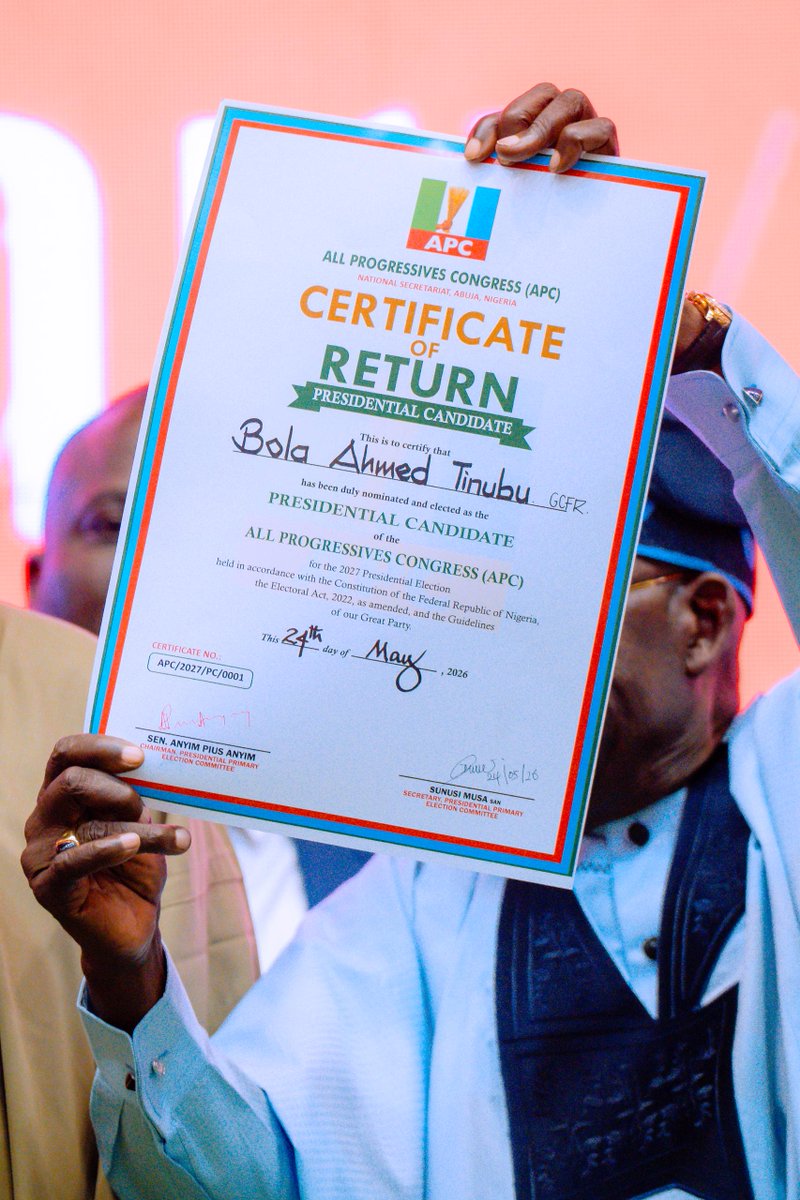
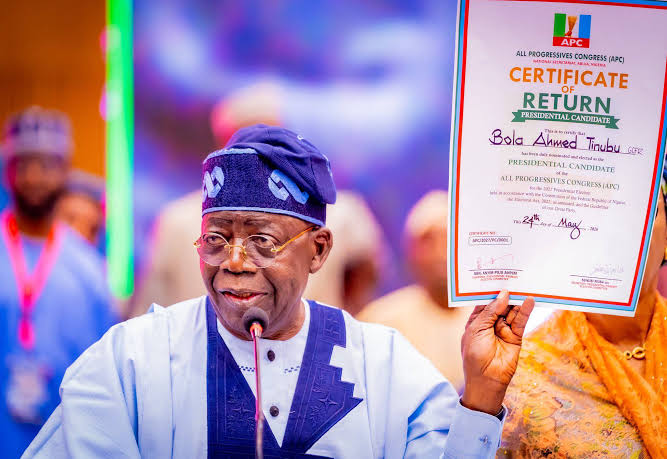
On Sunday May 24, Tinubu received his certificate of return and party flag at the Bola Ahmed Tinubu International Conference Centre in Abuja.
The event was conducted by the Chairman of the APC Presidential Primaries Election Committee, Pius Anyim, who described the exercise as very impressive. The result was read with thirty-six state governors present as collation officers, each having personally presided over the exercise in their respective states.
But anyone who watched the ceremony and thought the party was celebrating a primary result missed the real message being delivered.
The certificate ceremony was a demonstration of structure. Thirty-one governors. Thirty-six state collation officers, all of them governors or their designates. 8,809 wards simultaneously activated. 774 local government areas processing results. An eleven million member turnout in a party primary.
That is not a political party. That is a state apparatus operating with electoral precision.
The opposition watched all of this from wherever they were on Saturday. The ADC was busy clearing presidential aspirants. The NDC was finalising its own primary arrangements. PDP's two factions were both planning to produce separate presidential candidates for the same election.
And Tinubu's party was mobilising eleven million members across every ward in the country.
A Direct Warning To Every Opposition Camp
This section is not analysis. It is arithmetic.
ADC will produce a presidential candidate. Whether it is Atiku or Amaechi or Hayatu-Deen, that candidate must secure enough votes to beat 10.99 million from APC members alone before a single ordinary Nigerian casts a general election vote.
NDC will produce the Obi-Kwankwaso ticket. Their combined 2023 votes were approximately 7.6 million. That was with PDP also splitting the vote. In 2027, if PDP, ADC, NDC and Labour Party all field separate candidates, the opposition vote fractures exactly as it did in 2023. Tinubu wins again, this time with 11 million party members behind him before the campaign even starts.
PDP's two factions, Wike's and Turaki's, cannot both present separate candidates and expect anything other than self-cancellation. If the Supreme Court does not resolve the PDP leadership by the time the primaries conclude, the party will enter 2027 with two sets of candidates across every level, splitting PDP votes at a time when unity is the only argument that makes mathematical sense.
Labour Party produced 6.1 million votes in 2023 on the back of the Obidient movement's unprecedented youth energy. Obi left Labour Party. What remains of that structure without Obi at the top is an organisation considerably smaller than what mobilised in 2023.
Tinubu polled 10.99 million votes in a party primary. In the 2023 general election, he polled 8.79 million across the entire Nigerian voting population.
The APC has grown by over two million registered members since the 2023 election. Its primary turnout was eleven million. Its general election capacity, with undecided voters and independents added, will exceed the primary number.
If the opposition arrives at January 14, 2027, still fragmented across four or five platforms, Tinubu does not need to campaign. He needs to count.
The One Thing The Opposition Can Still Do
Here is the honest answer that every opposition leader needs to hear before their own primaries close this week.
The number 10.99 million is not invincible. It is large. But Nigeria had over 93 million registered voters in 2023. Only 25 million voted. If the opposition can unite, activate the 68 million registered voters who did not show up in 2023, and channel that latent energy behind one candidate on one platform, the mathematics change.
That is the only scenario in which Tinubu's primary numbers become beatable.
One candidate. One platform. One coordinated ground operation matching APC's thirty-one governor machinery with a coalition of youth energy, northern dissatisfaction, economic anger, and southern rotation consensus.
Not ADC running Atiku while NDC runs Obi while PDP runs two candidates from two factions while Labour Party runs a placeholder while NNPP runs Kwankwaso from a distance.
That configuration produces Tinubu's second term before a single general election ballot is cast.
The APC spent Saturday showing the opposition what organised political machinery looks like.
In Naija politics, the correct response to seeing that machinery in motion is not to issue a press release dismissing the primary as internal and irrelevant to the general election.
The correct response is fear. Productive, mobilising, coalition-building fear.
And then the work that follows fear. Before May 30 closes every remaining window.
What do you think? Do the 10.99 million votes Tinubu pulled in his own party primary change your assessment of the opposition's chances in 2027, or does the broader unregistered and uncommitted voter population still give a united opposition a realistic path to Aso Rock? Drop your thoughts in the comments section. Today is May 25, 2026. The opposition has five days to the INEC primaries deadline. Naija politics has never needed a faster conversation than the one that needs to happen right now.

0
48