
Kaothaj_
a month ago
In Naija politics, the path to the presidency is never just about who is the best candidate.
It is about who has the right structure, the right geography, the right coalition, and the right timing.
Sometimes the most qualified person loses because the combination was wrong. Sometimes a deeply flawed candidate wins because the arithmetic aligned perfectly.
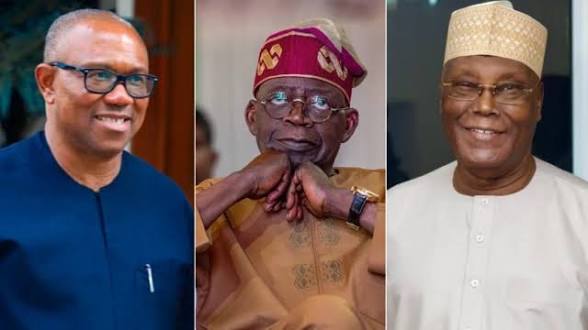
January 16, 2027 is five months away. Three men now dominate the conversation. Bola Ahmed Tinubu. Atiku Abubakar. Peter Obi.
One of them has already answered the combination question. The other two are still arguing about whether they even need to answer it.
Let us go through each path, honestly, without sentiment.
Tinubu: The Man With Everything Except Popularity
Bola Tinubu enters this race with structural advantages no opposition candidate can replicate.
Thirty-one APC governors. Every one of them controls the administrative machinery of their state. Every one of them manages local government chairmen who in turn manage ward executives who in turn manage polling unit supervisors. This is not metaphorical influence. This is the physical apparatus through which results are generated, collated, and submitted to INEC.
His party primary produced 10,999,162 votes from registered APC members. Eleven million people voted in an internal party exercise before the general election campaign has formally opened. That turnout, replicated even at 60 percent in the general election, starts him at 6.5 million votes before a single swing voter or undecided Nigerian makes a decision.
He has federal resources. The N47.9 trillion 2026 budget flows through ministries, departments, and agencies whose heads serve at his pleasure. Infrastructure commissionings continue. Welfare programmes, however imperfect, bear his name. The GenCo debt was settled. The Cardoso monetary reforms are delivering documented results with inflation falling from over 33 percent to 15.69 percent.
The Presidency has built its defence around a very specific point: the savings from subsidy removal have been real, the CBN's interest rate discipline has brought inflation down, and the structural pain of 2023 to 2024 is transitioning into stabilisation.
The weaknesses are equally real. World Bank data suggests 79 percent of Nigerians face poverty. Petrol remains above N1,400 per litre. The PFIPC ghost agency scandal, even after ICPC's partial vindication, leaves institutional questions unanswered.
But for Tinubu, the structural calculation is simple. He does not need to win a popularity contest. He needs to get more votes than either opponent. In a three-way race where both opposition candidates insist on running separately, he does not need a majority. He needs a plurality.
He had 36 percent in 2023. That was enough.
Atiku: The Northern Structure Without the Southern Votes
Atiku's ADC primary produced 1,846,370 votes, with near-total mobilisation in states like Sokoto where 68,823 of 69,871 registered voters cast ballots.
The northern political network that backs Atiku is not symbolic. El-Rufai, Malami, Tambuwal, and the men who built APC's northern machinery in 2015 are now on the other side. They know how northern votes move. They know which calls to make and which relationships to activate.
His subsidy restoration promise, whatever its economic problems, lands in northern Nigeria as a direct acknowledgement of real pain. The northern voter filling his motorcycle tank every morning at N1,400 per litre does not need an economics lecture. He needs a candidate who says: I see the problem and I will fix it.
Atiku says that. With a name and a face the North knows after seven presidential campaigns.
The problem is not the North.
The problem is every geopolitical zone south of it.
Wike delivered the sharpest summary of the South-South problem: "Amaechi was governor and could not deliver for Buhari. He was a Grade A minister and still could not secure 25 per cent for Buhari in Rivers State."
The South-East has Peter Obi running on NDC. Every Igbo vote Obi gets from that zone is a vote Atiku cannot count. And the South-East gave Obi 3.1 million votes in 2023 before his NDC even existed as a party.
The Middle Belt, historically competitive, has been alienated by Amaechi's Sultan comment. A VP who tells an audience that Christians are persecuted while Muslims enjoy government protection does not help a presidential candidate who needs Middle Belt Christians to trust the ticket.
Both Atiku and Obi camps have now formally rejected G-100's call for a single opposition candidate. Atiku's team said the former vice president has moved past coalition talks and is already presenting policy alternatives. Translation: we are running alone.
Running alone means the 2023 arithmetic repeats. Atiku's northern votes plus whatever he can generate in the South is less than Tinubu's APC structure plus 31 governors. That calculation has been done. The 2023 result is the answer.
Obi: The Energy Without the Engine
Peter Obi is the most genuinely difficult candidate to assess in this race because his two most important attributes point in opposite directions.
His first attribute: the Obidient movement. Urban, educated, digitally organised, ideologically motivated, genuinely angry about Nigeria's failures. In 2023, this movement generated 6.1 million votes on a party with no governors, no federal infrastructure, and no traditional ward-level machinery. That is the most impressive electoral performance from a zero-resource base in Nigerian political history.
His second attribute: the NDC. A party registered in late 2025. Deregistered by a Kogi court. Reinstated by the Court of Appeal. Without governors. Without senators who ran on its platform. Without the polling unit infrastructure that translates campaign energy into election-day results.
The NDC's position on the single candidate debate was direct. The party backs Obi as the strongest opposition candidate and argues that a single ticket is not the only path to defeating the ruling APC. It believes Obi leading a coalition is the right formation.
Obi leading a coalition. Not joining one. Leading.
That position tells you everything about why the G-100 summit on August 31 will produce more declarations than decisions. Obi will not subordinate to Atiku. Atiku will not subordinate to Obi. And the mathematical consequence of both men running is a repeat of 2023 with more parties on the ballot.
TheCable posed the question directly: can leading opposition figures subordinate personal and partisan ambition to a larger national interest and agree on an arrangement capable of producing competent, credible and unifying leadership?
The answer, based on everything that has happened from the Ibadan Declaration to the G-100 rejection, is no.
Obi's path to Aso Rock exists only under specific conditions. That the Obidient energy from 2023 fully transfers to NDC. That Kwankwaso's Kano network, despite the defection of Gaya and Hanga, delivers the North-West at competitive levels. That Dickson's South-South connections bring Ijaw votes home. That the South-East consolidates entirely behind the Igbo candidate argument.
Even with all of those conditions met, the NDC without governors faces the collation challenge. At 2am when results are being entered into the system, the party with 31 governors has 31 sets of officials watching every LGA collation. NDC has candidates hoping INEC's servers are honest.
That is not cynicism. That is the operational reality of Nigerian elections.
The Osun Lesson: What The Numbers Actually Say
The August 15 Osun result provided the clearest data point for this three-way assessment.
Adeleke won with 511,067 votes using Accord Party machinery, endorsement from PDP, Labour Party support, and APC internal defectors. He defeated a candidate backed by the full weight of federal APC machinery, Oyetola's ministerial influence, the Oyinlola endorsement, and a national chairman's Trailer confidence.
But two things came from Osun that the opposition immediately stopped talking about.
First: Adeleke's victory speech endorsed Tinubu for 2027. Half a million Osun votes are going to the incumbent, delivered by the man the opposition just celebrated.
Second: ADC scored 17,180 votes. Fewer than the cancelled ballots. In a state where Atiku personally campaigned.
The APC attributed its Osun loss partly to internal structural issues and Oyetola's political capital being deployed through the wrong network configuration rather than as evidence of a fundamental shift in APC's national electoral position.
The APC lost Osun. The APC learned from losing Osun. The APC with its 31 governors and national structure absorbs one state loss. It does not collapse.
The Honest Final Assessment
In Naija politics, presidential elections are not opinion polls. They are not Twitter trending topics. They are not the sum of endorsements from party chairmen at luncheons.
They are the sum of votes cast at polling units managed by party agents across 176,846 polling units in 774 local governments in 36 states and the FCT.
On that measure, today, August 24, 2026:
Tinubu has the strongest path to Aso Rock. His structure is present at every level. His financial advantage is real. His incumbency allows him to time announcements, commissionings, and policy acts to electoral cycles. And the opposition is doing his campaign work for him by refusing to unite.
Atiku has the most credible opposition path but only if something changes between now and January 16. That something is a coalition agreement that puts northern structure behind one candidate. Without it, he is running 2023 again on a slightly different platform.
Obi has the most compelling public narrative and the least structural support for converting that narrative into polling unit outcomes. His path requires NDC to build in five months what APC built in ten years. That is not impossible. It has simply never been done in Nigerian electoral history.
The August 31 opposition summit is the last realistic opportunity for any of these paths to change.
If Atiku and Obi walk out of August 31 on separate platforms, Tinubu wins January 16.
Not because he deserves it. Because he prepared for it.
And in Naija politics, preparation is the campaign.
What do you think? Is there any realistic scenario in which Atiku or Obi defeats Tinubu running separately, or has the 2027 election already been decided by the opposition's refusal to consolidate? And with August 31's summit approaching, do you believe any of the major opposition figures have the ego discipline required to step aside for the greater good? Drop your thoughts in the comments. Today is August 24, 2026. This is Naija politics and the most consequential five months in Nigeria's recent political history start right now.
2
17