Kaothaj_
5 months ago
In Naija politics, the loudest man in the room is rarely the most dangerous.
The dangerous one is the man in the corner who is quietly building something. The one who understands that in Nigerian politics, a presidential ambition is not announced. It is constructed, brick by brick, budget by budget, project by project, until the question answers itself.
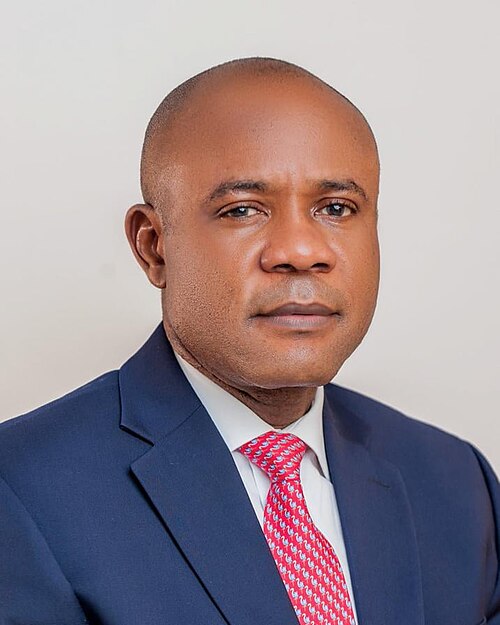
Meet Dr. Peter Ndubuisi Mbah. Born March 17, 1972 in Owo, Nkanu East Local Government Area, Enugu State. Maritime lawyer. Financial analyst. Oil and gas entrepreneur. Former Commissioner for Finance. Current Governor of Enugu State.
And perhaps the most carefully positioning political figure to emerge from the South-East in a generation.
A Foundation Built Long Before He Became Governor
Mbah is not a man who stumbled into governance. He prepared for it the way successful CEOs prepare for a boardroom takeover.
He studied law at the University of East London. He earned a Master's degree in Maritime and Commercial Law from Lagos State University. He holds an MBA from IESE Business School, University of Navarra in Barcelona. He has a Postgraduate Diploma in Strategy and Innovation from the Said Business School, University of Oxford. He is an alumnus of the Chief Executive Programme of the Lagos Business School.
Then he built a business empire. He founded Pinnacle Oil and Gas Limited, a firm he grew from scratch into a multi-billion-dollar leader of Nigeria's petroleum downstream sector. He founded GILPEL Industries Limited. He established FOCUS International Schools in Lagos.
When Governor Chimaroke Nnamani appointed him Chief of Staff in 2003 and subsequently as Commissioner for Finance and Economic Development, Mbah did not enter government as a politician seeking position. He entered as a technocrat who already understood balance sheets, strategy, and revenue generation.
He chaired the Federal Accounts Allocation Committee's Sub-Committee on Legal Matters. He chaired the Board of Directors for the Enugu State Insurance Company. He chaired the Board of Directors for the Enugu State Finance and Investment Company. He chaired the Enugu State Tenders' Board.
That is not a politician's resume. That is a CEO's resume wearing a politician's suit.
In Naija politics, that combination is rare. And when it arrives in the governorship seat of a state, it produces results that are difficult to ignore.
The Numbers That Silence Sceptics
When Mbah presented his governorship manifesto at Godfrey Okoye University in October 2022, political analysts and even some of his own campaign team quietly wondered if their candidate was overpromising.
He said he would grow Enugu's GDP from $4.4 billion to $30 billion in four to eight years. He said he would reduce the state's poverty index from 58 percent to zero. He said he would restore public water to Enugu city in 180 days. He said he would build 10,000 kilometres of roads in four to eight years.
They called it a typographical error.
Then he arrived in office on May 29, 2023, and produced numbers that forced those sceptics to sit down.
Enugu State's Internally Generated Revenue stood at N26.8 billion in 2022. By 2023, it had risen to N37.4 billion. In 2024, it hit N180.5 billion. In 2025, the figure reached N406.77 billion.
Let that absorb.
N26.8 billion to N406.77 billion. In three years. Without raising tax rates.
He did it by deploying technology, e-payment systems, plugging revenue leakages, and widening the tax net rather than deepening it. The state is now targeting N870 billion in IGR for 2026.
Before his administration, Enugu State's total budget hovered around N100 billion to N120 billion with capital expenditure of about N30 billion, representing 25 to 35 percent of the budget. In his first full year budget of 2024, a record N521.5 billion, he devoted N414.3 billion, 79 percent of the budget, to capital expenditure and only N107.2 billion, 21 percent, to recurrent expenditure.
In 2025, he pushed the budget to N971 billion with 86 percent allocated to capital expenditure and only 14 percent to recurrent expenditure.
His 2026 budget is N1.62 trillion, already a historic figure for Enugu State. Capital expenditure gets N1.296 trillion. That is 80 percent of the budget going to building things.
These are not political performance statistics. These are private sector metrics applied to public governance.
The Smart Schools: Where UNESCO Took Notice
In Naija politics, when a state governor's education programme attracts the United Nations, something genuinely extraordinary is happening.
Mbah launched the Smart Green Schools initiative, an ambitious plan to construct 260 fully equipped, technology-driven schools across all 260 political wards in Enugu State. Each Smart Green School is built for experiential learning, teaching children as young as four years old subjects including robotics, artificial intelligence, augmented reality, mechatronics, and modern ICT.
Thirty of the Smart Green Schools were already completed by December 2024 and commissioned by President Bola Tinubu during his official visit to Enugu in January 2025.
Education has received no less than 33 percent of Enugu's budget every year under Mbah, consistently exceeding UNESCO's recommended 26 percent benchmark. In 2026, the allocation stands at 32.27 percent, representing N521 billion dedicated exclusively to education from a single state budget.
UNESCO's response was a formal visit. The Head of the UNESCO Office and Representative in Nigeria, Jean-Paul Ngome Abiaga, led a high-level delegation to Government House in Enugu, describing the Smart Schools initiative as transformative and forward-looking. UNESCO pledged strategic partnership with the state in teacher training, digital education development, and cultural renaissance of Igbo heritage.
UNESCO, in partnership with the European Union, is already implementing a $5 million education support programme in six Nigerian states, including Enugu, and plans to train no fewer than 2,183 teachers in ICT and digital pedagogy aligned with the Smart Schools framework.
When the UN comes to your state not to give aid, but to request partnership, you are doing something that goes beyond ordinary governance.
Mbah also commenced construction of eight Science, Technical, and Vocational schools across Enugu's eight federal constituencies, focusing on emerging technology, robotics, mechatronics, building and architecture, and industrial agriculture. The pilot Government Technical College in Enugu, rebuilt from scratch after its dilapidated colonial-era infrastructure was demolished, was commissioned by the First Lady of Nigeria, Senator Oluremi Tinubu, on June 9, 2025.
On Healthcare: One Centre in Every Single Ward
This is the project that separates Peter Mbah from every governor who came before him in Enugu. Not just in the South-East. In Nigeria.
He looked at the national average maternal mortality rate of 512 deaths per every 100,000 live births. He looked at infant mortality. He looked at under-five mortality. He looked at 557 primary healthcare centres across the state, most of them dilapidated, understaffed, without electricity, without running water, without equipment that worked.
And he decided that the entire approach was wrong.
Rather than spread resources thinly across 557 existing PHCs, his strategy was to consolidate and develop 260 world-class Type-2 Primary Healthcare Centres across all 260 electoral wards, because the administration wanted to provide 24-hour services in each facility so that at any time, in any rural community across the state, citizens would have access to quality primary healthcare.
One centre. One ward. No exceptions.
Each Type-2 PHC has 24-hour electricity sustainably powered by renewable energy, staff quarters to ensure healthcare officers are readily available without delay, and access to water, sanitation, and hygiene.
He did not just build structures. He staffed them. His administration recruited 2,500 health workers to address identified personnel deficits and sustained training and capacity building programmes to sharpen existing staff competences. Salaries are paid promptly and consistently, which the Medical and Health Workers Union of Nigeria described as exceptional governance in the Nigerian reality.
The results came quickly and they are documented.
In 2024, Enugu witnessed a dramatic turnaround of over 400 percent drop in maternal mortality, a decline that speaks volumes about the efficacy of the administration's interventions.
A PHC at Otukwu community in Emene opened three weeks after completion and had already registered 140 residents. Two babies were born there in that first month, and their parents named them Peter and Ndubuisi in honour of the governor.
That is not a statistics report. That is a community telling its governor something in the most direct language available to them.
Mbah recently approved N4 billion to equip an additional 100 primary healthcare centres, taking the number of fully operational PHCs toward 200, with the target of all 260 being fully operational before the end of May 2026.
And the healthcare vision does not stop at the primary level. He is simultaneously revamping 22 cottage and general hospitals, upgrading some cottage hospitals to general hospital status, transforming the Enugu State University Teaching Hospital at Park Lane, and building the nearly completed 300-bed Enugu International Hospital designed to deliver world-class specialist services in oncology, cardiology, nephrology, neurosurgery, and transplant medicine.
When commissioned, the Enugu International Hospital will not only slash outbound medical tourism but position Enugu as a regional hub for specialised medicine, attracting patients, specialists, and investment from across West Africa.
Nigeria currently loses over $1 billion annually to medical tourism, mostly to India, the UK, and Germany. Mbah is building the infrastructure to keep that money at home. In Enugu.
The World Health Organization's South-East Zonal Coordinator personally visited a PHC site and publicly commended the governor for showing all-inclusive leadership in the health space that touches lives in the remotest parts of the state.
When the WHO and UNESCO are both visiting your state in the same month, both to commend and collaborate, you are no longer governing like a Nigerian state. You are governing like a country.
Everything Else He Has Built
The education and healthcare stories would be enough for one administration. But Mbah appears to be running several administrations simultaneously.
On roads, his Zero Pothole Initiative has systematically targeted urban roads across Enugu metropolis, with hundreds of residential layouts that had been abandoned by successive governments now receiving asphalt roads with quality drainage systems. Over 2,000 projects across all 260 wards are at various stages of completion or already delivered.
On security, Mbah launched the Distress Response Squad and built arguably the most extensive CCTV camera network in Nigeria, using AI-enabled cameras to cover all areas of the state, complemented by a world-class command and control centre from where officials monitor all parts of the state and track criminal elements to facilitate arrest and prosecution. He banned the Monday sit-at-home order effective June 5, 2023, and the non-state actors threatening to punish the state have been unable to enforce it since.
On transport, he launched Enugu Air as a state-backed aviation initiative with three aircraft in July 2025, now grown to six planes with a target of 20 aircraft. He commissioned five ultra-modern bus terminals, deployed 100 CNG buses, and is rolling out 2,000 electric vehicles under the Enugu Smart Transport Programme.
On technology, his administration built the Enugu Geographic Information System, ENGIS, which reduced the processing time for land title documents from months to just 48 hours. The state won the Award of Excellence in Geographic Information Service at the 2025 Nigerian GovTech Awards. He sealed a partnership with Haier Group, the world's largest appliance manufacturer, for a $20 million technology investment for local manufacturing through the Enugu Haier Factory.
On investment, the state attracted a N100 billion deal with Pragmatic Palms Limited for the revival of Enugu United Palm Products Limited, a N40 billion deal with Jelfah Group for the revitalisation of Sunrise Flour Mills, and a partnership with Danish company ODK Tractors targeting the assembly of 1,200 tractors in Enugu to support his 260 Smart Farm Estates initiative.
He also launched the New Enugu City project, flagged off in October 2024, a nearly 10,000-hectare smart city development designed to host some of the tallest skyscrapers in Africa, featuring residential zones, industrial parks, medical centres, sports arenas, and dedicated power infrastructure.
The APC Move: The Chess Game Everyone Understands
On October 14, 2025, Peter Mbah defected from the PDP to the APC along with a large delegation of Enugu politicians including state and national assembly members and local government officials.
He said it was a move to ensure fairness, respect, and a voice for the South-East in national decisions.
That is the stated reason. The strategic reason is something Naija politics understands perfectly.
The APC has been in power federally since 2015. Tinubu's current term ends in 2027. If the North gets the presidency in 2027, their two terms would theoretically expire somewhere around 2035. The Southern turn, based on the rotation principle that has governed the APC's internal calculations since 2022, would fall in the period after that.
Mbah is 54 years old. He will be in his early to mid-sixties during that window. Young enough. Experienced enough. And if he delivers on his $30 billion GDP target, credentialed enough.
By being inside the APC at that point, he positions himself as the South-East's preferred option within the ruling party's own succession calculus, rather than waiting outside the room to be considered. In Nigerian politics, the candidates who end up holding the ticket are almost always the ones already inside the building when the decision is being made.
It is the same logic Tinubu applied between 2015 and 2023. Inside the party. Building alliances. Delivering. Waiting for the moment.
Why The East Has Not Had It Since Aguiyi-Ironsi
Here is the political reality that sits beneath every South-Eastern conversation about the presidency.
Since the end of the Civil War in 1970, no person of South-Eastern Igbo origin has governed Nigeria at the federal level. The closest the region came was 2023, when Peter Obi's run proved that an Igbo candidate could mobilise a national constituency capable of threatening the established political machines.
But Obi's run was built almost entirely outside the ruling party's infrastructure. It relied on youth energy, social media, and ideological momentum. It did not have the traditional levers of incumbency, financial structure, and party machinery behind it.
Mbah is building something different. He is constructing the case that a South-Eastern governor can deliver measurable governance results that match international standards, attract global institutional partnerships, grow a state economy at private sector speed, and enter the ruling party's internal conversation as a legitimate aspirant rather than an outsider demanding recognition.
That is a different political argument. And in the long game of Naija politics, it is potentially more durable.
The Final Assessment
Peter Mbah is not declaring a presidential run. He is not making speeches about Aso Rock. He is not positioning himself publicly in the 2027 conversation.
He is building roads in Enugu. He is opening schools that teach robotics to six-year-olds. He is putting a healthcare centre in every single ward so that no mother in any village in Enugu has to die because the nearest clinic is too far or too broken. He is attracting UNESCO, the World Health Organization, Danish investors, and the world's largest appliance manufacturer to the Coal City. He is growing his state's IGR from N26.8 billion to N406 billion in three years.
In Naija politics, the man who builds while others talk eventually becomes the man everyone talks about.
The South-East has long been told that its turn is coming. That the rotation principle will eventually land in Igboland. That patience is what is required.
Peter Mbah is not waiting patiently. He is using every month of his governorship to build the argument that when the South-East's moment arrives, there is a man who is ready.
Not just ready with a manifesto. Ready with evidence.
And in Naija politics, evidence is the rarest and most powerful currency of all.
What do you think? Is Peter Mbah's combination of technocratic governance and strategic party positioning making him the South-East's most credible presidential prospect in a generation? And does the fact that WHO and UNESCO are both partnering with Enugu under his watch prove that the region can produce not just a credible candidate, but a world-class executive? Drop your thoughts in the comments. The next chapter in the South-East's presidential story may already be writing itself, quietly, in the streets, wards, schools, and clinics of the Coal City.
0
56