

Kaothaj_
3 months ago
In Naija politics, the most dangerous opposition ticket is never the one that looks the strongest on paper.
It is the one that covers the specific geography of your vulnerability.
Tinubu knows exactly where he is vulnerable. He has been looking at those maps since the night of February 25, 2023, when the results came in and he saw the states he barely survived, the states he lost outright, and the states where his margins were thin enough that a different opposition combination could have erased them entirely.
He has thirty-one governors. He has 10.9 million party members who voted in a primary. He has federal resources and the full machinery of incumbency.
But he does not have the South-South. He does not have the northern Christian bloc. And he does not fully own the North-East or North-West in the way he owned them in 2023 with Buhari's endorsement behind him.
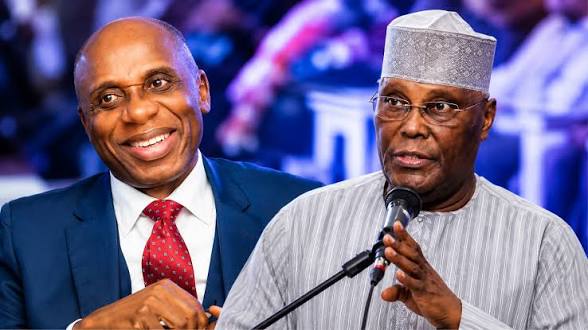
Now, with the Atiku-Amaechi ticket reportedly confirmed and an announcement expected from the ADC imminently, two men who know each of those vulnerabilities personally are standing on the same platform pointing directly at them.
The AA ticket is born. And Tinubu's campaign team needs to stop dismissing the opposition and start reading the electoral map more carefully.
How The Man Who Said He Would Never Play Second Fiddle Finally Played Second Fiddle
Let us acknowledge the backstory because it is too good to skip.
Amaechi obtained his N90 million ADC presidential nomination form. He said, on camera, that nobody had ever told him to be vice president because they knew his worth and what his reaction would be.
He contested the primary. He got 504,117 votes to Atiku's 1,846,370. He called the result concocted. He boycotted the declaration.
He said he would never play second fiddle.
Then Atiku visited him at his residence. Amaechi did not come to the gate.
Then Amaechi visited Atiku at his residence. He came through the gate.
A very close ally of Amaechi, speaking to The Guardian, explained how the change happened: "VP nominee would have extensive roles to play in the campaigns and government." Highly placed political leaders from both the North-West and South-South reportedly applied sustained pressure on Amaechi to accept the offer, arguing that the combination gave the ADC its best chance of threatening Tinubu.
The development was confirmed on Saturday by the immediate past ADC chairman in Rivers State, Leader Sampson, who said Amaechi had accepted the vice-presidential slot.
The man who would never play second fiddle is now in the second seat.
The satirical observation has been made elsewhere in these pages. But the strategic observation deserves its own moment.
Because Amaechi accepting the VP slot, with all the noise and contradiction it contains, is actually the most mature political decision he has made since 2022. He looked at the electoral map. He ran his own numbers. He understood that his best path to national relevance and eventual presidency runs through a credible 2027 campaign as VP. And he swallowed the pride.
That is not weakness. In Naija politics, knowing when to subordinate your ego to strategic reality is the rarest skill available. Most politicians never find it.
Amaechi found it in June 2026. And it may be the most consequential decision of this election cycle.
THE SOUTH-SOUTH CALCULATION: WHERE TINUBU'S REAL PROBLEM BEGINS
Let us go straight to the number that matters most.
In 2023, the South-South geopolitical zone produced the following presidential results:
Tinubu got 1,427,584 votes from the entire South-South region. Peter Obi got 1,127,123. Atiku got 1,177,980.
Tinubu won the South-South narrowly in aggregate, but his margin was paper thin. In Rivers State, he got 280,762 votes to Atiku's 175,467 and Obi's 175,071. Delta gave him 244,966 to Obi's 177,967 and Atiku's 199,559. Bayelsa gave him 105,786.
These are not dominant numbers. These are survival numbers. Numbers that held because the opposition was split three ways.
Now put Rotimi Amaechi on the opposition ticket and ask what changes.
Amaechi's emergence as the likely vice-presidential candidate represents a strategic calculation designed to balance the ticket across Nigeria's geopolitical zones, pairing Atiku from the North-East with Amaechi from the South-South region.
Amaechi governed Rivers State for eight years. He is the most institutionally connected South-South politician not currently in Wike's coalition. His network in Rivers State crosses ethnic lines between Ikwerre, Ogoni, and Ijaw communities in ways that most outsiders do not appreciate. He built roads in communities that had not seen government presence in a generation. He fought the federal government for Rivers State's resources publicly and loudly in ways that the South-South civic pride respects even among those who did not personally like him.
His appeal from the South-South geopolitical zone was central to the calculation that brought him onto the ticket.
If Amaechi's presence on the ticket converts even thirty percent of the South-South votes that went to Obi and Atiku separately in 2023 into a consolidated ADC vote, Tinubu's South-South margins become competitive rather than safe. And if they become competitive, his path to the 270 million electoral votes needed for a first-round victory narrows significantly.
THE NORTH-EAST AND NORTH-WEST: ATIKU'S HOME GROUND WHERE TINUBU IS NOT COMFORTABLE
Beyond the South-South, the northern arithmetic of the AA ticket deserves serious attention.
Atiku is from Adamawa State in the North-East. He polled 319,929 votes in Adamawa in 2023 to Tinubu's 192,820. He won Gombe with 285,949. He won Taraba with 319,929. He won Yobe with 246,611. He lost Borno to Tinubu but kept the margin competitive.
The North-East is Atiku's most reliable territory and it is the same region Tinubu carried partly because of Shettima's structural contribution. With El-Rufai, Malami, and Tambuwal all in the ADC supporting Atiku, the North-East and North-West delegate networks that delivered for APC in 2023 are now being redirected.
Consider what Malami represents. As former Attorney-General of the Federation, his political network in Kebbi and Sokoto is not symbolic. It is operational. He knows which local government chairmen to call. Which emirs listen to which political voice. Which community leaders can be mobilised for a specific outcome.
El-Rufai's Kaduna network is similarly structural. He governed for eight years. He knows where the votes are in Kaduna's complex Christian-Muslim geography better than any man currently alive in Nigerian politics.
Babachir Lawal left the ADC and called Atiku a warlord. But Babachir represents a northern Christian community that is simultaneously uncomfortable with Tinubu's Muslim-Muslim ticket. If the Atiku-Amaechi ticket can position itself as the alternative for northern Christians who want neither the Muslim-Muslim APC ticket nor Obi's NDC, it creates a real third lane in the northern Christian vote.
THE ARGUMENT AGAINST THE AA TICKET: WHERE THE WEAKNESSES LIVE
Honesty requires acknowledging what the Atiku-Amaechi ticket is not.
It is not a fresh face. Atiku is contesting the presidency for the sixth time. Nigerian voters, particularly young Nigerians who constitute a growing majority of the registered voter base, have processed Atiku Abubakar's presidential candidacy across three decades of Nigerian political history. They know his record. They know his cases. They know his family. They know his land. The 6.98 million votes he received in 2023 represent a ceiling, not a foundation, without a structural factor that dramatically expands the coalition.
Amaechi is not a clean brand. The legal proceedings that have followed him since his ministerial tenure, the allegations surrounding the Ministry of Transportation, and the political battles in Rivers State that ended in ways that left bitter feelings, all of these are material that any competent APC campaign team will load and deploy continuously.
No official confirmation has yet been made by either Atiku or Amaechi. Legit.ng reported that neither candidate had publicly commented on the reported agreement as of filing time.
The ticket is not announced. It is reported and sourced. If internal ADC dynamics produce a different outcome, everything written above changes with it.
And the ADC still carries its own structural weight of court cases, factions, and the Nafiu Bala saga that has not yet reached its final judicial chapter. A VP pick does not resolve a pending Federal High Court case.
WHY TINUBU'S TEAM CANNOT DISMISS THIS
Here is what the AA ticket does that no previous opposition combination in this cycle has achieved.
It covers two geopolitical zones, the North-East and the South-South, in a single ticket. It deploys the man with the deepest northern network alongside the man with the deepest South-South institutional connections. It closes the primary dispute inside the ADC, removing the energy-sapping post-primary bitterness that was costing the party momentum. It gives ADC's media handlers a ticket they can actually market rather than a one-man northern candidacy that looks like every previous Atiku run.
Analysts believe the partnership could reshape the dynamics of the 2027 presidential race as opposition parties intensify coalition-building efforts and prepare for what is expected to be a fiercely contested presidential race.
Reshaping dynamics is not the same as winning. But it is the prerequisite for winning.
And reshaping dynamics is exactly what the AA ticket has begun to do in the forty-eight hours since its confirmation leaked.
Tinubu's campaign team will study this carefully. They will run the South-South scenario. They will model the northern Christian bloc. They will assess what Amaechi's Rivers State credibility does to the Wike-Rainbow Coalition dynamic that is already under legal siege from three court rulings.
And at least some of them will acknowledge privately what they will not say publicly.
This is a more dangerous combination than it was last week.
THE FINAL VERDICT
In Naija politics, the last question is always the same. Does the opposition have what it takes to convert its strategic positioning into actual votes at polling units across 774 local governments?
The AA ticket brings the right geography. The North-East and South-South combination is more threatening to Tinubu's 2023 map than anything the opposition has yet assembled.
But tickets win elections with agents. Not analysis.
Every ADC ward in the North needs an agent at the collation table. Every South-South polling unit needs someone present when results are being recorded. Every state needs a legal team ready to go to the tribunal with evidence before the results are announced.
Atiku's structure has those people in the North. Amaechi's network has some of those people in the South-South. Whether the ADC has the financial and operational capacity to deploy them in sufficient density across thirty-six states is the question that a VP announcement, however significant, cannot answer by itself.
But the AA ticket, properly resourced and officially announced, gives Tinubu's team the most concrete reason to update their 2027 threat assessment since the primary results were announced.
And in Naija politics, the last thing any incumbent wants to do fourteen months before an election is update their threat assessment upward.
What do you think? Does the Atiku-Amaechi combination genuinely threaten Tinubu's South-South margins enough to make the 2027 election competitive, or are the structural advantages of thirty-one governors and 10.9 million party primary votes simply too large for any opposition ticket to overcome? Drop your thoughts in the comments section. Today is June 15, 2026. The Naija politics 2027 presidential race just got its most credible opposition combination yet and the countdown to January 14, 2027 is moving faster than anyone expected.
0
66