
Kaothaj_
4 months ago
In Naija politics, the most dangerous thing a candidate can do right now is confuse beating the opposition primary with beating the presidency.
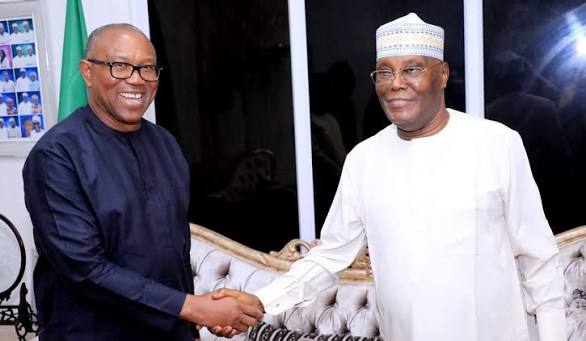
Both Atiku Abubakar and Peter Obi have cleared their respective hurdles. Atiku won the ADC presidential primary on Wednesday at the Transcorp Hilton in Abuja. Obi was confirmed as the NDC's consensus presidential candidate, with Kwankwaso as running mate. Two men. Two parties. Two completely different routes to the same destination.
And one very large number standing between both of them and Aso Rock.
10,999,162.
That is the number Tinubu's party mobilised from its own membership alone on May 23. Before a single ordinary Nigerian voter is counted. Before a single undecided person makes up their mind. Before campaign billboards go up. Before the debates happen.
10.9 million. From party members alone.
Whoever wins this debate does not just need to beat the other. They need to beat that number by enough margin to survive rigging claims, legal challenges, and the structural weight of thirty-one APC governors controlling results at the collation level.
So which of these two men has what it takes?
Let the debate begin. And let us be brutally honest about both sides.
ATIKU'S CASE: THE MAN WHO WON 1.8 MILLION ADC VOTES AND STILL NEEDS TO EXPLAIN HIMSELF
First, let us correct the record on Atiku's primary numbers, because accuracy matters in this debate.
Atiku Abubakar won the ADC presidential primary with a total of 1,846,370 votes, defeating Rotimi Amaechi who came second with 504,117 votes, and Mohammed Hayatu-Deen who secured 177,120 votes. The returning officer, Tunde Ogbeha, declared Atiku the winner after final collation at the Transcorp Hilton in Abuja on Wednesday.
1,846,370 votes. Not 1.3 million. Not 1.39 million. Nearly 1.85 million. From a party that has been fighting court cases, navigating three factions, and operating under INEC portal freezes for the better part of a year.
That is not a small number for a party primary in those conditions. In Sokoto alone, 68,823 votes were cast out of 69,871 registered voters. In Zamfara, 60,500 votes went to Atiku out of 61,137 cast. The northern states where Atiku's network is deepest showed up almost entirely for him.
After his victory, Atiku said: "I therefore appeal to all those who feel aggrieved to come back to our party and close ranks with the rest of us. No one was defeated. No one. We are one party, and we all need to recognise the fierce urgency of the moment."
Now for the honest examination.
The prosecution case against Atiku as opposition standard-bearer is the most documented case in Nigerian political history. He has contested the presidency in 2007, 2011, 2015, 2019, and 2023. In every one of those cycles, he arrived with structure, northern votes, and resources. In every one of those cycles, he fell short of the presidency.
In 2023, contesting directly against Tinubu on PDP's platform, with the full federal structure of Africa's most populous democracy's main opposition party behind him, he got 6.98 million votes. Tinubu got 8.79 million.
Now he is going into 2027 on the ADC platform, a party with ongoing court cases still pending from its internal crisis, with three months until Amaechi's team processes whatever grievance they are nursing post-primary, with the NDC splitting the Obi-Kwankwaso votes away from any unified opposition arithmetic.
The northern argument is Atiku's strongest card and it is genuinely strong.
Tinubu got over 60 percent of his 2023 votes from the North. The same North where Atiku's structure lives. The same North where El-Rufai, Malami, Tambuwal, and Babachir Lawal are in the ADC. The same North where economic pain is most severe and military failures are most visible.
If Atiku can mobilise even 40 percent of the northern vote that swung to Tinubu in 2023, combined with whatever South-South and South-West opposition votes the ADC can gather, the arithmetic becomes competitive.
The question is whether 2027's northern voter, having lived through three years of Tinubu's economic reforms, is angrier at Tinubu's incompetence or more loyal to Atiku's familiar face for the sixth time.
Familiarity is the ATM of Nigerian politics. But it has a withdrawal limit.
THE CASE AGAINST ATIKU THAT AMAECHI PROVED IN REAL TIME
Here is what should worry every ADC supporter regardless of their loyalty.
An ADC chieftain identified as Wala backed Amaechi during the primary and labelled the exercise a "shameless auction," suggesting the primary was not a genuine contest of ideas but a financial mobilisation exercise that rewarded whoever could pay the most delegates.
Amaechi's 504,117 votes were not symbolic. They were a real alternative vote that shows the ADC still has a significant constituency that does not want Atiku. Those voters do not automatically transfer to the general election as Atiku votes. Some will follow Amaechi's direction. Some will go to NDC. Some will sit at home.
The fractured feelings from an internally contested primary, in a party already carrying three factions worth of historical baggage, going into a general election against the most financially resourced incumbent in Nigerian history, is not an obstacle you overcome with a Transcorp Hilton speech.
Unity speeches are the starting point. Not the destination.
OBI'S CASE: THE CONSENSUS CANDIDATE WHO DOES NOT NEED TO APOLOGISE FOR HIS PRIMARY
Peter Obi is the NDC's presidential candidate. He did not fight for the ticket in a contested primary. He was the consensus choice of a party that then selected Kwankwaso as his running mate through an equally consensual process.
His critics will say that means he has not been tested. That his support has not been verified by a real vote. That we do not know what NDC's membership actually thinks because nobody voted.
That critique has merit. But it also misses something.
Obi's real primary was 2023. And the result of that primary, conducted among the entire Nigerian electorate rather than just party delegates, was 6.1 million votes. Without governors. Without federal resources. Without party machinery that had been built over years. On the back of a youth movement, a social media wave, and a message that cut across ethnic and religious lines in a way Nigerian presidential campaigns had not managed in two decades.
The NDC does not have a faction problem. It does not have a court case. It does not have an INEC portal crisis. It has a primary structure that produced its candidate without a single legal challenge.
Kwankwaso confirmed his acceptance of the vice presidential slot, stating: "It is with great sense of unity and solidarity that as a loyal party member, I support the decision to zone the presidential ticket of the NDC to the South."
The man who ran for president in 2023 and got 1.49 million votes is now running for vice president. That is a genuine concession, a real ego sacrifice of the kind that Nigerian politics almost never produces voluntarily.
And the O-K combination that sent chants of "O-K is okay" outside Seriake Dickson's gate in Guzape in May is now officially on a ballot.
The NDC's strongest argument is the simplest one. Obi plus Kwankwaso plus Dickson plus the Obidient movement plus the rotation consensus equals a combination that no individual element of the 2023 opposition ever achieved alone.
THE CASE AGAINST OBI THAT HIS SUPPORTERS HAVE STOPPED MAKING HONESTLY
Obi is in his fifth political party. The one-term president who swore he would not leave APGA is now the consensus presidential candidate of the NDC after leaving APGA, PDP, Labour Party, and ADC in sequence.
In 2023, the Obidient movement was fresh, hungry, emotionally activated, and representing a genuine first encounter between youth political energy and a credible candidate. That emotional energy drove 6.1 million votes.
In 2027, Obi is a known quantity. The freshness is gone. The surprise factor is gone. The voters who turned out for him in 2023 are now three years older, three years more politically experienced, and some of them are asking the question that the party card history makes unavoidable: is this man really going to stay?
Onanuga's description of Obi as a "political nomad" resonates not because it is fair but because it is factually grounded. Five parties. Each departure with a principled reason. Each departure at a moment of internal difficulty rather than sustained engagement.
The NDC's clean legal slate is an asset. But that asset is only valuable if the candidate on the ticket inspires enough voter confidence to convert NDC's primary cleanliness into general election turnout.
The Obidients who followed Obi from PDP to Labour Party are not all following him to his fifth party with the same intensity. Some have. Many are tired. And exhausted supporters produce lower turnout, which produces lower vote counts, which produces the same 2023 arithmetic in a 2027 context.
THE NUMBER THAT DEFEATS BOTH OF THEM IF THEY STAY SEPARATE
Here is the verdict that neither camp wants to hear but that Naija politics forces onto the table.
Tinubu's party has 12.6 million registered members. 11 million turned out for a party primary. His 2023 general election total was 8.79 million from the entire Nigerian voting population.
Atiku's ADC primary produced 1,846,370 votes. That is approximately 17 percent of what Tinubu mobilised from party members alone.
Obi's NDC has a consensus candidate with no verified membership vote count available for comparison.
If Atiku runs on ADC and Obi runs on NDC simultaneously, the 2027 presidential election is a mathematical repeat of 2023. The anti-Tinubu vote splits between two credible opposition candidates on two platforms. Tinubu's thirty-one governors deliver their states. Tinubu wins with a plurality.
The only scenario where either man beats Tinubu is one that neither man's current trajectory is pointing toward.
A Atiku-Obi coalition. One ticket. One party. One ground operation combining ADC's northern structure and NDC's youth energy.
Atiku has the northern machine. Obi has the urban and southern mobilisation. Kwankwaso has the Kano northwest. Together, they are the 2015 APC coalition equivalent that removed an incumbent president.
Separately, they are the 2023 repeat that gifted the presidency to someone who got 36 percent of the vote.
Atiku will not be vice president. He has made that clear through Momodu's repeated statements. Obi will not step aside for a northern candidate who does not acknowledge the rotation consensus. He has made that clear through five party exits.
Both men are right by their own logic. And both men will be wrong by January 14, 2027, if that logic keeps them on separate ballots.
THE FINAL VERDICT
In Naija politics, the question of who can beat Tinubu between Atiku and Obi has the same answer as every other question the Nigerian opposition has been unable to resolve for three years.
Neither. Alone.
Atiku brings northern structure, delegate arithmetic, and the Buhari gang's institutional knowledge of how the APC was built and can be dismantled. Those are real assets.
Obi brings urban youth mobilisation, South-East consolidation, religious cross-over appeal, a running mate who controls a movement in Nigeria's most populous northern state, and a legal platform with no pending litigation. Those are also real assets.
But Tinubu has 10.9 million party members who voted in a primary. And behind them, thirty-one governors managing the collation machinery in thirty-one states.
The opposition's path to Aso Rock is not blocked by the other opposition candidate.
It is blocked by their shared inability to recognise that the man in Aso Rock counted to 10.9 million before either of them finished counting their delegates.
And in Naija politics, a man who has already counted to 10.9 million does not lose to two men who are still arguing about who among them should be the one to step aside.
What do you think? Does Atiku's 1.8 million primary votes represent a genuine northern mobilisation that can threaten Tinubu's 2023 northern dominance, or does Obi's Obidient youth energy and clean legal platform give NDC a more realistic path to Aso Rock? And is there any scenario, however unlikely, in which these two men combine forces before January 14, 2027? Drop your thoughts in the comments section. This Naija politics battle for the soul of Nigeria's opposition is the most consequential conversation happening in Nigeria today and every Nigerian has a stake in how it ends.
0
52