

Kaothaj_
4 months ago
In Naija politics, the party that appears the most united is usually the one with the most sophisticated internal suppression system.
The APC has been running that system since 2015. Thirty-one governors. A pliant National Assembly. A succession of Senate presidents who understood that their authority came from Aso Rock and could be taken back the same way it was given.
But this week, in the red chambers of the National Assembly, something happened that the suppression system was not designed to handle.
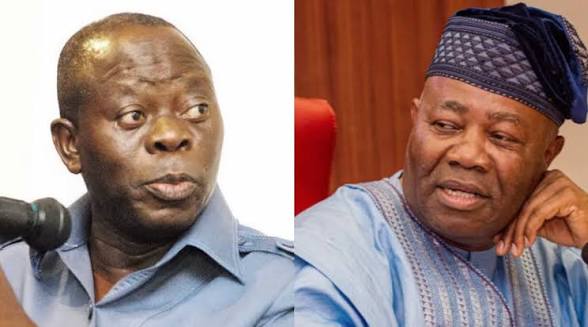
Two APC senators from the same party, from the same ruling establishment, went to war on the floor of the Senate. In public. On camera. With microphones cut and threats of removal exchanged.
And the story behind that war tells you more about what is happening inside Tinubu's Nigeria than any opposition press conference ever could.
It Started With a Rejection That Humiliated the Entire Senate Leadership
On Wednesday, April 22, 2026, Senate President Godswill Akpabio led the Senate leadership on a visit to the Presidential Villa. The purpose was simple, sensitive, and entirely self-serving.
The senators wanted automatic return tickets for the 2027 elections. They wanted Tinubu to tell the APC governors to stand down and allow incumbent legislators to sail through primaries without a serious challenge.
Tinubu said no.
He turned down the lobbying efforts by Senate leaders seeking automatic return tickets for sitting legislators, reaffirming the authority of state governors to oversee candidate selection in their respective states. A senior National Assembly source revealed: "The meeting was to plead for automatic tickets for senators but President Tinubu insisted that the governors are the leaders of the party in their states."
No. The governors decide. Not the senators. Not the Senate President. The governors.
Less than 24 hours after rebuffing the Senate leadership, Tinubu convened a second meeting with APC governors, at which he formally ceded authority over the primaries process to the state executives. Niger State Governor Mohammed Bago, speaking after the meeting, revealed the extent of the authority Tinubu had delegated.
The Senate leaders walked out of the Villa empty-handed. The governors walked in the next day and collected the prize.
Multiple lawmakers speaking off the record admitted: "Going home to face a primary is one thing. Going home to face a governor's preferred candidate is another thing entirely. Many felt the President could just say the word and calm the waters. He said no."
He said no.
That meeting planted the seed of everything that happened in the Senate chamber this week. Because a group of men who had just been told their political futures are in the hands of their state governors came back to Abuja and tried to protect themselves the only way still available to them: by changing the rules of the chamber itself.
The Rules That Changed Everything. And Then Changed Back.
On Tuesday, May 5, after a closed-door session that lasted nearly three hours, the Senate quietly amended Orders 4 and 5 of its Standing Rules.
The revised rules introduced stricter eligibility conditions for both presiding and principal offices in the Senate, effectively restricting access to lawmakers with proven legislative experience. Under the amended Order 4, nominations for presiding officers must strictly follow a ranking hierarchy. Under Order 5, only senators who had served at least two consecutive terms immediately before nomination were eligible to contest for principal offices.
Translation: if you are a first-term senator, you cannot be Senate President in the 11th Assembly. If you are a governor coming into the Senate for the first time in 2027, you cannot contest any leadership position from day one.
The amendment had one primary beneficiary. Akpabio. And one primary victim. Everyone planning to challenge him.
Because there are no fewer than ten sitting governors already positioning to enter the Senate in 2027, many with ambitions for the Senate presidency itself. The amendments came amid growing interest by outgoing governors and political heavyweights, many positioning to contest for top leadership roles such as Senate President and Deputy Senate President.
The most prominent name sitting in that category is Hope Uzodimma of Imo State. Although Uzodimma has not publicly declared any ambition for the Senate presidency, the Orlu Political Consultative Assembly had already declared him the sole senatorial candidate for Orlu zone in what it described as a total, unanimous and irrevocable decision.
A man with a unanimous and irrevocable consensus backing in his senatorial zone who has not yet declared his Senate presidency ambition does not need to declare it. The people declaring it for him are doing the job loudly enough.
Akpabio's amended rules would have blocked Uzodimma and every other incoming governor from contesting the Senate presidency from day one.
The message was clear. The chamber is ours. You can join. You cannot lead. Not yet. Not on your first day.
Then Oshiomhole Exploded. On Camera. With His Microphone Cut.
The day after the amendment passed, Wednesday May 6, Akpabio began the routine reading of the Votes and Proceedings from the previous sitting.
Oshiomhole stood up to raise a point of order.
Akpabio ignored him. Oshiomhole repeatedly shouted "point of order" even after his microphone was switched off.
His microphone was switched off. And he kept shouting.
Akpabio called on former Chief Whip Orji Uzor Kalu to clarify the rules. Kalu confirmed that points of order are not permitted during the consideration of Votes and Proceedings. Despite this, Oshiomhole continued pressing his objection. Senate Whip Tahir Monguno warned him to comply or face disciplinary action.
Then Akpabio delivered the line that will be quoted for the rest of this political season.
"Oshiomhole, if you become unruly, we will use the rules to take you out of the Senate."
The Senate President of the Federal Republic of Nigeria threatened to remove a sitting senator using procedural rules. In plenary. On record. In front of cameras.
And the senator he threatened is not an opposition member. He is a fellow APC lawmaker. A former governor of Edo State. A former National Chairman of the APC who helped build the very party both of them belong to.
Akpabio then subjected the Votes and Proceedings to a voice vote and ruled in favour of the "ayes" despite louder opposition from the "nays."
He heard louder nays and declared the ayes had it. In the Nigerian Senate. In 2026.
Oshiomhole Came Back The Next Day With A Resignation Demand
On Thursday May 7, Oshiomhole walked out of the chamber, found the cameras, and dropped the most explosive statement of the week.
He called for Akpabio's resignation, describing the amended rules as evidence of a "moral crisis" within the Senate. He stated: "This rule has a serious moral crisis. The Senate president became minority leader on his first term. He is now the one presiding and asking us to change those rules, even those who have done one term cannot even contest."
The hypocrisy argument landed with surgical precision. Akpabio himself became Senate minority leader in his first term. He rose through the legislative ranks using the very flexible rules he was now tightening to protect his position. He benefited from an open system and then tried to close it behind him.
Oshiomhole added: "David Mark had the honour and privilege of serving as Senate president for eight years, not by playing by the rules. Those rules that enabled David Mark to preside for eight years, what happened to them? Why changing them now because he fears that more senators will be eligible which will broaden the competitive base. So he wants to soak it. If other people are afraid, I am not."
If other people are afraid, I am not.
That is not a parliamentary observation. That is a declaration of war from a man who has spent his entire career as the most combative politician in any room he enters.
Then The Senate Did Something Nobody Expected: It Reversed Itself
On the same Thursday, with the Oshiomhole storm still live and the cameras still rolling, the Senate moved to undo what it had done two days earlier.
Senate Leader Opeyemi Bamidele moved a motion to rescind the amendments. Deputy Senate President Jubril Barau, who presided over the session, described it as necessary to align the Senate rules with constitutional provisions. Barau said: "This is a very straightforward motion. It is just for us to go in conformity with the Constitution. It is something that is very clear and we do not need any debate."
The Senate reversed itself in forty-eight hours. An amendment passed in a closed-door three-hour session on Tuesday was dead by Thursday afternoon.
With the reversal, senators previously disqualified from vying for the Senate presidency and other principal positions have now regained eligibility.
Uzodimma's Senate presidency ambition is breathing again. Every incoming governor who was blocked on Tuesday is unblocked today.
And Akpabio, who presided over the original amendment, watched it unravel while Oshiomhole was still talking to journalists outside.
Is Tinubu Done With Akpabio?
This is the question that every political observer in Abuja is now asking in quiet voices.
The pattern of events tells a story that requires no interpretation. Tinubu told the Senate leaders their tickets are in the hands of governors. Then Akpabio tried to use Senate rules to protect his Senate presidency against an incoming wave of gubernatorial challengers. Then the amendment was reversed in forty-eight hours.
A Senate President who cannot protect his own Senate amendments for two days is not a Senate President with Aso Rock's full backing.
Akpabio did not rise to the Senate presidency in 2023 through his own independent political strength in Akwa Ibom. He rose because Tinubu needed a compliant upper chamber and Akpabio was the instrument through which that compliance was delivered. The relationship was always transactional. And transactional relationships in Naija politics have expiry dates that track with electoral cycles.
The 2027 election is Tinubu's consolidation moment. He needs governors who can deliver state-level votes, not a Senate president who is fighting to stay relevant by amending standing rules. The same governors who went to Aso Rock the day after the Senate leaders were rejected understand this assignment.
The stance has strengthened governors' grip on party structures, enabling many of them to influence senatorial nominations as they prepare for life after office.
Tinubu gave the governors the primaries. The governors will use the primaries to install their preferred senators. Those senators will elect their preferred Senate President in the 11th Assembly. Whether that President is Akpabio, Uzodimma, or someone the cameras have not focused on yet is the question that the next eighteen months will answer.
What is already answered is whether Akpabio controls the timeline.
He does not.
What This Means For Akwa Ibom and Tinubu's South-South Calculus
Akpabio is not just a Senate President. He is the most significant political figure in Akwa Ibom State. His loyalty to Tinubu has been total and public. He has been the administration's most reliable legislative voice, moving motions, defending budgets, and managing a chamber that could have been far less cooperative.
If Tinubu abandons Akpabio ahead of 2027, the signal sent to Akwa Ibom and the broader South-South is that loyalty to Aso Rock does not buy protection when governors decide they want your seat.
Akwa Ibom is a South-South state. The South-South is already restless about political marginalisation. The region produced the vice presidency in 2023 through Shettima, which was itself a concession to the North. Now if Akpabio falls and a governor takes his Senate presidency, the message to the South-South is clear. Deliver your votes. Produce your instruments of compliance. And when your usefulness expires, find your own way home.
That message has electoral consequences in a region Tinubu cannot afford to alienate heading into 2027.
Is This The Beginning of APC's Implosion?
Here is the honest answer.
No. Not yet.
The APC has survived worse internal turbulence than an Oshiomhole-Akpabio clash. The party absorbed the Buhari-Tinubu tension of 2022. It absorbed the Saraki rebellion of 2018. It absorbed the El-Rufai defection and the Malami exit and the Amaechi departure. It has thirty-one governors, federal resources, and a structural advantage at the local government level that the opposition has never matched.
A Senate fight over standing rules is not an implosion.
But it is a crack. And in Naija politics, cracks in a ruling party always look manageable until they do not.
The senators who were told their tickets are in the hands of governors are now going home to negotiate with governors many of them have been at war with. Some of those negotiations will not end well. Some senators will lose their primaries. Some will defect to opposition parties. The National Assembly's majority, which Tinubu has depended on for every legislative win since 2023, is not as structurally guaranteed as the thirty-one governors number suggests.
As one senior National Assembly source put it: "Going home to face a primary is one thing. Going home to face a governor's preferred candidate is another thing entirely."
That sentence describes the political reality of several dozen APC legislators right now. Men who voted to override themselves, who supported policies that hurt their constituents, who maintained legislative loyalty to an administration whose president just told them their jobs are the governors' decision.
They are now going home to face those governors.
In Naija politics, a loyalty that receives nothing in return produces a defection that surprises nobody in hindsight.
Oshiomhole said it best, even if he meant it about a different argument.
If other people are afraid, he is not.
Several APC senators are afraid right now. And frightened men in Nigerian politics do not sit quietly. They make noise, they make deals, and eventually they make moves.
The Senate chamber this week gave you the first public glimpse of what that noise sounds like.
It is going to get louder.
What do you think? Is Akpabio's inability to protect his own Senate amendments a sign that Tinubu is already engineering his replacement as Senate President? And with governors now empowered to decide which senators get party tickets, how many APC defections will we see before the May 30 primaries deadline? Drop your thoughts in the comments section. The Naija politics story of 2026 is no longer just about the opposition destroying itself. The ruling party is now serving its own drama on a platter and the audience is watching from both sides.
0
54