
Kaothaj_
5 months ago
In Naija politics, when the conversation is about who becomes the next president, the bodies pile up quietly.
Nobody campaigns on the coffins of soldiers. Nobody holds rallies beside the smouldering ruins of sacked villages. Nobody points a microphone at a widow in Katsina and asks her what she thinks about the ADC convention crisis or INEC's derecognition of David Mark's NWC.
She cannot eat those stories. She cannot sleep inside those debates.
She just needs the men with guns to stop coming.
And they are not stopping. They are not even slowing down.
This week, Nigeria received the kind of news that should stop the entire country cold. It did not. And that silence, from government and opposition alike, is a scandal that deserves to be named directly.
The General Is Dead. The Second In Five Months.
At 12:30 a.m. on Thursday, April 9, 2026, ISWAP, the Islamic State-backed faction of Boko Haram, launched a coordinated assault on the 29 Task Force Brigade Headquarters in Benisheikh, Kaga Local Government Area of Borno State.
They came with heavy gunfire and explosives. They overran the base. They burned vehicles and buildings.
At least 18 soldiers were killed in the attack. Among them was Brigadier-General Oseni Omoh Braimah, the Brigade Commander of the 29 Task Force Brigade under Operation Hadin Kai.
A Brigadier-General. The Brigade Commander. The man who was supposed to lead the counter-insurgency effort in that zone. Gone.
Military sources revealed the circumstances surrounding Braimah's death. When the attack intensified, the General attempted to manoeuvre out of the base in an armoured personnel carrier. The vehicle failed to start. That was how he was captured and eventually killed by the insurgents.
An armoured vehicle that failed to start. In the middle of a terrorist attack. On a military base.
Sources alleged widespread negligence and corruption among senior military officers, claiming that funds meant for vehicle maintenance and fuel are often diverted. "They do not maintain the vehicles, and they also have a habit of not making fuel readily available for emergencies like this," one source told Sahara Reporters.
A Brigadier-General died because an armoured vehicle did not have fuel or maintenance. In a theatre of active combat. In Nigeria. In 2026.
This is not just a security failure. This is institutional rot dressed in military uniform.
This Is The Second General In Five Months
And here is what makes this even more devastating.
Braimah's death follows the killing of Brigadier-General Musa Uba by ISWAP in November 2025. Uba was the highest-ranking military official to die in the long-running conflict since 2021. The killing of Braimah is now the second death of a high-ranking officer in five months.
November 2025. April 2026. Five months apart. Two Brigadier-Generals.
A public analyst, Dr Musa Usman Konduga of the University of Maiduguri, described the killing as "one killing too many." He recalled that three commanding officers in Kukawa, Kunduga and Banki were killed in similar circumstances within a short period of time before Braimah's death.
Not two generals. Five senior commanding officers. In roughly the same stretch of time. In the same North-East theatre.
The US State Department this week authorised non-emergency US government employees to leave Abuja due to the deteriorating security situation. Researchers have warned of an uptick in violence since 2025. Borno's capital Maiduguri has seen two suicide bombings since December, echoing the type of attacks that characterised the insurgency's peak a decade ago.
The US State Department told its non-essential staff to leave Abuja. Not Maiduguri. Not Borno. Abuja.
The diplomatic community reads the intelligence on Nigeria and concluded that the capital city itself is not secure enough for non-essential American personnel.
That is a devastating verdict. Written without drama. Delivered without fanfare. And largely ignored by Nigerian political discourse.
The Strategy Is Clear: Decimate Leadership
This is not random violence. This is not Boko Haram and ISWAP simply shooting at whatever they find.
Look at the pattern. Kukawa. Kunduga. Banki. Damasak. Now Benisheikh.
The targets are not ordinary soldiers. They are commanding officers. Brigade commanders. The men with institutional knowledge, tactical experience, and the authority to coordinate counter-insurgency operations at the field level.
When you kill a Brigadier-General, you do not just kill one man. You remove months or years of battle intelligence that lived in that man's head. You remove the relationships he had built with local civilian populations and informants. You create a vacuum that takes time to fill. And in that vacuum, the insurgents operate with more freedom, more boldness, and more success.
This is a military decapitation strategy. And it is working.
When an armoured vehicle cannot start because maintenance funds were diverted, when fuel is not available for emergency extraction, when a general is trapped and killed on his own base by the failure of basic logistics, the enemy does not need superior numbers or weapons.
They need patience and information. And they clearly have both.
Meanwhile, The Bandits Are Levying Towns
Now move from the North-East to the North-West. From ISWAP's calculated military campaign to the bandits' open extraction of civilian obedience.
This week in Katsina State, residents fled their communities after bandits sent a letter demanding 700 cows and 1,000 sheep to avoid an attack. The letter received on Monday April 6, 2026, gave a Friday, April 10 deadline. Panic-stricken, hundreds of residents were seen trekking to nowhere, with no shelter, as they fled before the deadline.
700 cows. 1,000 sheep. Or we attack your village.
This is not Nigeria's civil war era. This is not 1967. This is April 2026 and bandits are openly sending formal written ultimatums to Nigerian communities demanding livestock tribute before the deadline they have generously allocated.
In Katsina this week, bandits also attacked two communities in Matazu Local Government Area, killing a policeman, burning a community health centre, and looting shops in broad daylight.
They burned a healthcare centre. In daytime. On an ordinary Sunday.
Meanwhile, Amnesty International condemned the recent wave of abductions in Zamfara, describing the situation as one that reflects inadequate attention by authorities. The Country Director said: "The priority is to stop the killings people are suffering, enough is enough, whether in Plateau, Benue, Zamfara, Sokoto or Katsina."
Enough is enough. Said by Amnesty International. Not by a Nigerian presidential candidate. Not loudly by any organised opposition force.
Where Is The Noise From The Opposition?
Here is the failure of Naija politics in its most glaring form this week.
The ADC convention crisis dominated the headlines. The Nafiu Bala versus David Mark legal battle consumed the oxygen. Kwankwaso waited all night for a meeting that never came. Bala called Kwankwaso an APC mole. A third faction emerged. INEC issued statements. Lawyers filed motions.
All of this happened in the same week that a General died on a base because an armoured vehicle had no fuel.
In the same week that communities in Katsina were running away from bandit ultimatums.
In the same week that the US State Department told its staff in Abuja to leave.
The opposition's most vocal fighters, the same people who rightly and loudly called out Tinubu's electricity failure and forced a response within 48 hours, have been largely quiet about the scale of what is happening to the North. The ADC coalition, which includes several former northern governors who know these communities personally, whose constituents live in the sacked villages and displaced camps, spent most of their energy in courtrooms arguing about who is the authentic party chairman.
Peter Obi showed us what happens when opposition speaks precisely and persistently about governance failure. Tinubu moved on the power sector debt within 48 hours. That same energy, applied to the security crisis with the same precision, would force a reckoning.
When Obi asked "would he have abandoned Nigeria for another country, would he have run?" he was talking about party loyalty. The same question applies to the North's security crisis. Would these political leaders who want to lead Nigeria in 2027 have left Katsina communities trekking with their children to escape bandits? Would they have issued the same "exceptional courage and superior firepower" press statements after watching another general die in a vehicle that would not start?
Leadership is not just what you say at conventions and press conferences. It is what you demand accountability for in the times when saying it is politically inconvenient.
The North is burning. People are dying. Generals are being killed because their equipment was not maintained. Communities are paying tribute to bandits. Towns are being sacked.
And the people who want to lead Nigeria in 2027 are, largely, still arguing about convention dates.
The Government's Response: Condolence Statements and Courage Praise
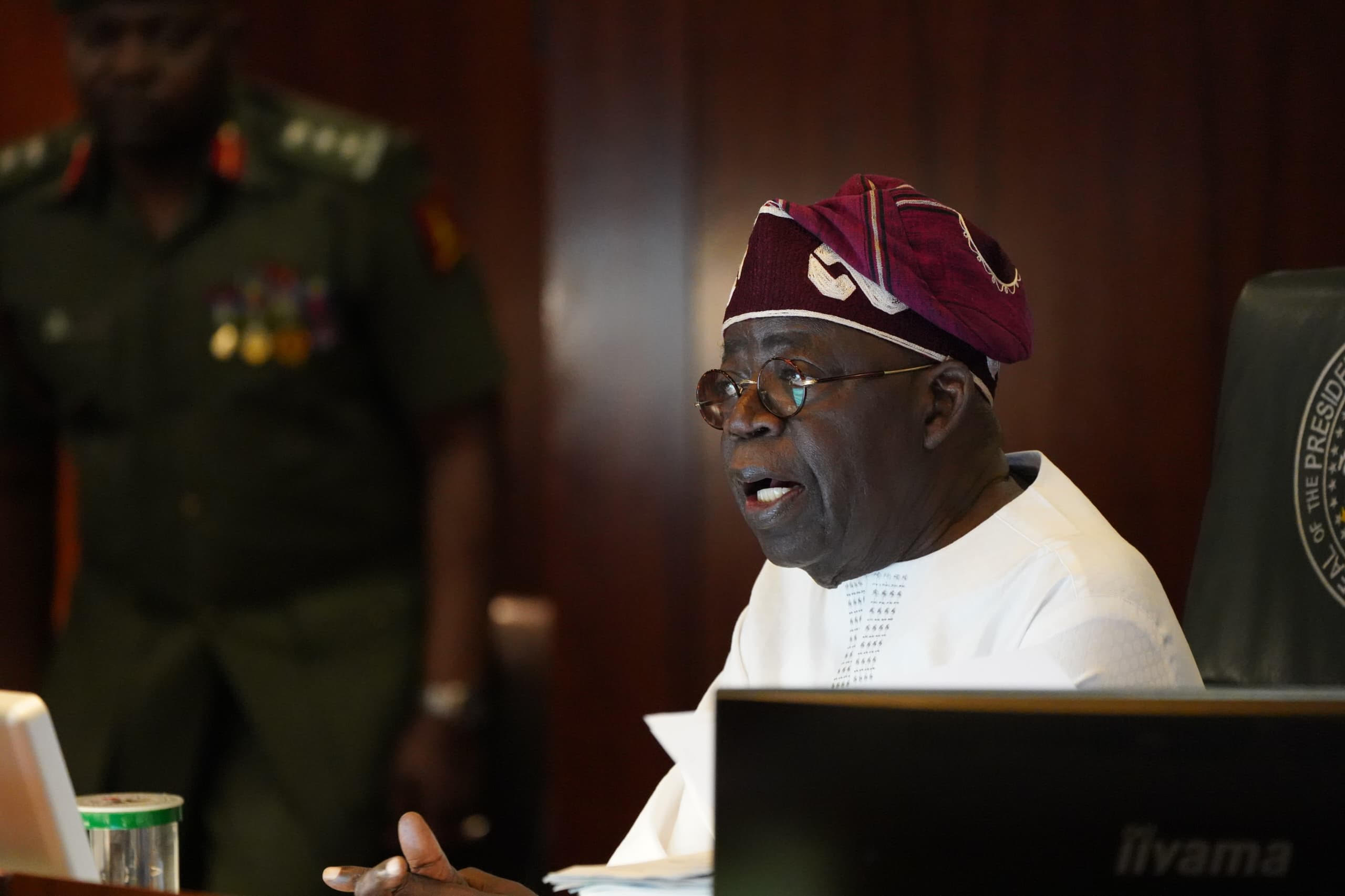
Tinubu issued a statement praising the "courage and heroism" of the fallen soldiers.
He said: "From the reports I have received, our armed forces have been conducting sustained, intense land and air offensives against the insurgents, neutralising many of their fighters and commanders. The insurgents' counterattack is a sign of desperation. Their sacrifices will not be in vain."
Desperation. He called the killing of a Brigadier-General and 17 soldiers a sign of the enemy's desperation.
If this is what desperation looks like, what does an ISWAP offensive look like?
The government has been saying the insurgency is weakening for years. Every statement after every attack contains the same language. Sustained offensives. Neutralised commanders. Sign of desperation. The brave and gallant soldiers.
And yet the generals keep dying. The towns keep burning. The communities keep running.
In Naija politics, the measure of a government's seriousness on security is not its press statements. It is whether the armoured vehicles have fuel when the general needs to escape.
The Bottom Line: A Country Distracted at a Moment That Requires Full Attention
Nigeria is fighting a two-front war of its own making.
In the North-East, a sophisticated, patient insurgency is systematically hunting and eliminating the experience layer of the Nigerian military. Two Brigadier-Generals in five months. Multiple commanding officers before them. The decapitation strategy is producing results that press statements cannot obscure.
In the North-West, bandits have graduated from kidnapping to governance. They levy towns. They set deadlines. They send formal letters demanding tribute. They burn healthcare centres and police stations in daylight. And the communities have no choice but to run, pay, or die.
Meanwhile, the political class in Abuja is consuming itself over convention dates, INEC portal registrations, ADC factions, and Nafiu Bala's age.
There is a place for politics. There is always a place for politics. Democracy requires it. But democracy also requires that those who want to lead the country demonstrate, even in opposition, that they understand what leadership demands when the blood is real.
The opposition must pick up the security question the way Obi picked up the electricity question. With precision. With Tinubu's own words. With data and names and places. With the kind of sustained public pressure that makes ignoring it politically impossible.
Because in Naija politics, what you choose to talk about signals what you think matters.
And right now, a General died because a car would not start. Towns are running from bandit ultimatums. The US State Department is telling its people to leave Abuja.
This matters. More than the convention. More than the portal. More than who insulted who on a late-night television programme.
This is the kind of failure that ends second terms. The question is whether anyone in the opposition is brave enough to say so loudly, consistently, and at the exact moment when it is most uncomfortable.
What do you think? Is the Nigerian military's loss of Brigadier-General Braimah evidence of a deeper systemic failure that the government is hiding behind press releases? And why is the opposition spending more energy on party structures than on the security crisis killing Nigerians daily? Drop your thoughts in the comments section. This Naija politics silence on bloodshed is a choice, and it is one that voters will remember.
1
58