Politics
The process of making decisions for communities or countries, often involving governance, power, and public policy

Siminalayi Fubara, governor of Rivers, has signed the state’s 2026 N1.854 trillion appropriation bill into law.
In a statement issued on Wednesday by Onwuka Nzeshi, his chief press secretary (CPS), Fubara described the signing of the appropriation bill as “a breath of fresh air” and the beginning of a new chapter of unity and progress in the state.
Fubara signed the bill at a ceremony held at the government house in Port Harcourt, the Rivers capital, where he expressed gratitude to God, stakeholders and members of the state house of assembly for the passage of the budget.
“First of all, we want to thank the Almighty God for making this day a reality. I strongly believe that it is a breath of fresh air and a healthy relationship moving forward,” he said.
The appropriation bill, tagged “Budget of resilience for growth and development”, was earlier passed on Thursday by the Rivers state house of assembly.
The signing follows months of political tension between the governor and the state assembly.
On July 10, Fubara presented the appropriation bill to the Martin Amaewhule-led assembly, following which it was considered and passed before being transmitted it to the governor for assent.
Fubara commended the lawmakers for their diligence and speed in handling the budget, particularly at what he described as a critical time in the state’s history.
He also acknowledged Nyesom Wike, minister of the Federal Capital Territory (FCT), for facilitating the process that led to the passage and signing of the bill.
The governor reaffirmed his administration’s commitment to the “Rivers first” mantra, saying the implementation of the 2026 budget would focus on the welfare of the people.
“I thank members of the state house of assembly for a wonderful job at this very critical time of our life,” he said.
“I want to assure you that our intention will still remain the progress and development of our dear state.
“Let me also thank our leader, the Honourable Minister of the Federal Capital Territory, Chief (Barr.) Nyesom Wike, for facilitating this meeting and this process that we are all signing into.”
The event was attended by members of the state executive council, principal officers of the state house of assembly and other government officials.
Source: TheCable
0
7
In Naija politics, the most dangerous crack is never the one on the wall of the other party's building.
It is the one opening quietly in your own foundation while you are busy pointing at your neighbour.
The APC spent the first half of 2026 celebrating structural dominance. Thirty-one governors. Senate. House of Representatives. Presidential primary with 10.9 million votes. The national chairman who called the Osun contest a Keke Napep facing a Trailer. The party that was so confident of its machinery that it was literally mapping out which states it would recover before the 2027 general election.
Then came Ogun State.
And the party that has spent this election cycle mocking opposition factions, parallel conventions, rival NWCs, and court battles over legitimate leadership is now petitioning the Inspector-General of Police to arrest one of its own members for claiming to be its own candidate.
In a state it is supposed to own.
Five months before the presidential election.
How Ogun's APC Ticket Became a Legal Battlefield
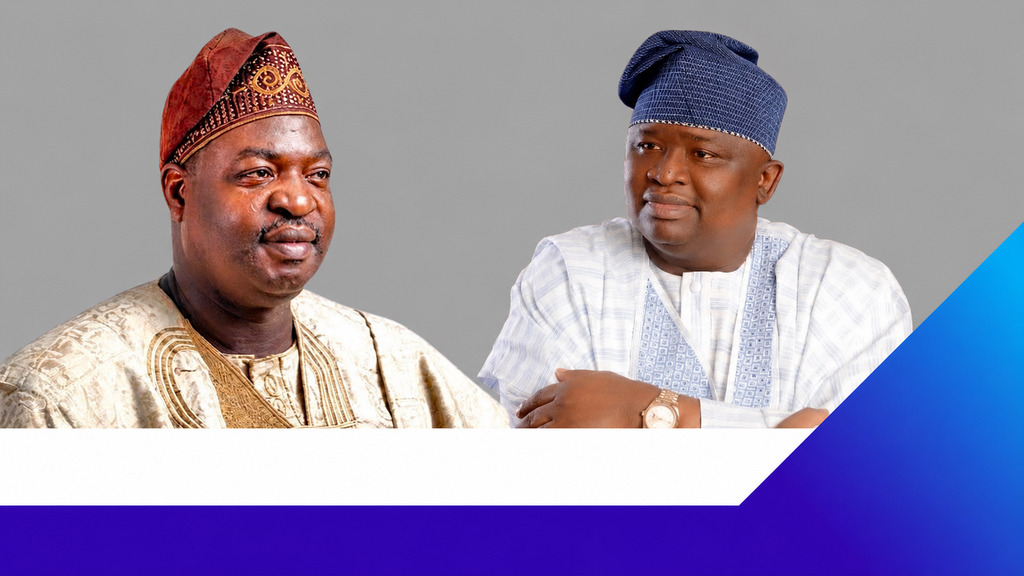
Senator Solomon Olamilekan Adeola, popularly known as Yayi, is a political heavyweight. He represents Ogun West in the Senate. He is a close Tinubu ally. His emergence as the APC governorship consensus candidate was announced on April 13 by Governor Dapo Abiodun at a strategic caucus meeting attended by former governors Olusegun Osoba, Ibikunle Amosun, and Gbenga Daniel, along with other governorship aspirants.
The word consensus does a lot of work in that sentence. Because one aspirant was notably absent from the meeting where he was being consensused out of the race.
Abayomi Semako Hunye is a former commissioner and immediate past Managing Director of the Ogun State Waste Management Authority. He is of Yewa extraction, the same geopolitical subgroup as Adeola, making the intra-Yewa dimension of the conflict an additional political sensitivity that nobody in the state's APC is publicly comfortable discussing.
Two weeks after Adeola was announced as consensus candidate, Hunye obtained the APC governorship nomination form through a third party in Abuja. He was screened, cleared, and assigned an aspirant number. He participated in the governorship primary.
The result announced by the electoral committee chairman Wale Ohu: Adeola 304,055 votes. Hunye zero votes.
Zero.
Not five. Not five hundred. Not fifty thousand fewer than Adeola in a state where he claims enormous local support.
Zero votes. In a state where he was cleared as a legitimate aspirant with an assigned number. Where he participated in the process. Where his agents were present at polling units across the state.
Hunye's campaign rejected the result before the announcement had even finished reverberating. His own collation showed 453,765 votes for him against 304,055 for Adeola.
Not a narrow dispute. Not a margin complaint. A complete inversion of the announced result, with Hunye claiming he won by nearly 150,000 votes in a primary that gave him zero.
The controversy over the conduct of the governorship primary of Ogun State chapter of the APC may be far from being over.
That is one of the more restrained descriptions of a situation where a man is claiming he won a primary by 150,000 votes and the party says he scored zero.
The Suspended Man Who Was Never Told He Was Suspended
Then came the APC national secretariat's response.
APC National Secretary Ajibola Basiru announced that Hunye had been suspended from the party, effective April 7, 2026, following allegations of activities considered injurious to the party, anti-party conduct, and actions capable of causing division.
Hunye's response demolished the announcement with a single question that nobody in the APC has satisfactorily answered.
He said: if he was suspended on April 7, how did the APC sell him a governorship nomination form after April 7? How did the APC screen and clear him as an aspirant after April 7? How did the APC assign him an aspirant number and allow him to participate in a governorship primary after April 7?
Hunye has continued to challenge the emergence of Senator Olamilekan Solomon Adeola as the party's candidate, with the dispute moving to court over alleged irregularities and disenfranchisement.
A suspended man who was sold a nomination form by the party that suspended him. Screened by the party that suspended him. Cleared by the party that suspended him. Given an aspirant number by the party that suspended him. And then recorded as having zero votes by the party that suspended him after all of that.
The APC's position produces a logical impossibility. Either the suspension happened before the form sale and the party knowingly sold a form to a suspended member, or the suspension was backdated to the period before the form sale to justify excluding him after the primary produced results they did not want him to see.
Both options are uncomfortable for a party that is supposed to be demonstrating institutional credibility ahead of January 2027.
The Police Petition That Escalated Everything
On August 24, the APC's Director of Administration Ayoola Peter Olajolo petitioned the Inspector-General of Police, Tunji Disu, and the DSS Director-General separately, demanding the investigation, arrest, and prosecution of Hunye.
The petition stated: "I write to bring to your urgent attention a grave threat to public peace and electoral integrity involving one Mr. Abayomi Hunye. The Subject has notoriously and unlawfully taken to the public domain, including print and social media, parading himself as the Governorship Candidate of our party for the forthcoming January 2027 election."
The APC accused Hunye of impersonation, conduct likely to cause a breach of peace, and violation of the Electoral Act.
Hunye responded with characteristic precision. He said he has never declared himself the officially recognised APC candidate. He said his position is that the matter is before the court and the court has not yet determined who the candidate is. He said: "Ogun State candidature of governorship election is still hanging at the court. The court is going to determine who becomes the candidate and the case is still on."
There is a legal distinction between saying "I am the APC candidate" and "the court has not yet decided who the APC candidate is." Hunye is making the second claim. The APC is treating it as the first.
Hunye issued a warning that the political crisis surrounding the party's 2027 governorship ticket could escalate far beyond the experience of the recently concluded Osun State governorship election.
He then did something that the APC should take seriously. He said he would work against Adeola if the dispute is not resolved to his satisfaction through the courts.
Work against. In the state that the APC is supposed to be defending as the President's critical South-West base.
The Abiodun PGF Connection and What It Means
Governor Dapo Abiodun of Ogun State is the same governor who was recently accused, alongside Peter Mbah of Enugu, of attempting a palace coup inside the Progressive Governors Forum against Hope Uzodimma's chairmanship.
The Arewa Youth Forum issued a 48-hour ultimatum to Abiodun and Mbah, accusing them of sabotaging Tinubu's re-election.
Now the same Abiodun who announced Adeola as the consensus candidate is presiding over a state APC that is petitioning the IGP to arrest one of its own members and claiming a man who participated in its primary scored zero votes.
The pattern tells a story about how the APC manages its internal consensus arrangements. It is the same pattern visible in Gombe, where Pantami threatened to fight the consensus to his last breath. In Rivers, where the entire primary structure was legally invalidated. In the PGF, where the campaign fund controversy produced two rival governor factions at a meeting in the same night.
The APC's structural narrative, that thirty-one governors equals unbreakable cohesion, is being tested in Ogun the same week the opposition is holding its single-candidate summit in Abuja.
What Osun Proved That Ogun Must Reckon With
The APC's national chairman said Osun was a Keke Napep facing a Trailer. The Keke Napep won.
It won because APC's internal fractures, the Wike-Fubara war, the Oyetola ministerial factor, the Oyinlola miscalculation, were visible enough for Adeleke to navigate.
Ogun is not Osun. The political geography is different. Adeola is a senator with genuine Ogun political weight. Abiodun is finishing his term with a functioning administrative structure behind him.
But a man who claims to have won a primary by 150,000 votes and was recorded at zero, who is now unveiling a running mate, who is before a Federal High Court, who is promising to work against the official candidate, and who is from the same Yewa subregion as the official candidate, is not a small crack.
He is a man who knows exactly which stones to pull from which parts of the Yewa structure to make things difficult in that zone.
And in Ogun State's presidential election context, where Tinubu needs the South-West to deliver maximum votes on January 16, a fractured Ogun APC is a genuine problem.
Not an existential one. But a real one.
Is This the Beginning of the End for the APC Empire?
No. Not yet.
The APC has thirty-one governors and a structural advantage that one state's primary dispute cannot unravel overnight. Hunye's case is before a Federal High Court that may or may not move quickly enough to affect the January election. Adeola's name has been submitted to INEC. The machinery of the party is formally behind him.
But here is what the Ogun crisis joins.
The PFIPC ghost agency. The PGF N800 billion campaign fund dispute. The Gbajabiamila BCDA standoff where a government appointment sat three weeks without implementation. The Pantami Gombe consensus rejection. The Oshiomhole-Akpabio Senate war. The APC deregistering its own Osun operation when the national chairman called it a Trailer and the Trailer lost.
None of these individually collapses the APC. Combined, they describe a ruling party that is experiencing the classical symptoms of a dominant party that has absorbed too many individual ambitions without enough structural discipline to manage them all simultaneously.
The APC of 2013 that removed Jonathan was a lean, disciplined, purpose-built coalition. The APC of 2026 is a hotel where every political ambition in Nigeria checked in and nobody agreed on check-out time.
That is not the same party. And in Naija politics, it does not always produce the same result.
What do you think? Can Adeola win the Ogun governorship in January while Hunye is still before a Federal High Court claiming he won the primary by 150,000 votes and threatening to work against him? And does the pattern of APC internal crises across Ogun, Gombe, Rivers, the PGF, and the Senate tell you that the ruling party's structural advantages are more fragile than the thirty-one governors number suggests? Drop your thoughts in the comments. Today is September 2, 2026. This is Naija politics and the ruling party's most comfortable state is showing cracks in the wall that nobody on the APC's communications team wants to discuss.
0
21


When, in April 2026, former Vice President Atiku Abubakar hired Von Batten-Montague-York, L.C., a Washington-based lobbying firm, to protect and strengthen his “reputational standing” in the United States, more attention was paid to the deal’s worth than to the contract’s signee.
A Foreign Agents Registration Act (FARA) filing with the US Department of Justice showed that the contract amounted to $1,200,000 annually, eliciting varied reactions from Nigerians, and criticism, mainly from loyalists of Atiku’s 2027 opponent, President Bola Tinubu, candidate of the ruling All Progressives Congress (APC).
The contract agreement, seen by TheCable, was signed for Atiku by Fabiyi Oladimeji, a Nigerian politician and chieftain of the African Democratic Congress (ADC), while Karl Von Batten signed on behalf of Von Batten-Montague-York, L.C.
NINE NAMES, SEVERAL VARIANTS
Now, here is where it gets interesting.
On Von Batten’s LinkedIn profile, his full name is listed as “Karl-Marx Edward Ikemefuna William George Okeke-Von Batten” — a mixbag of British, German/Austrian, and Nigerian names.
Karl Marx was a German philosopher and revolutionary socialist who is widely regarded as the father of communism. “Von” is a common prefix for surnames linked to nobility in Germany and Austria, while Ikemefuna Okeke suggests south-east Nigerian roots.
Von Batten also appears to use the names interchangeably.
In the FARA filing for Atiku in 2026, he used Karl Von Batten. However, in the filing for a 2022 contract with the Sool, Sanaag, and Cayn regions of northern Somalia/Somaliland, he used Karl-Marx Okeke-Von Batten.


It is not immediately clear how Batten came to acquire the collection of names. TheCable has reached out to him for clarity on his origin and roots.

TRUMP ACOLYTE AND AMY VETERAN
On his LinkedIn page, Von Batten, a staunch supporter of US President Donald Trump and member of the Republican Party, listed the University of Oxford, Columbia University, Harvard University, and New York Institute of Technology as his alma maters.
Although Von Batten did not state his course of study or the year he attended the institutions, his professional profile, seen by TheCable in an archived 2018 Council of the District of Columbia bill, provided more details.
The profile, published on LegiScan, showed that Von Batten obtained a Doctor of Health Administration from A.T Still University of Health Sciences, bagged a Master of Science at Oxford University, and a Master of Arts/MBA at Columbia University.
The 2018 profile, however, did not include Harvard University, which is listed on his LinkedIn page. Rather, it showed that he obtained a post-MBA certificate in financial management from Cornell University — an institution that is not listed in his professional profile found on LegiScan.
TheCable has written to all the institutions in both his professional profile and LinkedIn page to ascertain his attendance and other relevant details.
According to his professional profile, Von Batten said he was a member of the National Guard Bureau of the US Army between January 2004 and March 2006.
Von Batten said he worked in the US Department of Health and Human Services for the next two years, after which he moved to the Office of the US Global AIDS Coordinator and Health Diplomacy for another five years.
He said he subsequently served in the United States Department of Defence before moving to the United States Department of Veterans Affairs (Veterans Health Administration) in 2016.
Advertisement
 Von Batten posted a photo of himself in a US Army uniform in 2025
HE ‘JOINED THE US ARMY AFTER 9/11’
In an X post published in November 2025, Von Batten said in 2001, he was “an immigrant and young investment banker” working on the 39th floor of the World Trade Centre in the US when the September 11, 2001 terrorist attack happened.
Von Batten, who is married to Elizabeth Blazevich (Okeke-Von Batten), said the incident motivated him to enlist in the US military.
“In 2001, Wall Street was my home. I was an immigrant, a young investment banker, and my office was on the 39th floor of the World Trade Centre, Tower 1. September 11, 2001, changed my life,” Batten wrote.
“Before I knew it, like thousands across the country, I rushed to the recruiting station and volunteered for military service. We had one mission: seek, find, and destroy the enemies of the United States.
“I was inspired by four things: watching innocent Americans die, watching the towers collapse, my desire for revenge, and the words of President George W. Bush as he stood on a pile of rubble holding a bullhorn.”
In his LinkedIn About section, Batten said he served “under General Roosevelt Barfield in support of the Joint Chiefs of Staff per Operation Enduring Freedom and Operation Iraqi Freedom”.
 Von Batten with members of the National Council for Democracy in Rwanda
LOBBYING FOR AFRICAN COUNTRIES
Von Batten, through his lobbying firm, has executed contracts for a number of African countries.
An Africa Report article of February 2022 said the United Somalia Alliance had hired Von Batten to “lobby against US recognition of Somaliland independence”.
In April 2022, the lobbyist and the clan leaders of the Sool, Sanaag, and Cayn regions of Somalia signed a lobbying contract with Von Batten-Montague-York to “educate the Biden Administration and Congress about the subjugation and disenchantment of the SCC people by the Somaliland regime”.
In March 2023, Von Batten and the federal ministry of fisheries and blue economy of Somalia signed a lobbying contract to “lobby, advocate, and push matters and interests beneficial to the Federal Republic of Somalia”.
Three years later, in February 2026, the Republic of Burundi engaged his firm in a $60,000 lobbying contract to “provide comprehensive government affairs, strategic advisory, and public relations services in the United States in furtherance of Burundi’s sovereign interests”.
DRC LINKS AND RWANDA ROW
Von Batten was recently engaged by the Democratic Republic of Congo (DRC) government to lobby the international community for sanctions against Rwanda, a neighbouring country accused of complicity in the insecurity in Eastern DRC.
In February 2025, Taarifa, a Rwandan newspaper, reported that the country’s embassy in the United States had denied reports suggesting that President Paul Kagame’s invitation to the US National Prayer Breakfast had been revoked.
According to Taarifa, the claims emanated from Batten, who was reported to have said Kagame was “uninvited” because of Rwanda’s alleged role in the DR Congo crisis.
The Rwandan embassy described the claims as “a flat-out lie” and “just petty nonsense”.
Source: TheCable
0
7
In Naija politics, the most dangerous joke a man can tell is the one that lands on himself.
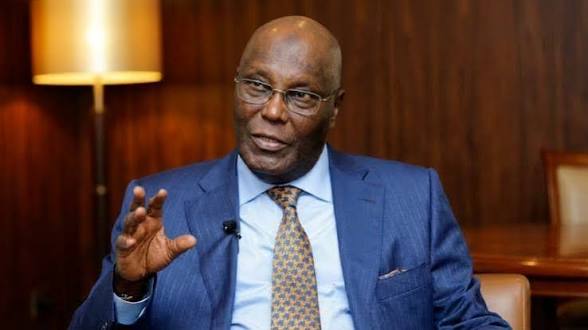
On Friday August 28, 2026, Atiku Abubakar sat before a BBC microphone and delivered what he clearly believed was a knockout punch.
He said: "I have a president who is 90 years old now, and who is sick. I am healthy and strong. So why would I not make my services available to my fellow countrymen?"
He also said he had evidence that Tinubu is 90 years old and would produce it in court.
90 years old.
Let the full weight of that claim sit for one moment before we proceed.
Atiku Abubakar, a man who will be approaching his own 80th birthday before Nigerians vote in January 2027, looked into a BBC camera and argued that he should be president because his opponent is too old.
The man contesting for the presidency for the seventh time. The man who first ran in 1993. The man whose political career has outlasted the age of several entire generations of Nigerian voters. That man said his 74-year-old opponent is disqualified by age.
In Naija politics, this is the political equivalent of arriving at a glass-throwing competition from a house made entirely of windows.
What the Math Actually Says
Tinubu's publicly documented date of birth is March 29, 1952. The State House published Tinubu's own birthday message on March 29, 2026, in which he explicitly referred to his 74th birthday. INEC documents submitted for the 2027 election list Tinubu's date of birth as March 29, 1952 and his age as 74.
Even in the alternative birth year arguments, the highest credible claim from critics places Tinubu's birth at 1949 or 1950, which would make him 76 or 77 in 2026.
Not 90. Not even the 1954 or 1955 dates that occasionally circulate would make him 90; they would make him only 72 or 71 in 2026.
Atiku did not produce his evidence during the BBC interview. He said he would present it in court.
P.M. News conducted an immediate fact-check and found: Claim: President Bola Tinubu is 90 years old. Evidence Supporting Claim: Atiku says he possesses evidence but has not publicly produced it in the interview. Official/Public Record: Tinubu's publicly stated date of birth is March 29, 1952.
The evidence exists, says Atiku.
In court, says Atiku.
On a BBC interview with no documents, says Atiku.
In Naija politics, the most powerful evidence is always the evidence that appears just after the election it was supposed to influence.
Then Bayo Otitoju Did the Math Nobody Wanted Done
Former presidential aide and media personality Bayo Otitoju entered the conversation with the precision of a man who brought a ruler to a poetry contest.
He noted that MKO Abiola, whose mandate Tinubu fought to restore, would have been 89 years old this year had he lived.
Atiku made the claim during an interview with the BBC while defending his decision to seek the presidency again despite his age. But Otitoju pointed out the implication that nobody in the Atiku camp had apparently paused to consider.
If Tinubu is 90 years old in 2026, and Tinubu was a prominent political figure fighting for the restoration of Abiola's mandate in the early 1990s, then Tinubu would have been in his late fifties or early sixties while campaigning for democracy alongside younger activists.
Otitoju added the observation that would have made anyone in the Atiku camp wince: if Tinubu is indeed 90, then by that timeline, he would be older than his own father's documented age at equivalent periods.
The mathematics of a 90-year-old Tinubu does not just contradict INEC records. It contradicts the historical timeline of every political event Tinubu is documented to have participated in as a young activist, a Lagos gubernatorial candidate, and a two-term governor.
A 90-year-old Tinubu in 2026 was 57 in 1993.
A 57-year-old man who was Lagos governor from 1999 would have entered the governorship at 33.
None of these numbers are being reconciled in Atiku's version of Nigerian political history.
The Birthday Tweet That Will Live Forever
And now comes the detail that makes this entire episode the most extraordinary self-inflicted political wound of the 2027 election cycle.
In March 2020, on the occasion of President Tinubu's birthday, Atiku Abubakar posted on his verified X account to wish the sitting president a happy birthday.
He specifically referenced Tinubu's 68th birthday.
Not his 74th, which is what the official records say. Not his 90th, which is what Atiku now claims. His 68th.
Atiku Abubakar, in writing, on the public internet, with his verified account, wished Bola Tinubu a happy 68th birthday in March 2020.
Five months later, the same Atiku sat before a BBC camera and told the world Tinubu is 90 years old and has evidence to prove it.
When the interviewer corrected him, saying Tinubu was not yet 80, Atiku responded, "Do I look to you like someone who has reached 80 years of age?"
Correct. He does not look 80.
But in March 2026, he also did not look like a man who believed his 68-year-old opponent would become 90 by August.
What happened between March and August that added 22 years to Tinubu's life in Atiku's reckoning?
The BBC interviewer did not ask that follow-up question.
Twitter did not need to be asked. The thread appeared within hours.
Reno Omokri and the 1996 Photograph
Reno Omokri joined the pile-on with a photograph.
Omokri wrote: "This is a photo of Asiwaju Bola Ahmed Tinubu and Dele Momodu taken in London in 1996. If Asiwaju is indeed 90 years old, as recently alleged, then Dele Momodu must be in his eighties. Look at the photo yourself. I have not altered it in any way. Dele Momodu is alive to testify to the authenticity of this photograph and the date and place where it was taken."
The implication is straightforward. If Tinubu were 90 years old in 2026, he would have been 60 years old in 1996, and Omokri challenged Nigerians to judge whether the person in the photograph appeared to be 60.
The PM. News fact-check correctly noted that photographic appearance is not reliable evidence of actual age. People age differently. The photograph does not prove anything definitively.
But the photograph does something the fact-check cannot undo.
It lands the question visually and memorially on every person who sees it. And in Naija politics, the image that lodges in the voter's mind is frequently more powerful than the argument that displaces it logically.
Atiku offered a claim. No evidence. A court promise. A birthday tweet from five months ago. And now a photograph from London in 1996.
His 90-year-old claim arrived at the worst possible archaeological site.
The Interview That Explains Why He Said It
Here is where the satire must acknowledge the genuine political pressure that produced this statement.
Atiku was responding to questions about whether his age could affect his ability to govern Nigeria if elected. The former vice president was asked about his decision to contest the presidency again in 2027, despite having previously sought the office on several occasions. Atiku, who would be approaching 80 by the time Nigerians vote in 2027, rejected concerns about his age.
The interviewer pressed him on his own age. And Atiku, feeling cornered, pivoted. If you think I am old, look at the man already in office.
That pivot is psychologically understandable. It is politically disastrous.
Because what Atiku needed to do in that BBC interview was make a compelling case for why a man approaching 80, on his seventh presidential attempt, offering to restore a subsidy he once called a fraud, after his ADC primary opponent called his primary concocted, after his VP made the Sultan comment, after his party scored fewer votes in Osun than the cancelled ballots, after Bindow left his home state, after Babachir called him a warlord, deserves the Nigerian presidency.
That case can be made. It requires talking about northern suffering. About the N8 trillion off-budget spending. About the GenCo debt that sat for years until Obi embarrassed the government into action. About the soldiers dying in unmaintained equipment. About the 25 million additional Nigerians in poverty.
Instead, Atiku said his opponent is 90.
And published a birthday tweet in March wishing him a happy 68th.
Is This The Last Kick?
In Naija politics, desperation does not always look like weakness. Sometimes it looks like a man on a BBC microphone claiming his 74-year-old opponent is 90 while approaching his own 80th birthday.
The honest answer to the question this post is asking is uncomfortable.
Atiku's decision to raise the age question in a BBC interview was not a strategic masterstroke. It was a deflection. A pivot away from a question about his own age into an unverified allegation about his opponent's age that he supported with a birthday tweet of his own that said 68.
It produced a news cycle. It got attention. Atiku is still in the conversation.
But the conversation is about age arithmetic and Twitter archaeology. Not about the 25 million Nigerians in poverty. Not about the N8 trillion off-budget spending. Not about the N30 trillion in subsidy savings that cannot be fully accounted for.
The opposition's most potent campaign material is the Tinubu administration's own documented record. Every time Atiku reaches for an age claim instead of a governance failure, he hands the government a news cycle it did not have to earn.
Atiku has seven attempts at the presidency behind him. He is not running out of experience.
He appears to be running out of strategy.
And in Naija politics, a candidate who argues that his opponent is 90 while his own aide's birthday wish from five months ago says 68, who promises to restore a subsidy his own 2023 manifesto said to remove, who disowns his spokesman over the same policy his spokesman was explaining, who scores fewer Osun votes than cancelled ballots and calls it a collaboration, is not a candidate who is running out of time.
He is a candidate who has already left most of it behind.
The evidence will be presented in court.
Right after the election.
This is Naija politics. Where the most audacious claim always arrives without the accompanying documentation. And where the birthday tweet is always still there in the archive.
What do you think? Is Atiku's 90-year claim a calculated attempt to raise age as a legitimate electoral concern or the clearest sign yet that the ADC campaign has run out of credible policy attacks to deploy against the incumbent? Drop your thoughts in the comments. Today is August 31, 2026. This is Naija politics and the most entertaining self-own of this campaign cycle just happened on BBC Hausa.
0
36

(From left to right) Kingsley Chinda, Sim Fubara, Nyesom Wike, Sam Jaja and Magnus Abe
Nyesom Wike, minister of the Federal Capital Territory (FCT), received Siminalayi Fubara, governor of Rivers, at his residence in Port Harcourt on Sunday.
The meeting is the first between the two politicians since Fubara announced that he would not seek a second term as governor of the state.
Wike was joined by Kingsley Chinda, the All Progressives Congress (APC) governorship candidate in Rivers, and Magnus Abe, chairman of the Rainbow Coalition reconciliation committee.
Sam Jaja, former deputy national chairman of the APC, accompanied Fubara to the meeting.
The meeting comes amid efforts to consolidate the reconciliation between Wike and Fubara following their prolonged political feud.
Wike recently announced that Fubara had agreed to return to the political family that supported his emergence as governor of Rivers.
The relationship between the two men deteriorated shortly after Fubara assumed office in 2023, resulting in a political crisis that polarised the state.
The dispute saw lawmakers loyal to Wike initiate impeachment proceedings against Fubara and eventually led to President Bola Tinubu declaring a six-month state of emergency in Rivers.
The two camps eventually reached a truce, with Fubara joining the APC and aligning with the Rainbow Coalition backed by Wike.
Following Wike’s declaration that the feud had ended, a reconciliation committee headed by Abe was constituted to engage Fubara and his supporters.
Fubara has since declared his support for the Rainbow Coalition and endorsed Chinda as his preferred successor in the 2027 governorship election.
He also backed Tinubu for re-election and urged his supporters to support the president and candidates of the coalition.
Fubara had initially been screened alongside Chinda for the APC governorship primary but later withdrew from the race, saying his decision was made in the interest of peace and unity in Rivers.
Chinda, who was the sole aspirant after Fubara’s withdrawal, subsequently emerged as the APC governorship candidate.
Source: TheCable
0
5
0
4
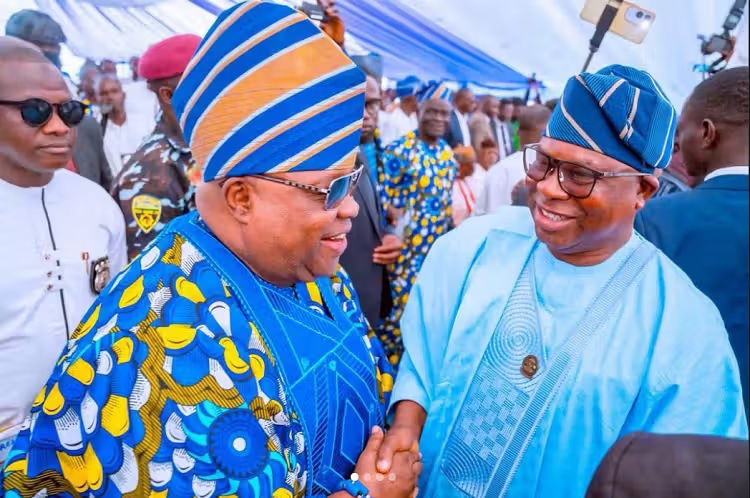
Bola Oyebamiji, the All Progressives Congress (APC) candidate in the Osun governorship election, has accepted the outcome of the poll and called on party members to close ranks ahead of the 2027 elections.
Ademola Adeleke, the Accord candidate, was declared winner of the August 15 governorship election.
In a statement on Saturday, Oyebamiji thanked the APC members for standing by his campaign, praising their “sacrifices, resilience, prayers and unwavering belief” in him.
He also expressed appreciation to President Bola Tinubu, Bisi Akande, former governor of Osun, and Adegboyega Oyetola, minister of marine and blue economy, for their guidance and support.
Oyebamiji said while he accepts the election result, the violence recorded during the poll must not be overlooked.
“While we accept the outcome of the election and congratulate the winner, we cannot forget the painful incidents of violence and the lives that were lost,” he said.
“I mourn every victim of political violence and stand in solidarity with their families.
“I call on the relevant security agencies to thoroughly investigate these incidents and ensure that those responsible are brought to justice. No political contest should cost any Nigerian their life.”
The APC candidate said that although the election is over, his commitment to Osun remains unwavering.
He added that where there are legitimate concerns, his camp would continue to seek “justice and fairness through lawful and constitutional means”.
“As we now turn our attention to the 2027 general election, I call on every APC member and supporter to close ranks, strengthen our structures and rededicate ourselves to the task ahead,” he said.
“Our immediate responsibility is to mobilise for the re-election of His Excellency, President Bola Ahmed Tinubu, GCFR, and the success of all our candidates in Osun state.”
Adeleke had earlier extended an olive branch to Oyebamiji and other candidates after his re-election, urging them to put aside their differences and support his administration.
The governor also called on Oyebamiji to congratulate him, describing the election as a contest with “no victor, no vanquished”.
Source: TheCable
0
6
By Sentry

A Silent but bruising war is raging in the Nigerian Democratic Congress (NDC) between two unlikely adversaries, namely the party’s presidential candidate, Mr Peter Obi and his long-dated supporter, Aisha Yesufu.
Without an iota of doubt, Yesufu had been one of the most vocal supporters of Obi since the build-up to the 2023 elections during which Obi became the presidential candidate of the Labour Party (LP). She went everywhere with Obi during the electioneering, shouting herself hoarse and devoting every ounce of her energy to the campaigns in the hope that Obi would win the presidential election.
As it turned out, Obi lost the election with a wide margin, coming a distant third behind President Bola Ahmed Tinubu and former vice president Atiku Abubakar.
Still, Yesufu did not relax her support for Obi. As the 2027 elections gathered momentum, she once again threw her weight behind the presidential aspirant, following him first to the African Democratic Congress (ADC) upon his defection from the Labour Party and then to the NDC.
Matters, however, became complicated when they arrived at NDC and Obi automatically picked the party’s presidential ticket while Aisha’s hope of an easy ride to picking the senatorial ticket of the party for the Federal Capital Territory (FCT) was dashed by the powers that be.
“No, no, no, no, don’t even go there,” one of the party leaders was said to have told her immediately she made her ambition known.
In place of Yesufu, another woman whose face was largely unknown in political circles was handed the ticket; a development that sent Yesufu into high dudgeon, causing her to accuse the party’s leadership of marginalising her. “I am not even asking for a level playing field; I only needed a field,” she said.
The grapevine has it that things have not been the same between her and Obi since the unsavoury experience and she has been waging a silent war against the NDC presidential candidate. Already, she has declined the party’s request that she should be on Obi’s campaign train for the 2027 election.
Yesufu is said to be unable to understand how Obi’s running mate, Dr. Rabiu Kwakwaso could push his loyalists in the party to obtain desired tickets not just in the north but also in the Southeast such that the party was beginning to look like an arm of the Kwakwansiyya Movement while Obi could neither stand nor push for his own loyalists in the sharing of party tickets.
Source: The Nation
0
4

Former Vice President Atiku Abubakar has said he will reopen Nigeria’s land borders if elected president.
The African Democratic Congress presidential candidate made the pledge while addressing supporters in a video circulating online and shared by ADC chieftain, Dele Momodu, on Friday.
Atiku said the closure of Nigeria’s borders with neighbouring countries had negatively affected transborder trade and contributed to unemployment among young people.
“The Northern states is bordering Cameroon, Chad, Niger, Benin Republic.
“And you close all those borders. All our young men who are doing trading between these countries, they carry goods across, they do this and that, all what we call transborder trade is a legitimate business,” Atiku said.
He said many young people who previously operated businesses with capital running into millions of naira had been forced out of business following the border closures.
“All the upcoming young men and women who used to have a capital of 10 million, 20 million, and they were employing two, three other people, and then all of them went bankrupt and unemployed. How can there be security?” he asked.
“So I said I am going to reopen the borders and I will,” he added.
Atiku also said he had explored ways of improving the movement of goods through ports in the southern part of the country.
“During the last campaign, I went across to Europe to discuss with shippers and ship development companies how we can together develop South and South-Eastern ports so that there is balance as far as importation of goods and transportation of goods are concerned,” he said.
The ADC presidential candidate said improving port infrastructure in the South would also reduce the time and cost of transporting goods to the North-East.
He cited the movement of containers from Lagos to Yola, Adamawa State, where he said he had a factory.
“So when, if I drop my container in Calabar or in Uyo or in Port Harcourt, it will just take me 24 hours to take the container to Yola.
“But right now, it takes me not less than two months to take my container from Lagos because you have to cross over from South-West, you go to North-East, and then there is even no road,” Atiku said.
He said his position was aligned with the concerns of the people over the movement of goods and the development of southern ports.
Nigeria’s land borders were closed in August 2019 under the administration of then-President Muhammadu Buhari.
The Federal Government cited the need to curb large-scale smuggling of rice, poultry products, petroleum and other goods, as well as weapons and drugs, and to encourage local agricultural production.
In December 2020, Buhari ordered the reopening of four borders, including Seme Border in Lagos State, Illela Border in Sokoto State, Maigatari Border in Jigawa State and Mfun Border in Cross River State.
The Federal Government under President Bola Tinubu reopened the Tsamiya land border with Benin Republic in Kebbi State and the Kamba corridor linking Nigeria with the Niger Republic in February 2026.
At the time, the Nigeria Customs Service said the reopening would be accompanied by measures to prevent smuggling and other illegal activities.
Although some strategic border posts were gradually reopened, some land borders have remained restricted or under tight controls.
Source: Punch
0
6
By Deborah Bodunde
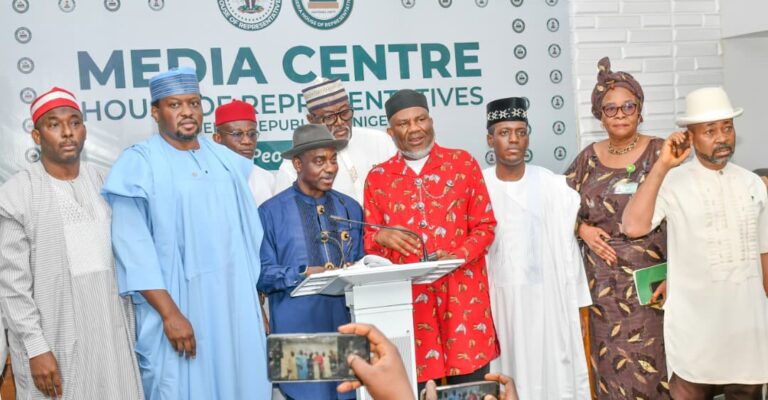
The minority caucus of the house of representatives has asked President Bola Tinubu to withdraw $5 billion from Nigeria’s external reserves to tackle worsening insecurity in northern Nigeria.
In a statement signed on Thursday by Fredrick Agbedi, minority leader of the house, and Afam Victor Ogene, spokesperson of the caucus, the lawmakers said the scale and frequency of attacks across the region have become intolerable.
The caucus called on Tinubu to take “immediate, decisive and comprehensive action” to halt the killings, rescue abducted citizens and reclaim communities occupied by terrorists, bandits and criminal gangs.
The lawmakers cited recent attacks in Plateau, Niger, Sokoto, Kaduna, Katsina and Borno states.
“This is no longer a situation that can be addressed principally through statements of condemnation after every attack. Nigeria requires a sustained, coordinated and overwhelming security response,” the statement reads in part.
“If funding is an issue, the government should draw $5 billion from the nation’s external reserves for an extraordinary national security intervention.”
The minority caucus urged Tinubu to replicate the strategy used to rescue schoolchildren and teachers abducted in Oriire LGA of Oyo, where victims were freed following an intelligence-led operation targeting the kidnappers’ networks and hideouts.
The lawmakers asked the president to “lock down the affected theatres of operation, dominate the territory and sweep the forests, hideouts and criminal enclaves where terrorists and bandits operate”.
They said the proposed lockdown should target the operational areas of criminal groups, rather than innocent residents.
“We are not asking the President to lock down innocent Nigerians. We are asking the Commander-in-Chief to lock down the operational space of terrorists and bandits, deny them freedom of movement, cut off their supply lines and communications and deploy overwhelming force,” the statement added.
The caucus also urged Tinubu to visit Zamfara to engage directly with communities affected by terrorism and banditry, saying such a move would demonstrate leadership and reassure affected residents.
‘FAST-TRACK SOLDIERS’ PAY INCREASE’
The lawmakers also commended the recent increase in the salaries of members of the armed forces, describing it as an important step towards improving their welfare and morale.
However, they urged Tinubu to immediately forward the necessary amendment to the 2026 Appropriation Act and a supplementary appropriation bill to the national assembly to provide the legal and financial framework for implementing the increase.
The minority caucus noted that it is ready to support the reconvening of the national assembly, if necessary, to fast-track the process.
“The welfare of our soldiers cannot be subjected to avoidable procedural delays when the nation is at war with terrorists and bandits,” the lawmakers said.
The caucus also demanded the immediate release of Nasir el-Rufai, former governor of Kaduna, whose continued detention they described as “political persecution”.
Source: TheCable
0
2
By Matthew Atungwu

Borno South Senator, Ali Ndume says President Bola Tinubu does not need to be the chairman of the All Progressives Congress, APC, Presidential Campaign Council for the 2027 general elections.
Ndume stated this on Wednesday while fielding questions in an interview on Arise Television’s Prime Time.
He argued that the president is the “product” of the APC being sold to the electorate, stressing that the party’s national chairman should lead such efforts.
Recall that Tinubu last week constituted his Presidential Campaign Council ahead of the 2027 polls and made himself the chairman.
Source: Daily Post
0
5
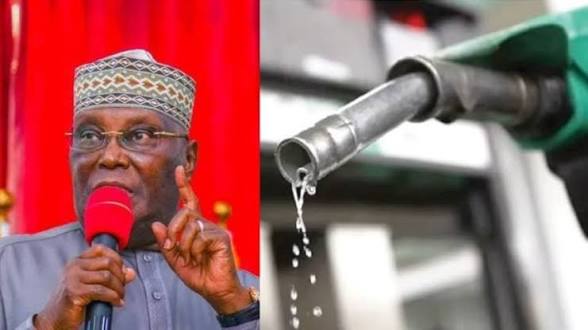
In Naija politics, a presidential candidate is only as credible as the consistency between what he says on Monday and what his campaign says on Tuesday.
When the candidate says restore. His aide says restore and remove. The candidate disowns his aide. Then the candidate's senior spokesman says it was never a restoration of the old regime but a different targeted intervention. And the candidate himself doubles down saying he will restore it fully and his position will not change.
All of this happened in the same week. In real time. On AIT, X, Vanguard, Daily Trust, Tribune, and Channels TV simultaneously.
This is where Atiku Abubakar's subsidy policy stands on August 23, 2026. Not as a coherent economic position. As a campaign in visible internal disagreement with itself, conducted through public media, over the most politically sensitive economic question in Nigeria.
Before we get to the economics, let us first establish exactly what happened.
Three Messages, Three Spokespeople, Zero Coherence
Message One came from Atiku himself in a Hausa-language Facebook Live session on August 19. He said he would restore the fuel subsidy if elected. Clear. Unambiguous. "I will restore it."
Message Two came from his aide Paul Ibe on AIT on Tuesday. Ibe said the proposed measure would be temporary and designed to give Nigerians and businesses room to recover, stimulate economic activity and improve productivity, before being gradually phased out.
Temporary. Phase out. Not the same as restore permanently.
Message Three came from Atiku himself within hours of Ibe's interview.
Atiku said: "Earlier, one of my press aides contradicted me in a policy statement as far as subsidy is concerned. I want to repeat categorically that when I said I would return to subsidy, I will! Nigeria is rich enough to look after the welfare of its citizens. Let it be clearly stated that he was not speaking on my own authority."
He disowned his own spokesman. On X. Publicly.
Then a fourth statement arrived from Senior Special Assistant Phrank Shaibu.
Shaibu said the restoration would not be "a return to Nigeria's discredited import-subsidy regime" but targeted support for domestic production. He described Ibe's comments as "an unauthorised, imprecise and materially misleading characterisation of Atiku's policy position" and warned that no spokesperson has the latitude to "redefine, embellish or improvise on a policy already clearly articulated by the candidate."
Four communications. From the same campaign. In 72 hours. About the same policy.
One says restore permanently. One says restore and phase out. One disowns the phrasing. One says it was never about the old import regime.
Which one should Nigerians believe?
In Naija politics, when a campaign cannot align its own spokespeople on the direction of its flagship economic promise, the voters watching are not confused about the policy. They are confused about the campaign's ability to govern.
What Nigeria Actually Spent on Subsidy: The Data That Should Frame This Debate
Before assessing whether restoration is viable, it is necessary to understand what the subsidy actually cost Nigeria across the years it existed.
The fuel subsidy did not begin in 2023. It has been one of the most persistent features of Nigerian governance since the return to democracy in 1999.
In 1999, Nigeria spent approximately N40 billion on the petroleum subsidy. By 2006, that figure had risen to N193 billion. In 2011, under Jonathan, it hit N1.35 trillion. In 2012, following the short-lived removal attempt that triggered the January protests and was subsequently reversed, the cost reached N2.12 trillion.
Between 2013 and 2022, under both Jonathan and Buhari, the subsidy bill grew from approximately N971 billion to a peak that became the subject of the most audited financial scandal in Nigerian governance history.
In 2021, the NNPC reported subsidy costs of N1.43 trillion. In 2022, the figure climbed to N4.7 trillion. In January and February 2023 alone, before removal in May, the subsidy was costing the federal government approximately N400 billion per month.
The Tinubu administration has stated that between May 2023 and 2025, over N30 trillion was saved from subsidy removal.
From 1999 to May 2023, Nigeria paid an estimated total of between N12 trillion and N15 trillion in accumulated subsidy costs across different administrations, depending on how the calculation accounts for the NNPC's opaque historical deductions.
The 2022 to early 2023 monthly burn rate of N400 billion means that in a full year of 2023 at pre-removal rates, Nigeria would have spent approximately N4.8 trillion on subsidy alone. Against a total federal revenue of approximately N10.4 trillion in 2022.
Nearly half of federal revenue going to keep pump prices lower than market. And that is before accounting for the arbitrage industry that developed around the price differential, the petroleum marketers who exported subsidised Nigerian fuel to neighbouring countries at market prices and reclaimed the subsidy from the government, and the manipulation of import figures that multiple audits have documented.
What Subsidy Removal Has Actually Produced
The removal was painful. That is not in dispute.
The pump price rose from N197 per litre to above N1,400 per litre. Transportation costs tripled. Food prices followed. Inflation hit 35 percent in December 2024, the highest in over three decades.
World Bank data indicates that approximately 25 million additional Nigerians entered poverty between 2023 and 2025 following the compounding effects of subsidy removal, naira devaluation, and electricity tariff increases simultaneously.
These are real human consequences. The man filling his generator every morning feels them. The market woman buying rice feels them. The salary earner whose N100,000 wage has lost 60 percent of its purchasing power feels them.
But the savings side is also measurable.
The CBN, under Cardoso, used the freed fiscal space and tighter monetary policy to reduce headline inflation from over 33 percent in early 2024 to 15.69 percent by April 2026. That is a 17 percentage point reduction in inflation within approximately 18 months.
For context: the N30 trillion savings from subsidy over the Tinubu years represents more than the total federal budgets of several previous administrations combined. If even a fraction of that had been deployed into verified infrastructure, healthcare, and education spending, the developmental impact would be visible.
The problem, as Atiku correctly identified, is that the savings have not been fully accounted for. The off-budget spending flagged by the IMF at N8 trillion raises legitimate questions about where the freed fiscal resources went.
But the answer to unaccounted savings is not to eliminate the savings.
The Economics of Restoration: What Atiku's Plan Actually Requires
Atiku described his proposed policy as targeted, capped, budgeted and independently audited intervention aimed at supporting domestic production. Phrank Shaibu said it would focus on supporting domestic refining rather than restoring the import subsidy regime.
Paul Ibe explained the mechanism: crude oil would be supplied to local refiners at a discounted price to enable them to produce petroleum products at lower costs.
This is actually a different policy from what Atiku said in the Hausa Facebook Live session. What Ibe described is closer to a feedstock support mechanism for local refineries, similar to how some Gulf states operate petroleum pricing, than a traditional import subsidy where the government pays marketers the difference between market and regulated pump prices.
The distinction matters enormously.
A feedstock support model for domestic refining, particularly with the Dangote Refinery now operational and several modular refineries at various stages of production, could in theory reduce pump prices without the same fiscal burden as the import subsidy regime. If Nigeria refines its own crude domestically and government supports the feedstock cost rather than imported refined product, the accountability chain is shorter and the arbitrage opportunities are fewer.
But here is the implementation problem.
Nigeria's crude oil production has averaged between 1.3 and 1.5 million barrels per day, consistently below the government's 1.8 million barrel target. The domestic refining capacity, including Dangote, is still ramping up. The Port Harcourt refinery, once fully operational, adds capacity. But total domestic refining capacity has not yet matched domestic consumption on a sustained basis.
A feedstock support model requires surplus domestic crude available at government's disposal to direct to refineries at subsidised prices. Nigeria does not consistently have that surplus. It still imports finished petroleum products to meet the gap.
Atiku said: "When fuel rises, transport rises. When transport rises, food rises. When food rises, families suffer." He said he would restore targeted subsidy to put purchasing power back in the hands of Nigerians.
The human logic is sound. The fiscal mechanism for delivering it has not been publicly costed, timed, or presented to any economic body for assessment.
The Fundamental Contradiction Nobody In the Campaign Has Resolved
Here is the problem that no amount of spokesman management resolves.
Atiku campaigned in 2023 with a manifesto that called for subsidy removal. He was one of the most consistent voices in Nigerian politics arguing that the subsidy was a drain on resources and a vehicle for corruption. He used the word fraud to describe it in past public statements.
He now wants to restore it.
His aide says restore and phase out. He disowns his aide. His senior spokesman says it was never about the old regime. He says his position will not change.
He said: "On the question of subsidy, my position has not changed and will not change: I will restore it! A nation as blessed as ours has no business abandoning its citizens to hardship."
His position has not changed.
But his position in 2023 was remove it.
Both statements cannot simultaneously be the accurate description of an unchanged position.
Tinubu described the proposal as evidence of "serious ignorance on governance and economy."
That is a partisan attack from a political opponent. It is also not entirely wrong as a characterisation of the communication management, if not the underlying policy logic.
What Nigeria Should Actually Do: The Question Nobody Is Answering
Here is the honest economic position that neither Atiku nor Tinubu has fully articulated.
The subsidy in its 1999 to 2023 form was economically indefensible. It subsidised consumption rather than production. It benefited marketers and the arbitrage industry more than the ordinary Nigerian. It consumed resources that should have funded the infrastructure that would have made fuel prices irrelevant to ordinary transport economics.
The removal in May 2023 was economically correct. The manner of removal, simultaneous with naira devaluation and electricity tariff increases with no social protection buffers, was economically reckless.
The answer to a reckless removal is not a poorly planned restoration. It is a properly sequenced combination of domestic refining support, social protection programmes targeted at the bottom 40 percent of the income distribution, and productivity investments that reduce the transport cost sensitivity of the economy over time.
Norway subsidises neither oil consumption nor general consumption. It taxes oil production and invests the revenues into a sovereign wealth fund that funds public services at world-class quality. Nigeria has the oil. It has no fund. It has the subsidy debate instead.
That is the real economic conversation. Not restore or remove. But how to transition from an economy where the price of a government-determined commodity determines whether families eat.
In Naija politics, that conversation is too long for a Hausa Facebook Live session and too honest for a campaign that needs a simple promise to deliver to voters.
So instead, what Nigerians got was restore. Then restore and phase out. Then disown the aide. Then restore again.
That is not an economic policy.
That is a campaign managing its own confusion.
And in January 2027, the voters of Nigeria will be choosing between the man who removed the subsidy without adequate preparation and the man who wants to restore it without adequate explanation.
This is Naija politics. Where the most consequential economic debate of the election cycle is being conducted in press statements and AIT interviews rather than in documented policy frameworks with costing, timelines, and accountability mechanisms.
The ordinary Nigerian deserves better than this debate.
They deserve the honest conversation about why the savings from N30 trillion cannot be accounted for, how to grow domestic refining to the point where feedstock support makes sense, how to protect the poorest from energy price shocks without rebuilding the corruption infrastructure that made the original subsidy a fraud.
That conversation is not happening.
What is happening instead is a campaign disowning its own spokesman.
On X.
In August 2026.
Five months before an election.
What do you think? Is a targeted domestic production subsidy tied to crude oil refining fundamentally different from the import subsidy that was removed, or is Atiku's proposal, however it is eventually defined, destined to recreate the same fiscal and corruption problems the original removal was meant to end? Drop your thoughts in the comments. Today is August 23, 2026. This is Naija politics and the most confused policy announcement of this campaign season just got another chapter this morning.
0
24

Danjuma Shekwolo, chairman of Kuje area council in the Federal Capital Territory (FCT), says residents of the council must support the All Progressives Congress (APC) or leave the area council.
Shekwolo made the remark in a video shared on X, saying he would not accept opposition from residents who, in his view, had benefited from the interventions of President Bola Tinubu and Nyesom Wike, the FCT minister.
“I have said in my area council, it’s either you are doing APC or leave the area council. I am not arguing with you,” Shekwolo said.
TRENDING VIDEO: “In my area council, It’s either you’re doing APC, or you leave the area council. I’m not hiding it at all; I’m saying it with confidence” — Samuel Shekwolo, Kuje area council chairman pic.twitter.com/Hv8tjS07cM
Advertisement
— TheCable (@thecableng) A.gust 25, 2026
“I cannot have the minister and the president doing for us what they are doing, and on the day of the election you now come and say you want to match me. I will not agree. It is either you are with us.”
AMNESTY INTERNATIONAL REACTS
The comments have drawn condemnation from Amnesty International Nigeria, which said political support could not be made a condition for residents to continue living in Kuje.
In a statement posted on X on Tuesday, the organisation described Shekwolo’s remark as an attack on residents’ freedom of association and political choice, and called on security agencies to intervene.
The organisation said no public official had the right to determine where Nigerians could live based on their political affiliation or voting preference.
“Authoritatively saying that those who will not vote APC must leave Kuje area council is a call to violence and direct attack on freedom of association and liberty of persons,” Amnesty said.
The organisation said no public official had the right to determine where Nigerians could live based on their political affiliation or voting preference.
“No one has the right to make a living in a place in Nigeria tied to joining or voting for one political party. The police and other security agencies must immediately halt this plan to use violence on people for their political choices,” it said.
Amnesty further accused the council chairman of threatening residents who may not support the APC and urged that he be held accountable.
“This plan to unleash violence on those who are not supporting APC in Kuje area council will have wider impact and will put lives at risk. People’s right to political choices must be respected and upheld,” the organisation said.
In February, Shekwolo candidate of the All Progressives Congress (APC), polled 17,269 votes to defeat Zakwoyi Danlami of the Peoples Democratic Party (PDP), who got 15,824 votes in the Kuje area council chairmanship election.
Source: TheCable
0
2

Chibuike Amaechi, former governor of Rivers state and vice-presidential candidate of the African Democratic Congress (ADC), clashed with Omoyele Sowore, presidential candidate of the African Action Congress (AAC), during the Nigerian Bar Association (NBA) conference in Port Harcourt, Rivers state capital, on Monday.
Amaechi was responding to Sowore’s criticism that members of Nigeria’s political elite, including the former minister of transportation, had contributed to the country’s economic problems.
Addressing the audience, Sowore, launched a direct broadside against establishment politicians, calling on voters to reject repeated promises from figures who had previously held office.
”Please, please, don’t let these politicians lie to you,” Sowore urged the audience.
Highlighting an alleged earlier admissions made by Amaechi, Sowore added: “I loved one thing that Amaechi said. He said, apart from Sowore and Abiola, the rest of us that have been in government have failed. They have no business coming back.”
Turning directly to Amaechi’s tenure as governor of Rivers state and minister of transportation, Sowore criticised past handling of major state projects and public sector funding.
“When it comes to subsidy, transportation policy is important. We have a former governor of Rivers state here, Amaechi, who built a rail line that went nowhere. If that rail line was working subsidy would have been working for Rivers people,” Sowore said.
“And we can’t ignore that those of you who had governed before refused to subsidise your people.”
Sowore further pointed to labour unrest during Amaechi’s governorship.
“You did not subsidise education in your state. Lecturers and doctors went on strike for 13 months! You may like him as a person, but he did not perform as a governor. That is the truth,” he said.
However, the former governor of Rivers defended his record in office and challenged Sowore to point to his own experience in governance.
Amaechi cited some of the major railway projects undertaken during his tenure as minister of transportation, including the Lagos-Ibadan and Abuja-Kaduna rail lines.
“Who are those from Lagos? Is the Lagos-Ibadan railway working or not? In my time, it was working. I don’t know what is happening under Tinubu. There is Abuja-Kaduna rail, working or not?” Amaechi said.
Sowore attempted to interject by raising Amaechi’s record as Rivers governor, but the former minister cut him short.
Amaechi challenged Sowore to inspect projects he said were executed during his tenure as governor.
“Where are the Rivers lawyers? Please take Sowore around. Where are the Rivers lawyers who are present? Take Sowore around,” he said.
Amaechi proceeded to list projects he claimed to have executed in the state.
“I said I built that road. I built this road. I built this primary school. I built that primary school,” he said.
He then turned to Sowore and asked: “Sowore, what is your experience?”
“When politicians are talking, close your mouth,” Amaechi added.
Source: TheCable
0
5

The Osun State Chairman of the All Progressives Congress, APC, Tajudeen Lawal, has raised the alarm over a possible attempt by the state government to create fresh tension at local government councils across the state.
Lawal’s warning is coming after a recent statement by the Osun State Government alleging that some stakeholders were planning to cause crises at local government councils and motor parks following the August 15, 2026 governorship election.
In a statement issued on Sunday by the Osun APC Director of Media and Information, Kola Olabisi, Lawal cautioned Governor Ademola Adeleke against actions capable of plunging the state into another round of political tension.
The APC chairman urged the government not to use security concerns as a pretext to intimidate political opponents or interfere with the administration of local governments.
Lawal said the government’s allegations concerning planned attacks on council secretariats and motor parks should be treated seriously if they were based on credible intelligence.
He, however, challenged the government to submit any such intelligence to relevant security agencies for investigation and appropriate action without political interference.
According to him, “the people of Osun deserve protection, peace and security rather than fear, intimidation or political persecution”.
Lawal also drew the attention of security agencies to the fact that APC-led Association of Local Governments of Nigeria, ALGON, administrations are currently occupying local government council premises across the state.
He urged the Nigeria Police Force and other security agencies to guarantee the safety of serving local government officials, council workers and other lawful occupants of the premises, irrespective of their political affiliation.
“The APC-led ALGON local government administrations are the current occupants of these council premises. The responsibility of the police is to protect lives and property and guarantee their safety.
“Nobody should be attacked, intimidated or forcibly removed under the guise of political disagreement,” he added.
The APC chairman called for adequate deployment of security personnel to local government secretariats across the state to prevent individuals or groups from taking the law into their own hands.
Lawal expressed concern over the possibility of a repeat of what he described as the alleged treatment meted out to Remi Abass, warning that political disagreements should not become an excuse for the abuse of citizens or the use of state power against political opponents.
He urged Governor Adeleke to exercise restraint and remember that he was governor of the entire state, including residents who did not vote for him.
“Osun cannot afford another cycle of political violence. If the government has credible intelligence about plans to attack local government councils or motor parks, let it hand such intelligence over to the security agencies instead of using the allegation to create unnecessary tension,” Lawal said.
He also called on the police, Department of State Services, DSS, Nigeria Security and Civil Defence Corps, NSCDC, and other relevant agencies to intensify security around council secretariats, motor parks and other sensitive locations.
Lawal urged political actors to avoid provocative statements and actions capable of escalating tensions, stressing that political differences should be resolved through dialogue, constitutional means and, where necessary, the courts.
The APC chairman said security agencies must remain neutral, professional and impartial, insisting that the safety of citizens should not be determined by political affiliation.
“Osun people are watching. This is the time for responsible leadership, not revenge politics. No political victory is worth the blood, freedom or property of any citizen,” he added.
Lawal also appealed to residents to remain calm and law-abiding while urging security agencies to intensify intelligence gathering, preventive deployment and monitoring of sensitive locations across the state.
He maintained that the security agencies should not wait until violence occurred before taking action, but should respond promptly to credible intelligence about potential threats.
The Osun APC chairman called for peace, justice and responsible leadership, adding that the state should not be subjected to another cycle of political confrontation.
Source: Daily Post
0
3