
A terminal for university students across all disciplines in Nigeria to chat, debate, pass information, network, learn, and grow.
41 members • 130 followers
Licia
6 months ago

On Tuesday, March 24, 2026, Lagos State University (LASU) hosted its 119th Inaugural Lecture at the Buba Marwa Auditorium. Professor Olugbenga Gabriel Akindoju of the Department of Science and Technology Education delivered a powerful discourse titled "Bridging Gaps, Reimagining Futures: Unveiling Digital Pathways and Innovations for Transformative Education in Sub-Saharan Africa."
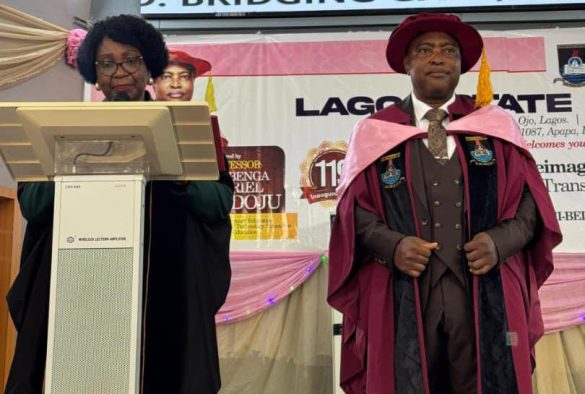

The highly cerebral inaugural lecture was all about digitalisation of the education sector and its impact on humanity, especially in the sub-Saharan space of the global divide.

According to Akindoju in the lecture, there are limitations in the area of digital learning in most areas of sub-Saharan Africa whereas the attention of the scholar was pin-pointedly focused on Kenya, Nigeria, Rwanda and Ghana.
 Prof Akindoju stated: ” The intersection of my academic journey and the pressing needs of our educational systems. It calls for addressing persistent gaps, leveraging technology, and fostering innovation to ensure inclusive, equitable, and quality education for sub-Saharan Africa.”
While addressing the core of the lectures, the avid scholar came up with the infusion of Artificial intelligence which he maintaines is the solution for sub-Saharan states to compete effectively in global affairs and also create awareness for a new African infusion into the ICT systems.
According to him, web-based instructions, predictive analysis and digital pedagogy, cultural relevance , artificial intelligence access, teacher’s re-education (training) all have roles to play in assisting the government in a massive way at all levels of intervention for the sub-Saharan states of Africa to get it right in the long run.
 Prof Akindoju posited: “Education is universally recognised as a cornerstone of human development, yet sub-Saharan Africa (SSA) continues to face some of the most profound challenges in achieving equitable and quality outcomes.
“According to UNESCO, (2022), over 98 million children of school age remain out of school, representing the highest number of regional exclusion.”
The issue of the out-of-school children is one in a million factors that have led to the underdevelopment of the ICT sector in the area of education, according to Prof. Akindoju.

The teacher of teachers observed that poverty and non-availability of funds play a major role in retarding the growth of ICT education amongst the school pupils of sub-Saharan African states.
He said,” Despite global progress expanding access to education , sub-Saharan Africa continues to face the highest rates of exclusion with millions of children left out of school.”
He observed, for instance, that Nigeria still has over 10.5 million out-of-school children, the highest globally.
This alone has spelt doom for the area known as sub-Saharan Africa; meaning that something positively radical must be done if the continent is supposed to move forward in a rapidly changing global environment.
 He further asserted that teachers of ICT were lacking in the sub-Saharan divide as they are not even well equipped to transfer their knowledge of the subject matter to their wards.
He said, “The acute shortages of qualified teachers estimated at 17 million by the year 2020 underscores the urgent need for the recruitment, training and retention of strategies to strengthen the region’s education workforce.
The digital divide, according to the LASU Alumnus and erudite scholar is a barrier divide that limits the transformative potential of the classrooms.
He also stated that only about 20 per cent of rural schools have reliable ICT capabilities compared to the 80 per cent in urban areas according to a World Bank research.
The scholar maintained that ICT is a game changer in our world today and it is a tool that can be used to reduce poverty and also as a pathway for transformative development.
Prof. Akindoju started his educational pursuit from the St. Joseph CAC Primary School, Oke Isegun in, Ondo State and he finished from the St, Peters Roman Catholic Church School, Odoragunshin -Eredo, Epe in Lagos State. He also attended St. Patricks Grammar School in the same locality of Odoragunshi at Epe.
He proceeded to LASU where he had his Fist, second and Ph.d degrees respectively.
Part of his Recommendations
Infrastructure Expansion
Broadband and Device Access: Governments must prioritize investment in broadband deployment and affordable smart devices, especially in underprivileged communities.
Community Digital Hubs: Establish libraries and ICT centres that provide free access to AI-driven educational technologies.
Assistive Platforms: Support inclusive platforms like VISOS to ensure visually impaired learners can participate fully in assessments.
Pedagogical Transformation
Web-Based Instruction: Scale up WBIA across subjects to democratize access and foster interactive learning.
Multimodal Strategies: Encourage instructional games, simulations, and virtual reality to enhance engagement and comprehension.
Teacher Development: Embed AI literacy and digital pedagogy into pre-service and in-service teacher training programs.
Localization and Cultural Relevance
Indigenous Knowledge Integration: Incorporate ethnobiology and indigenous knowledge into STEM curricula to contextualize abstract concepts.
Language Inclusion: Develop localized digital content in Yoruba, Swahili, Twi, and other African languages to ensure accessibility.
Cultural Identity in Technology: Align digital tools with learners’ cultural realities, making education both accessible and empowering.
Sustainability Imperatives
Green Computing: Promote eco-friendly ICT practices, including energy-efficient devices and recycling programs.
Renewable Energy: Expand solar-powered ICT labs in off-grid communities to ensure equitable access.
Policy Alignment: Embed sustainability into national ICT strategies, making digital transformation future-proof.
AI Equity and Teacher Readiness
National AI Strategy: Develop a comprehensive roadmap for AI integration in education, ensuring equitable access across all schools.
Capacity Building: Provide continuous professional development for teachers on AI usability and classroom integration.
Policy Reform: Establish frameworks that guarantee fair distribution of AI resources, bridging gaps between affluent and underprivileged schools.
Inclusivity for Marginalized Learners
Assistive Technologies: Expand platforms like VISOS to cater to learners with visual, auditory, and physical impairments.
Universal Design for Learning (UDL): Adopt inclusive design principles in curriculum and assessment to accommodate diverse learner needs.
Equity Monitoring: Implement monitoring systems to ensure marginalized groups are not excluded from digital transformation initiatives.
He concluded that, by aligning recommendations with the six pillars—Infrastructure, Pedagogy, Localization, Sustainability, AI Equity, and Inclusivity—this inaugural paper provides a holistic roadmap for educational transformation in Sub-Saharan Africa. These recommendations ensure that digital innovation is not only adopted but contextualized, democratized, and sustained, paving the way for a future-ready education system that reflects African realities and aspirations.
The citadel’s Vice-Chancellor, Professor Ibiyemi Olatunji-Bello, while welcoming the members and staff of the institution, guests and the gentlemen of the press, expressed her delight that Prof Akindoju, a home grown teachers’ teacher has impacted on many students to the point where he has produced 12 Ph.D. students; 40 Masters students and numerous first degree graduates.
According to Olatunji-Bello, the world today is rapidly changing and we must align, change with it if we must survive; which is where the need for education comes in.
0
5